Tessa Hedley in The Guardian:

More here.

Tessa Hedley in The Guardian:
More here.
Dan Jones in Nature:

Made famous by James Gleick's 1987 book Chaos, this theory provides a framework for understanding a remarkably broad range of complex systems, from weather patterns to neural activity in the brain. One way to visualize the mathematics is to imagine a landscape of hills and valleys. The behaviour of the complex system corresponds to the path of a ball rolling across this landscape. The trajectory becomes very complicated as the ball is deflected by the hills. But eventually, the ball will get trapped in one of the valleys, where it will either cycle endlessly around the walls or sink to the middle and lie still. The ball's final trajectory or resting place is called an attractor. To Coleman, this kind of entrapment was the perfect metaphor for the stable, if destructive, patterns of social behaviour seen in intractable conflicts. The landscapes in this case are mainly psychological and social, comprising innumerable strata of history, identity and collective memories of harms suffered at the hands of the 'other'. Yet the resulting conflict attractors are terribly real, he says, with psychological forces conspiring to “create simplistic narratives about conflicts that are devoid of nuance and keep us locked in”.
Picture: The Israeli–Palestinian conflict has been ongoing for 68 years.
More here.
Christopher Caldwell in WSJ:

From these situations emerges a social and a philosophical vision, unsystematic but nonetheless profound. The late political scientist James Q. Wilson described “Calvin and Hobbes” as “our only popular explication of the moral philosophy of Aristotle.” Wilson meant that the social order is founded on self-control and delayed gratification—and that Calvin is hopeless at these things. Calvin thinks that “life should be more like TV” and that he is “destined for greatness” whether he does his homework or not. His favorite sport is “Calvinball,” in which he is entitled to make up the rules as he goes along.
Day-in, day-out, Calvin keeps running into evidence that the world isn’t built to his (and our) specifications. All humor is, in one way or another, about our resistance to that evidence.
Read the rest here.
David Auerbach in The American Reader [h/t: Marco Roth]:
We live in an age where the most “radical” book of economics to make a splash, Thomas Piketty’s Capital in the 21st Century, explicitly distances itself from Marxism on numerous occasions, and ends by calling only for a modest wealth tax . We live in an age where the Occupy movement, despite its sometimes radical appearance, orients itself around such conventionally liberal reforms as the campaign for a living wage, prosecution of criminal bankers and tougher financial laws (e.g., “Occupy the SEC”), and exhibits a polite antagonism toward the one percent of plutocrats. The radical left’s best-known contemporary thinker, Slavoj Žižek, is treated as more of a clown than an ally by what should be his ideological homebase. (“His strategic notions,” writes Ben Kunkel in the leftist New Statesman, “are various and incompatible,” while Marxist critic Terry Eagleton deems Žižek “outrageously irresponsible.”)
One might think that the radical, anti-liberal left is just bitter that they have been pushed off the edge of the spectrum of political discourse and relegated to ever-shrinking university departments and a handful of sympathetic periodicals. The story, however, is more complicated than that—and its complications have profound relevance to the frustrations and peculiarities of the current Western political landscape. The burgeoning anti-oppression movement is concerned primarily with manifestations of false consciousness, and their diagnoses consequently center not on the overtly reactionary forces of society, but on those claiming to be liberal and progressive. Yet what does it mean to be focused on “racism without racists” when racists are hardly an extinct breed? What led to this focus, and what does it mean to the future of leftism? Classifying leftist ideology in a framework of agency and trust, I find a buried contradiction at the heart of anti-oppressive activism, one in which practitioners pathologically self-position themselves in a space of chronic moral jeopardy.
THE FRAMEWORK
Leftist Concepts: Trust (x) vs. Agency (y)

The x-axis is the Axis of Trust, with a positive Solidarity Pole and a negative Suspicion Pole. The y-axis is the Axis of Agency, with a positive Ethical Pole and a negative Structural Pole. The labels on the graph above designate leftist positions. Some of these positions are concepts or ideologies, while others are movements or organizations. In both cases, however, their positions on the graph are a consequence of the practical implications of people who hold a particular ideology, subscribe to the validity of a particular concept or belong to a particular movement.
More here.
Selected Ash’aar from Ghalib
1
That was one man’s failure,
Not God’s rule. Come let us too
Join an expedition to Mount
Sinai. What if he unveils!
2
What sapience, Ghalib,
What eloquence, what lines!
We could name you a saint
If you quit drinking wine.
3
Every day, the heavens
Spin on their axes. Things
Happen, as things have, and
Always will. Why worry?
4
Why blame the hangman
Or shun the preacher?
That face is familiar
Whatever the disguise.
Ghalib
translations: M. Shahid Alam
Julia Amalia Heyer and Christoph Pauly interview Thomas Piketty in Spiegel:
SPIEGEL: You publicly rejoiced over Alexis Tsipras' election victory in Greece. What do you think the chances are that the European Union and Athens will agree on a path to resolve the crisis?
Piketty: The way Europe behaved in the crisis was nothing short of disastrous. Five years ago, the United States and Europe had approximately the same unemployment rate and level of public debt. But now, five years later, it's a different story: Unemployment has exploded here in Europe, while it has declined in the United States. Our economic output remains below the 2007 level. It has declined by up to 10 percent in Spain and Italy, and by 25 percent in Greece.
SPIEGEL: The new leftist government in Athens hasn't exactly gotten off to an impressive start. Do you seriously believe that Prime Minister Tsipras can revive the Greek economy?
Piketty: Greece alone won't be able to do anything. It has to come from France, Germany and Brussels. The International Monetary Fund (IMF) already admitted three years ago that the austerity policies had been taken too far. The fact that the affected countries were forced to reduce their deficit in much too short a time had a terrible impact on growth. We Europeans, poorly organized as we are, have used our impenetrable political instruments to turn the financial crisis, which began in the United States, into a debt crisis. This has tragically turned into a crisis of confidence across Europe.
SPIEGEL: European governments have tried to avert the crisis by implementing numerous reforms. What do mean when you refer to impenetrable political instruments?
Piketty: We may have a common currency for 19 countries, but each of these countries has a different tax system, and fiscal policy was never harmonized in Europe. It can't work. In creating the euro zone, we have created a monster. Before there was a common currency, the countries could simply devalue their currencies to become more competitive. As a member of the euro zone, Greece was barred from using this established and effective concept.
SPIEGEL: You're sounding a little like Alexis Tsipras, who argues that because others are at fault, Greece doesn't have to pay back its own debts.
More here.
Jay Bookman in the Atlanta Journal-Constitution:

Content and motive aside, the letter itself drips with insulting condescension.
“It has come to our attention while observing your nuclear negotiations with our government that you may not fully understand our constitutional system,” the letter lectures right from the opening sentence. After pointing out that Obama leaves office in 2017, the senators remind Iran’s leaders that “most of us will remain in office well beyond then, perhaps decades,” and that they would consider a deal “nothing more than an executive agreement between President Obama and Ayatollah Khamenei,” rather than an agreement between countries.
The senators conclude with the hope that “this letter enriches your knowledge of our constitutional system and promotes mutual understanding and clarity as nuclear negotiations continue.”
In short, the letter is a clear effort to sabotage the talks.
More here.
Omri Boehm in the New York Times:
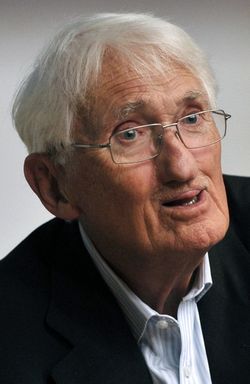
In an extensive interview given in 2012 to the Israeli daily Haaretz, the German philosopher Jürgen Habermas was asked for his opinion about Israeli politics. His answer was that while “the present situation and the policies of the Israeli government” do require a “political kind of evaluation,” this is not “the business of a private German citizen of my generation.” (my emphasis).
The reluctance of German intellectuals to speak critically about Israel is, of course, understandable. Many would agree that refusing to comment in this case is only appropriate — German responsibility for the crimes of the Holocaust would make it so. Evidently, Habermas’s silence speaks for many other intellectuals, including ones who belong to younger generations.
Still, the problem with Habermas’s answer to Haaretz and the stance it represents is that, in fact, Habermas is not much of a private German citizen at all: when the quintessential public intellectual seeks refuge in privacy; when the founder of a branch of philosophy called discourse ethics refuses to speak, there are theoretical and political consequences. Silence here is itself a speech act, and a very public one indeed.
In order to understand the meaning of this silence, it is necessary to go back to Kant’s concept of enlightenment. In his well-known essay from 1784 — “What Is Enlightenment?” — Kant defines enlightenment as “man’s emergence from his self-incurred immaturity,” a process of growing up that consists in finding the “courage” to think for oneself. That does not mean, however, to think by oneself, or alone. On the contrary, Kant insists that using one’s “own understanding” is possible only through a “public use of one’s reason,” in at least two interrelated ways.
More here.
Natalie Wolchover in Quanta:

“We must be getting pretty close,” Michael Green recalls telling John Schwarz as the thunder raged and they hammered away at a proof of the theory’s internal consistency, “because the gods are trying to prevent us from completing this calculation.”
Their mathematics that night suggested that all phenomena in nature, including the seemingly irreconcilable forces of gravity and quantum mechanics, could arise from the harmonics of tiny, vibrating loops of energy, or “strings.” The work touched off a string theory revolution and spawned a generation of specialists who believed they were banging down the door of the ultimate theory of nature. But today, there’s still no answer. Because the strings that are said to quiver at the core of elementary particles are too small to detect — probably ever — the theory cannot be experimentally confirmed. Nor can it be disproven: Almost any observed feature of the universe jibes with the strings’ endless repertoire of tunes.
The publication of Green and Schwarz’s paper “was 30 years ago this month,” the string theorist and popular-science author Brian Greene wrote in Smithsonian Magazine in January, “making the moment ripe for taking stock: Is string theory revealing reality’s deep laws? Or, as some detractors have claimed, is it a mathematical mirage that has sidetracked a generation of physicists?” Greene had no answer, expressing doubt that string theory will “confront data” in his lifetime.
Recently, however, some string theorists have started developing a new tactic that gives them hope of someday answering these questions.
More here.
Andrew Conway on Cloudmark Security Blog (via The Browser):

The first place you might consider attacking would be the DNS root name servers. These control the very top level of DNS, and without them no server on the Internet would have a name. There are a limited number of them, and they are controlled by a committee, the DNS Root Server System Advisory Committee otherwise known as the Secret Masters of the Internet. However, the servers themselves are run on heavily protected highly redundant hardware, and are geographically distributed. They also run different software, so a single vulnerability could not be used to take down all the root servers. They are such an obvious place to attack that they are too well defended to be a good target.
The Internet can route around damage. That is a strength when dealing with minor damage or attacks but a problem when a major component is damaged. The network traffic that gets rerouted causes bottlenecks and slowdowns elsewhere in the network. Once you hit the dreaded Reload Threshold, when web pages are loading slowly enough that people start hitting the reload button and sending multiple requests for the same page, then large sections of the net would grind to a halt. This happened on July 18th, 2001 when a train accident in a tunnel in Baltimore severed an Internet backbone cable. That afternoon users all over the US had problems accessing web sites in other parts of the US, apparently randomly. A simple brute force DDoS attack against one or two key points in the Internet would be enough to make the rest unusable. Personally I would probably go after MAE-West in San Jose, partly because almost all the traffic to and from Silicon Valley goes through there but mostly because it has a cool name.
Read the full piece here.
Robert Macfarlane in More Intelligent Life:

Vladimir Nabokov’s account of this loathsome road-trip occupies less than a tenth of his notorious novel. To me these are the most brilliantly unsettling pages he ever wrote: a Baedeker of perversion that—in Humbert’s phrase—“put[s] the geography of the United States in motion”, as he and poor Lo career across the “crazy quilt of forty-eight states”. If you’ve read “Lolita” (1955), you’ll know the disturbing dissonance it incites. For Humbert is a narrator of astonishing guile, his voice so slyly supple that it distracts from the black vileness of his deeds. Style serves as his alibi and amnesty. You feel uneasily complicit at each jolt of pleasure his prose delivers, each arch allusion you pursue, each double-entendre you decode. Yes, his language is foully fallen—and it pulls the reader down with it.
More here.
Carl Zimmer in The New York Times:

…I.G.T. is altogether different from traditional vaccination. It is instead a form of gene therapy. Scientists isolate the genes that produce powerful antibodies against certain diseases and then synthesize artificial versions. The genes are placed into viruses and injected into human tissue, usually muscle. The viruses invade human cells with their DNA payloads, and the synthetic gene is incorporated into the recipient’s own DNA. If all goes well, the new genes instruct the cells to begin manufacturing powerful antibodies. The idea for I.G.T. emerged during the fight against H.I.V. In a few people, it turned out, some antibodies against H.I.V. turn out to be extremely potent. So-called broadly neutralizing antibodies can latch onto many different strains of the virus and keep them from infecting new cells.
More here.

Here are some chairs I noticed. An empty chair at the natural optical centre of Degas’s Dance Foyer of the Opera at rue le Peletier (1872), occupied by a fan and a puddle of white cloth. It is waiting – and the viewer is waiting, subliminally – for its occupant to return and claim the fan. It is reserved. Someone has bagged it. Not a circumstance you often see painted, though common enough in real life. Nor is the violinist playing. He is pausing, his bow at rest on his trouser leg. Degas has painted a pause. A thing that hasn’t been painted before. In the same picture, a dancer to the right, in the foreground, is sitting on another chair, her legs stiffly out front – ungainly yet graceful, resting. The upright back of the chair is invisible because it is under her unmanageably stiff tulle skirt, lifting the skirt up and slightly out of alignment. All her fatigue is there in the mistake, the carelessness of her plonking down. (The tulle in this picture, by the way, is a miracle: done not in the easier pastel, with its naturally smudgy, suggestive cloudiness, but in oil paint, using the texture of the fine linen canvas.)
Degas’s Ballet Class (circa 1880) has a little old lady in the foreground reading a folded newspaper. Her straw hat has a band of feathers, leaving the crown exposed, to parallel the bald spot of the dancing master. Her paper has a flap hanging down that mirrors the main dancer’s open scissor legs. So, cleverly composed, then, but I want to draw your attention to the way the old lady is sitting on her chair.
more here.

Classical music is often bedeviled by the simple question “How do you make an audience truly engaged without pandering?” Peter Sellars’s staging of the St. Matthew Passion was one of most successful answers I’ve ever seen.
Part of the magic was how local everything was. The Berlin Philhar-monic is surely one of the most august organizations in the world, but there they were, right down the steps from us, looking a bit uncomfortable. They even sounded uncomfortable at times: the viola da gamba seemed a bit raw and out of tune, the violin obbligato for the the famous aria “Erbarme dich, Mein Gott” was determinedly ahead of the beat. The first night the final chorus of part one, “O Mensch,” was out of sync in a way closer to Charles Ives than Bach. On the second night, the orchestra played a cue before the Evangelist was in place and had to restart. Probably they were just momentarily wrong-footed by the pauses built in by Sellars: in any other production of St. Matthew, the continuo plays everything more or less right on the heels of the previous event. At the Armory, we waited to see what would happen next.
more here.

And so it was that some four or five generations came of age around Glenties and Castlederg, Ballyconnell, Ballinamore, Boyle, and Crossmolina dreaming of places like Summit Hill, Mauch Chunk and Wilkes-Barre, Hazleton, Tamaqua, Pottsville and Plymouth.
Those names were whispered into the late twentieth century. As a child, in the 1970s, I heard some of them. Put to bed in my grandparents’ house outside Ardara, there were white-matted studio photographs of three handsome young men in big black wooden frames at the foot of the bed. The only other pictures on the walls of that house were the Sacred Heart of Jesus and the colour snap on the moon-phase calendar which Tommy Tom gave out every Christmas to advertise the Greenhouse Bar and Shop. The framed photographs had been shipped home from Pennsylvania and California in the early 1900s. The handsome men were elder brothers of my grandfather, Néillí Sweeney (1900-’86). He, the youngest of the family, never saw one of those brothers, and another he had no recollection of having seen. The brother whom he did not remember seeing was James, who died, aged twenty seven, after an operation on a sarcoma of the neck in the Mercy Hospital, Wilkes-Barre, in 1909. It was the same hospital, run by Irish nuns, where Con Carbon had died two years earlier. After stints in Scotland in his teens and early twenties, James had left for the hard coal fields in 1903, stopping with an uncle in Plymouth and going down the mines.
more here.
by Brooks Riley
Read the full transcript here. Or just watch:
Elliott Colla in Informed Comment:

As Carol Duncan has argued, being able to appreciate these artifacts is a mark of education and culture among modern elite cultures. It does not matter really whether one appreciates them as a scholar or archaeologist (for what they can tell us about history), or an aficionado (for their craft or aesthetic accomplishment) or as an amateur or tourist (who just likes the experience of viewing them). The social effect of appreciation is the same: to borrow from the work of Pierre Bourdieu, it is crucial for making social distinctions. Those who appreciate the value of such objects are civilized. Those who do not appreciate their value are barbarians.
It was not always this way. People used to venerate objects as sacred not on the ground of taste or science, but because they had an attachment to something that was holy — a person, a saint, a prophet, an event. In the past, there was no such thing as a universally venerated object — for the simple reason that, for instance, while Christians might venerate the objects that pertained to their narratives of the divine, Jews or Muslims would venerate other objects that pertained their narratives.
More here.