e-David Robot Painting from eDavid on Vimeo.
And more about this here.

e-David Robot Painting from eDavid on Vimeo.
And more about this here.
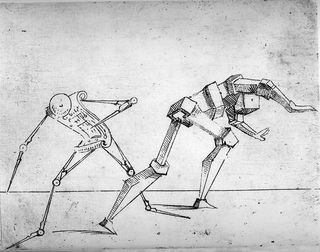
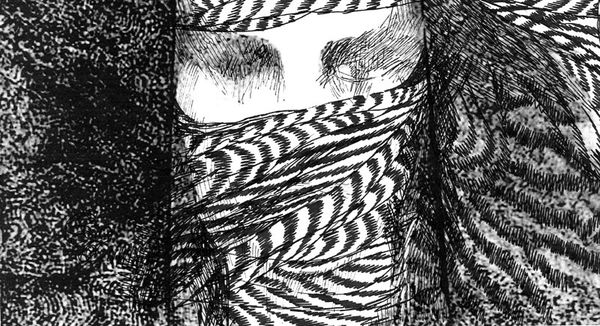
Sue Halpern in The New York Review of Books (image ‘Bizarre Figures’; etching by Giovanni Battista Bracelli, 1624):
In September 2013, about a year before Nicholas Carr published The Glass Cage: Automation and Us, his chastening meditation on the human future, a pair of Oxford researchers issued a report predicting that nearly half of all jobs in the United States could be lost to machines within the next twenty years. The researchers, Carl Benedikt Frey and Michael Osborne, looked at seven hundred kinds of work and found that among those occupations, the most susceptible to automation were loan officers, receptionists, paralegals, store clerks, taxi drivers, and security guards. Even computer programmers, the people writing the algorithms that are taking on these tasks, will not be immune. By Frey and Osborne’s calculations, there is about a 50 percent chance that programming, too, will be outsourced to machines within the next two decades.
In fact, this is already happening, in part because programmers increasingly rely on “self-correcting” code—that is, code that debugs and rewrites itself—and in part because they are creating machines that are able to learn on the job. While these machines cannot think, per se, they can process phenomenal amounts of data with ever-increasing speed and use what they have learned to perform such functions as medical diagnosis, navigation, and translation, among many others. Add to these self-repairing robots that are able to negotiate hostile environments like radioactive power plants and collapsed mines and then fix themselves without human intercession when the need arises. The most recent iteration of these robots has been designed by the robots themselves, suggesting that in the future even roboticists may find themselves out of work.
The term for what happens when human workers are replaced by machines was coined by John Maynard Keynes in 1930 in the essay “Economic Possibilities for our Grandchildren.” He called it “technological unemployment.” At the time, Keynes considered technical unemployment a transitory condition, “a temporary phase of maladjustment” brought on by “our discovery of means of economizing the use of labour outrunning the pace at which we can find new uses for labour.” In the United States, for example, the mechanization of the railways around the time Keynes was writing his essay put nearly half a million people out of work. Similarly, rotary phones were making switchboard operators obsolete, while mechanical harvesters, plows, and combines were replacing traditional farmworkers, just as the first steam-engine tractors had replaced horses and oxen less than a century before. Machine efficiency was becoming so great that President Roosevelt, in 1935, told the nation that the economy might never be able to reabsorb all the workers who were being displaced. The more sanguine New York Times editorial board then accused the president of falling prey to the “calamity prophets.”
More here.
Los Alamos Mon Amour
The second before and the eternity after
the smile that split the horizon from ear to ear,
the kiss that scorched the desert dunes to glass
and sealed the sun in its frozen amber.
Eyelids are gone, along with memories
of times when the without could be withheld
from the within; when atoms kept their sanctity
and matter meant. Should I have ducked and covered?
Instead of watching oases leap into steam,
matchwood ranches blown out like flames,
and listening to livestock scream and char
in test pens on the rim of the blast.
I might have painted myself white, or built a fallout room
full of cans and bottled water but it’s clear
you’d have passed between cracks, under doors,
through keyholes and down the steps to my cellar
to set me wrapping and tagging my dead.
So I must be happy your cells have been flung through mine
and your fingers are plaiting my DNA;
my chromosomes whisper you’re here to stay.
.
by Simon Barraclough
from Los Alamos Mon Amour
publisher: Salt Publishing, Cromer, 2008
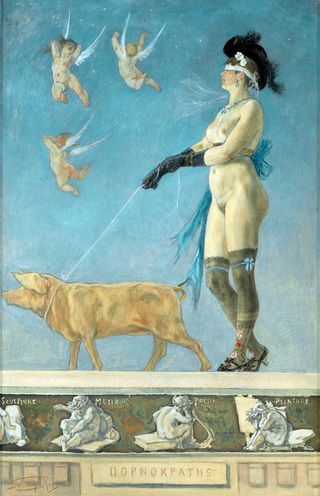
David Samuels in Lapham's Quarterly (image: Pornokrates, by Felicien Rops, 1878):
The fact that Moby Dick is the philosopher’s stone of American self-reflection makes it a wonderful target for reviewers, critics, and scholars who like to identify the books that Melville plundered, a good number of which are helpfully identified by the author in the novel’s prefatory extracts (supplied by a “Sub-Sub-Librarian”). “Give it up, Sub-Subs!” the author exhorts. But why should they? It’s fun to play games with whales and history. What they miss, of course, is that the fact that Melville’s literary career was born in fraud and realized its true greatness in the writing of Moby Dick is not a coincidence: Melville spent his entire writing life pondering the line that separates imposture from invention, and worse. Just as books are made of other books, every great American is a person who made themselves up out of whole cloth. So how else could a homespun American Shakespeare have happened, and what else could he have pondered, if not the frauds that define America and Americans?
Melville’s first book, Typee, the author’s account of his time among the Polynesians, made him famous; it was easily his most successful work during his lifetime. The new editor of the Brooklyn Daily Eagle, Walt Whitman, wrote an unsigned review pronouncing it to be “a strange, graceful, most readable book.” Whitman also noted a resemblance to contemporary seafaring tales, including an 1831 account of a shipwreck in the Caribbean Sea. Whitman’s nose for the magpie elements of Melville’s text wasn’t matched by two distinguished New England reviewers, who weren’t interested, or didn’t notice, or were too polite to say. In a signed review in the Salem Advertiser, Nathaniel Hawthorne, who had no personal taste for adventures, announced that the “book is lightly but vigorously written; and we are acquainted with no work that gives a freer and more effective picture of barbarian life.” Thoreauread Typee at Walden Pond, and appears to have understood the book as a valuable outline of experiments in living that had been successfully tested by Polynesian islanders.
To say that Typee is a book made out of other books doesn’t mean that Melville himself never sailed on the Acushnet, or that his account of his life among the Polynesians is devoid of truth in every detail.
More here.
Frank Pasquale in The Hedgehog Review:
At a recent conference on public health, nutrition expert Kelly Brownell tried to explain our new food environment by making some striking comparisons. First, he contrasted the coca leaf—chewed for pain relief for thousands of years by indigenous people in South America, with little ill effect—with cocaine, a highly addictive, mind-altering substance. Then he contrasted a cob of corn with a highly processed piece of candy derived from corn syrup. Nutritious in its natural state, the concentrated sugar in corn can spark unhealthy, even addictive behaviors once poured into candy. With corn and with coca, the dose makes the poison, as Paracelsus put it. And in the modern era of “food science,” dozens of analysts may be spending millions of dollars just to perfect the “mouthfeel” and flavor profile of a single brand of chips.
Should we be surprised, then, that Americans are losing the battle of the bulge? Indeed, the real wonder is not that two-thirds of the US population is overweight, but that one-third remains “normal,” to use an adjective that makes sense only in relation to an earlier era’s norms.
For many technology enthusiasts, the answer to the obesity epidemic—and many other problems—lies in computational countermeasures to the wiles of the food scientists. App developers are pioneering behavioristic interventions to make calorie counting and exercise prompts automatic. For example, users of a new gadget, the Pavlok wristband, can program it to give them an electronic shock if they miss exercise targets. But can such stimuli break through the blooming, buzzing distractions of instant gratification on offer in so many rival games and apps? Moreover, is there another way of conceptualizing our relationship to our surroundings than as a suboptimal system of stimulus and response?
Some of our subtlest, most incisive cultural critics have offered alternatives. Rather than acquiesce to our manipulability, they urge us to become more conscious of its sources—be they intrusive advertisements or computers that we (think we) control. For example, Sherry Turkle, founder and director of the MIT Initiative on Technology and Self, sees excessive engagement with gadgets as a substitution of the “machinic” for the human—the “cheap date” of robotized interaction standing in for the more unpredictable but ultimately challenging and rewarding negotiation of friendship, love, and collegiality.
More here.
Wendy Doniger in The Times of India:
William Dalrymple was in the chair at the London lecture on November 12, 2003, where someone lobbed an egg at me, missing me in more ways than one; in his article on Indian history he described the incident and continued: “Within India, mobs mobilized by the Hindu Right have occasionally attacked art exhibitions, libraries, publishers, and movie houses for their alleged unpatriotic and anti Hindu bias; but for the first time the campaign now seemed to be spreading onto campuses worldwide.” American scholars are the small fry in the larger global community at risk; we are relatively safe. But we too have our troubles.When books published by American scholars — Jeffrey Kripal, Paul Courtright, Jim Laine — were attacked in India, the Indian editions were suppressed, and although the books remained in print in America, the offending American scholars received death threats here.
In what I have now come to think of, wistfully, as the (good) old days, in illo tempore, whenever I gave a lecture on Hinduism, afterward, in the question period, an elderly Hindu gentleman (always a man) would rise, pay me an elaborate compliment, and proceed to give a mini-lecture of his own, often learned and sometimes relevant, as if to say, I know things that this American woman does not know. There was no malice in it, just, perhaps, an understandable desire to have the upper hand, the last word, or even, perhaps, to reclaim Hinduism for himself, a Hindu and a man. Usually he added something of value and of interest, and we would often continue the conversation after the lecture, at the reception. Sometimes it was just a ritual gesture, in which the content was largely irrelevant; it was the act of standing up, of claiming the space, that was important. That ritual gesture remains at the heart of the more recent interventions, but now there is certainly malice, and the people on the Internet are not nearly so learned as those old gentlemen used to be. I never thought I would miss those guys, but I would be greatly relieved to have some of them in my audiences now.
The Hindus who object to the books about Hinduism by non-Hindus are primarily concerned with three problems:
1. Non-Hindus rather than Hindus are writing about Hinduism;
2. Some non-Hindus (and indeed some Hindus, too) are writing about the “wrong sort” of Hinduism; and
3. Prominent authors, non-Hindu or Hindu, are writing from an academic rather than a faith stance.
More here.
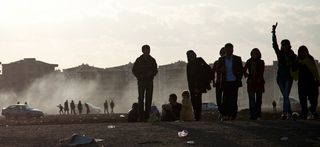
Adam Barnett in Dissent from a few weeks ago (image Kurds celebrating Newroz, Diyarbakir, Turkey, March 2013 (Alberto Tetta / Flickr)):
One of the experiences that sets the life of a reporter apart from other pursuits is the realization that when you enter a building in a foreign country and see the portrait of a convicted terrorist proudly displayed on every wall, you know you’re in the right place. Such was my experience upon entering the offices of the Peoples’ Democratic Party, or Halklarin Demokratik Partisi (HDP), in a side street near Istanbul’s central square, where I hoped to gain a Kurds’-eye-view of the war against ISIS in northern Syria.
I use the word “terrorist” with hesitation, not only because of its nebulous quality and widespread abuse, but because to millions among Turkey’s Kurdish minority, Abdullah Ocalan (whose portrait beamed down from the walls of the HDP offices) remains the symbolic leader of their decades-long struggle for dignity and human rights. In Turkey, where the label “terrorist” is applied with as much cynicism and bigotry as in Israel, the picture of Ocalan hangs over the fragile peace talks between Ankara and his Kurdistan Workers’ Party, or PKK, after three decades of war and misery that claimed at least 35,000 lives, most of them Kurdish.
The HDP is the latest attempt by Turkey’s Kurds to advance their interests by parliamentary means, and plays a crucial role in these talks—not yet negotiations—with its delegates relaying messages to and from Ocalan as he serves out his life sentence in an island prison. The party has much to its credit. A social-democratic bloc of Kurds, secularists, feminists, LGBT activists, and greens with twenty-eight seats in the Turkish national assembly (making it the fourth-largest party), the HDP has roots in the Turkish left of the 1960s and a lineage that goes back to the Democracy Party of Leyla Zana. It advocates equal rights for all minorities (including Alevis and Armenians) and state neutrality on matters of religion, as well as mandating at least one female co-chair at every administrative level and applying a sort of “affirmative action” for LGBT candidates. Already this puts most European and American parties to shame.
But what truly distinguishes the HDP, and could have wider resonance across an ever more fragmented Middle East, is its call for a radical decentralization of powers from Ankara to regional assemblies, along the lines of the democratic experiment being conducted in the area of northern Syria known to Kurds as Rojava. This program would include granting rights to local assemblies to choose an official language for public life and education (the rights most famously denied to Kurds by successive Turkish governments)—“devolution plus multiculturalism,” to put it in policy terms. This formula may sound rather anodyne, but it strikes at the lungs of Turkish nationalist ideology, which in its most virulent form denies even the existence of non-Turkish minorities in Turkey.
More here.
Michelle Goldberg on the reaction Laura Kipnis's recent piece in The Chronicle of Higher Education, in The Nation (image University Hall, Northwestern University (CC-BY-SA-3.0)):
Last Monday, about thirty Northwestern anti-rape activists marched to their school’s administrative center carrying mattresses and pillows. The event was a deliberate echo of the performance art project of Columbia student Emma Sulkowicz, who is lugging a mattress everywhere she goes on campus for a year to draw attention to the university’s failure to expel her alleged rapist. At Northwestern, the target of the protest was not a person accused of assault, but the provocative feminist film professor Laura Kipnis. Her offense was penning a February essay in The Chronicle of Higher Education, titled “Sexual Paranoia Strikes Academe,” which argues against her school’s ban on sex between professors and students, and more broadly against the growing obsession with trauma and vulnerability among feminists on campus.
“If this is feminism, it’s feminism hijacked by melodrama,” she writes. “The melodramatic imagination’s obsession with helpless victims and powerful predators is what’s shaping the conversation of the moment, to the detriment of those whose interests are supposedly being protected, namely students. The result? Students’ sense of vulnerability is skyrocketing.”
Including, apparently, their vulnerability to articles in The Chronicle of Higher Education. As the protesters wrote on a Facebook page for their event, they wanted the administration to do something about “the violence expressed by Kipnis’ message.” Their petition called for “swift, official condemnation of the sentiments expressed by Professor Kipnis in her inflammatory article,” and demanded “that in the future, this sort of response comes automatically.” (University President Morton Schapiro told The Daily Northwestern, a student newspaper, that he would consider it, and the students will soon be meeting with the school’s Vice President for Student Affairs to further press their case.) Jazz Stephens, one of the march’s organizers, described Kipnis’s ideas as “terrifying.” Another student told The Daily Northwestern that she was considering bringing a formal complaint because she believes that Kipnis was mocking her concerns about being triggered in a film class, concerns she’d confided privately. “I would like to see some sort of repercussions just so she understands the effect something like this has on her students and her class,” said the student, who Kipnis hadn’t named.
Kipnis could hardly have invented a response that so neatly proved her argument. Not the argument about prohibiting student-teacher sex—there’s still a good case to be made for that. Certainly, Kipnis is right that some undergrads enjoy flaunting their erotic power, but such power is fleeting and ultimately no match for the institutional authority wielded by professors. Yet the reaction to Kipnis—the demands for official censure, the claims of emotional injury—demonstrated how correct she is about the broader climate.
More here.
Gaby Wood in The Telegraph:

I suppose it does take some explaining: Ishiguro is one of Britain’s best living novelists, and look how he keeps us waiting. “It takes me a long time to find a project that I think is going to be good enough,” he explains when I visit him at home in Golders Green. “I think I just reject a hell of a lot of stuff now. Often I have themes or a story – the emotions, even, that have to come out of it – but I haven’t got that last piece of the jigsaw.”
The Buried Giant, his first novel since Never Let Me Go, has been met with breathless anticipation – and a little perplexity, since it is set, as he puts it, “on the eve of England”, just before the Anglo-Saxons wiped out the Britons in what some historians believe to be an act of genocide. It is a bleak, wild land, populated by ogres and dragons and the weary leftovers of King Arthur’s court. If the setting seems unexpected, no one expected it less than the author himself. “It’s not what I’m used to,” he says. In the book, the west of the country and possibly more is subjected to a plague of forgetting, a “mist” that turns out to be formed by the breath of the she-dragon, Querig, who must be slain if anyone is to remember anything – but dare they remember everything, and what are the risks?
More here.
Kiera Butler in Mother Jones:
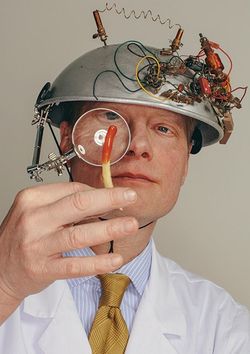
Nestled in a stately building on the campus of Cornell's College of Agriculture and Life Sciences, the lab occupies a suite of offices and classrooms, plus what at first glance looks like an unremarkable seminar space: large rectangular table, white board, sleep-deprived grad students. But on experiment days, out come the tablecloths, dishes, and cutlery. Researchers configure furniture to resemble a restaurant or a home dining room and use hidden cameras and two-way mirrors to document their subjects' actions.
After our lunch, I watch Wansink teach a graduate seminar on eating behavior. The students take turns reporting on their progress. A wiry postdoc named John is trying to figure out why people who indulge in novelty items like deep-fried Snickers bars at the state fair are thinner than those who opt for more conventional fare, like hamburgers. A slim, bespectacled Ph.D. candidate is using two versions of a clip from the movie Harold to study satiety. She has found that students who view a clip in which the characters finish their meal eat a little less afterward than those shown a version that ends with a meal in progress.
More here. [Thanks to Elatia Harris.]
The piece about Bill Clinton I wish I could take back, and nine other things about which I no longer hold the same opinion.
Stephen M. Walt in Foreign Policy:

To inspire a bit more reflection and self-criticism by both academics and maybe even a few politicos, I offer here the Top 10 Things About Which I Changed My Mind.
No. 1: The origins of World War I
I’ve been reading and teaching about the causes of World War I since I got my first academic job, but my account of how and why the war broke out has changed significantly over the years. When I first started teaching in the mid-1980s, I was heavily influenced by Richard Ned Lebow’s Between Peace and War, which portrays the July Crisis as a series of misperceptions and tragic accidents, driven by both organizational and psychological pathologies. I also embraced the “cult of the offensive” explanation offered by Jack Snyder and Stephen Van Evera, which links the war to widespread European beliefs that conquest was easy and that the war would be very short and cheap. I also read key works from the “Fischer school” (which emphasizes German responsibility), but I saw that as a background condition rather than the primary cause.
But over the years, I began to rethink this interpretation, and my understanding was greatly influenced by my former student Dale Copeland’s detailed analysis in his book, The Origins of Major War. He pins the blame almost entirely on Germany — and especially Chancellor Theobald von Bethmann-Hollweg — and I have yet to see any account that does a better job of uncovering the central cause of the war. But given how historiographical traditions keep evolving, and given the ability of new theories to shape how we view the past, I could always change my mind again in the future.
More here.
Impact Investment from The Political Indian on Vimeo.
Benedict Carey in The New York Times:
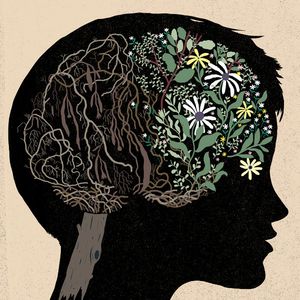
…The picture that emerges from these findings is of an older brain that moves more slowly than its younger self, but is just as accurate in many areas and more adept at reading others’ moods — on top of being more knowledgeable. That’s a handy combination, given that so many important decisions people make intimately affects others. No one needs a cognitive scientist to explain that it’s better to approach a boss about a raise when he or she is in a good mood. But the older mind may be better able to head off interpersonal misjudgments and to navigate tricky situations.
More here.
Raza Rumi in Fair Observer:

I had never met Roy, but I was aware of his powerful work. It is not easy to profess atheism when you belong to a Muslim country. Roy lived in the United States and ran a blog called Mukto Mona, (free mind), and he was vocal in opposing religious bigotry and intolerance. While he remained in the relatively safer climes of the US, he was still part of the discourse in Bangladesh, and this is why he was a threat to Islamist extremists. He received regular threats on social media — an irony of the ostensibly postmodern 21st century. The online store that sold Roy’s books was also harassed, and later it stopped displaying them altogether. In 2014, an Islamist said that Roy would be killed when he returned to his native country. So the doomed blogger had gone back to Bangladesh for his book promotion when extremists found the right opportunity to attack and kill him. His latest book, Bishwasher Virus (The Virus of Faith), says it all.
More here.
For a few weeks, anthropologist and 3QD friend Scott Atran has been on the front lines with the Peshmarga fighters in Kurdistan facing ISIS troops just a few hundred meters away. He had sent me this report some days ago by email:
by Scott Atran

Today we were near the front at Kirkuk. Peshmarga and and the Islamic State are separated by a narrow channel of water less than 100m wide with embankments and trenches on both sides. We were able to talk to 3 captured IS guys, at least two of whom will likely be executed in short order because they carried out pretty nasty killings. It is a hard war along a 1070 km front in Iraq alone. One of their Kurdish captors has been wounded 17 times, his brother killed. The other has a brother who was paraded by IS the other day in a cage with the captured Peshmarga fighters in Hawija. He knows his brother will be butchered and there is nothing he can do to save him. The three IS fighters were all young, in their twenties, two with wives and children and the eldest my son's age. A former senior US General in Iraq who was with me agreed that the failed security environment for their families created in the wake of the US invasion was in large part responsible for closing off any avenue of hope for these young people and making them susceptible for recruitment to IS. This is also the assessment of the senior Peshmarga (KDP/KRG) leadership. The stories these young fighters tell through our experiments and interviews help make this clear (but details later another time). One thing is clear, they know nothing about the Quran or Islamic history other than what they've heard in their upbringing and from AQ and IS. None have more than elementary school education.
Much has been written about foreign fighters, although their reality here on the ground is somewhat different than what has been widely presented by analyzing social media. In fact they come here to fight and die and almost none are ever captured: the westerners often die in suicide attacks; those from the former Soviet republics (Chechnya, Uzbekistan, Dagestan) with long fighting experience go on as operational leaders and snipers until they are killed, or captured and executed on the spot. Foreign fighters can return to home country only if they escape IS or are sent by IS, because IS will execute them under the slightest suspicion of defection. Peshmarga consider the foreign fighters to be the best, most committed and most dreaded.
IS used to pierce Peshmarga lines with suicide attacks in armored vehicles that barreled through barrages of RPGs. But now the Peshmarga have Milan anti-tank missiles from Europe that can stop this cold. Yet the US insists that the Peshmarga obtain permission from the central gov't in Baghdad (which is coordinating operations with Iran's Al Quds force Tikrit and elsewhere – a recipe for disaster on several planes) to keep the weapons flowing that keep the Kurds alive. All this to keep the Kurds tied to a gov't they hate and which hates them.
Some IS fighters are leaving the Tikrit front and infiltrating into Kirkuk with their families, but Kurdish forces do not expect major actions here.
Scott also has an article with Douglas M. Stone in the New York Times today:
The Islamic State continues to control a huge section of Syria. But in Iraq, its advance has stalled. While Shiite militias and their Iranian allies fight the Islamic State ferociously, the Kurds have held a 640-mile front against the Islamic State’s advance. Their steadfastness should prompt America to rethink its alliances and interests in the region and to deepen its relationship with the Kurds — who are sometimes described as the world’s largest stateless nation.
Last week, the Sunni town of Tikrit (Saddam Hussein’s hometown) fell to largely Shiite forces from Iraq, backed by Iran. An offensive to retake Mosul, Iraq’s second largest city and the heart of Arab Sunni nationalism, is now within reach. The Kurds plan to enter eastern Mosul, where many Kurds lived before the Islamic State seized the city in June, but they say that moderate Arab Sunnis must lead the effort to retake the rest of the city — not Baghdad’s predominantly Shiite forces or the Iranian-backed Shiite militias. The Kurds point out that it was grievances against Shiite rule that helped drive Sunni support for the Islamic State in the first place.
Together with Lydia Wilson and Hoshang Waziri, our colleagues at Artis, a nonprofit group that uses social science research to resolve intergroup violence, we found that the Kurds demonstrate a will to fight that matches the Islamic State’s. The United States needs to help them win.
More here.
Scott Atran is an American and French anthropologist who is a Director of Research in Anthropology at the Centre National de la Recherche Scientifique in Paris, Senior Research Fellow at Oxford University in England, Presidential Scholar at John Jay College of Criminal Justice in New York, and also holds offices at the University of Michigan. He has studied and written about terrorism, violence and religion, and has done fieldwork with terrorists and Islamic fundamentalists, as well as political leaders.
by Brooks Riley
Martha C. Nussbaum reviews ON OPERA and ESSAYS AND REVIEWS 1959-2002, by Bernard Williams, in The New Rambler:

Williams’s last consecutive book, Truth and Truthfulness, appeared in 2002, before his death. Three posthumous collections of essays have preceded these two books, gathering his major articles on moral philosophy, political philosophy, and the history of philosophy. (Williams was a serious scholar of both ancient Greek literature and philosophy and Descartes’ rationalism.) These two collections, separated from one another by more than a decade, represent the last publications we may expect to see from him, so they seem unusually precious. Both exemplify to an unusually high degree a quality of willingness to put one’s whole intellectual and emotional character on the line that always characterized his way of doing philosophy.
More here.
Melissa Davey in The Guardian:

By diluting these substances in water or alcohol, homeopaths claim the resulting mixture retains a “memory” of the original substance that triggers a healing response in the body.
These claims have been widely disproven by multiple studies, but the National Health and Medical Research Council (NHMRC) has for the first time thoroughly reviewed 225 research papers on homeopathy to come up with its position statement, released on Wednesday.
“Based on the assessment of the evidence of effectiveness of homeopathy, NHMRC concludes that there are no health conditions for which there is reliable evidence that homeopathy is effective,” the report concluded.
“People who choose homeopathy may put their health at risk if they reject or delay treatments for which there is good evidence for safety and effectiveness.”
An independent company also reviewed the studies and appraised the evidence to prevent bias.
More here.
Preeti Dawra in Live Mint:
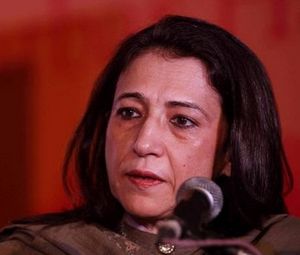
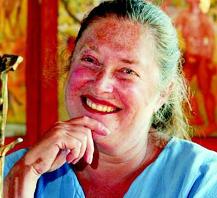
“You really have to come here and live its daily contradictions to understand the reality of modern day Pakistan,” adds Jalal, who is the Mary Richardson professor of history at Tufts University in the US where she teaches both in the history department and the Fletcher School of Law and Diplomacy. She has also taught at Harvard and Columbia University.
Jalal, an elegant woman in her mid-fifties with a feisty intellect and sharp tongue, was born in Lahore. Her father is Hamid Jalal, a senior Pakistani civil servant, and she is the grandniece of the renowned Urdu fiction writer Saadat Hasan Manto.
She explains that when she moved to New York as a teenager, where her father was posted at the Pakistan’s United Nations mission in 1971, she had difficulties reconciling the official narratives of the Pakistani state with daily news reports of atrocities perpetrated by the Pakistan army in then East Pakistan, which later became Bangladesh.
“This led me to ask questions about Pakistan’s history and self-representations, which in time came to define my research interests.”
More here.