Hacking the Brain: How we might make ourselves smarter in the future

Maria Konnikova in The Atlantic:

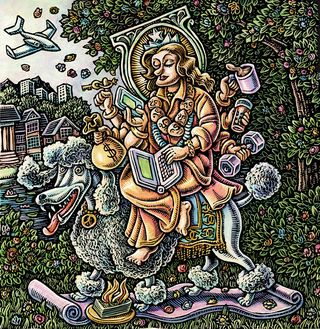
BrainThe perfectibility of the human mind is a theme that has captured our imagination for centuries—the notion that, with the right tools, the right approach, the right attitude, we might become better, smarter versions of ourselves. We cling to myths like “the 10 percent brain”—which holds that the vast majority of our thinking power remains untapped—in part because we hope the minds of the future will be stronger than those of today. It’s as much a personal hope as a hope for civilization: If we’re already running at full capacity, we’re stuck, but what if we’re using only a small fraction of our potential? Well, then the sky’s the limit. But this dream has a dark side: The possibility of a dystopia where an individual’s fate is determined wholly by his or her access to cognition-enhancing technology. Where some ultra-elites are allowed to push the limits of human intelligence, while the less fortunate lose any chance of upward mobility. Where some Big Brother–like figure could gain control of our minds and decide how well we function.

What’s possible now, and what may one day be? In a series of conversations with neuroscientists and futurists, I glimpsed a vision of a world where cognitive enhancement is the norm. Here’s what that might look like, and how we can begin thinking about the implications.

More here.

The Evidence Points to a Better Way to Fight Insomnia

Austin Frakt in The New York Times:

SleepInsomnia is worth curing. Though causality is hard to assess, chronic insomnia is associated with greater risk of anxiety, depression, hypertension, diabetes, accidents and pain. Not surprisingly, and my own experience notwithstanding, it is also associated with lower productivity at work. Patients who are successfully treated experience improved mood, and they feel healthier, function better and have fewer symptoms of depression. Which remedy would be best for me? Lunesta, Ambien, Restoril and other drugs are promised by a barrage of ads to deliver sleep to minds that resist it. Before I reached for the pills, I looked at the data. Specifically, for evidence-based guidance, I turned to comparative effectiveness research. That’s the study of the effects of one therapy against another therapy. This kind of head-to-head evaluation offers ideal data to help patients and clinicians make informed treatment decisions. As obvious as that seems, it’s not the norm. Most clinical drug trials, for instance, compare a drug with a placebo, because that’s all that’s required for F.D.A. approval. In recognition of this, in recent years more federal funding has become available for comparative effectiveness research.

When it comes to insomnia, comparative effectiveness studies reveal that sleep medications aren’t the best bet for a cure, despite what the commercials say. Several clinical trials have found that they’re outperformed by cognitive behavioral therapy. C.B.T. for insomnia (or C.B.T.-I.) goes beyond the “sleep hygiene” most people know, though many don’t employ — like avoiding alcohol or caffeine near bedtime and reserving one’s bed for sleep (not reading or watching TV, for example). C.B.T. adds — through therapy visits or via self-guided treatments — sticking to a consistent wake time (even on weekends), relaxation techniques and learning to rid oneself of negative attitudes and thoughts about sleep.

More here.

Tuesday Poem

Homan and Chicago Ave.

Cross the blood

that quilts your busted lip
with the tender tip
of   your tongue. That lip’s
blood is brackish and white
meat flares from the black
swell. You crossed your mama’s
mind so call her sometimes.
She dreams your dead daddy
still puts his hands on her
waist. She calls his name
then crosses herself, calls
the police then crosses
her fingers. Cross me
and get cut across your cheek,
its fat bag full of   bad words
and cheap liquor you hide
from your badass kids. Make
a wish for bad weather
when the hoodlums get to shooting
in a good summer’s heat.
Cross the territory between
two gangs and feel eyes stare
and cross in a blur of crosshairs.
When a shot man lands
in the garden of trash the block
flares up like an appetite
spurred on by the sight
of prey, by the slurred
prayer of a man so death-close
he sees buzzards burrow
their bladed beaks into
his entry wound. Tune
the trumpets. Make way through
dusk’s clutter. After death
the dead cross over into song,
their bones tuning-forked
into vibrancy. Cross your lips,
mutiny against all speech
when a corpse starts singing
despite its leaded larynx. Don’t
say miracle when butterflies
break from a death-gaped skull,

rout the sky, and scatter.
.

by Phillip B. Williams
from Poetry Magazine, 2013

Mind Your Own Business

Haney-mindful-Ehrenreich1

Barbara Ehrenreich in The Baffler (image by Lisa Haney):

At about the beginning of this decade, mass-market mindfulness rolled out of the Bay Area like a brand new app. Very much like an app, in fact, or a whole swarm of apps. Previous self-improvement trends had been transmitted via books, inspirational speakers, and CDs; now, mindfulness could be carried around on a smartphone. There are hundreds of them, these mindfulness apps, bearing names like Smiling Mind and Buddhify. A typical example features timed stretches of meditation, as brief as one minute, accompanied by soothing voices, soporific music, and images of forests and waterfalls.

This is Buddhism sliced up and commodified, and, in case the connection to the tech industry is unclear, a Silicon Valley venture capitalist blurbed a seminal mindfulness manual by calling it “the instruction manual that should come with our iPhones and BlackBerries.” It’s enough to make you think that the actual Buddha devoted all his time under the Bodhi Tree to product testing. In the mindfulness lexicon, the word “enlightenment” doesn’t have a place.

In California, at least, mindfulness and other conveniently accessible derivatives of Buddhism flourished well before BlackBerries. I first heard the word in 1998 from a wealthy landlady in Berkeley, advising me to be “mindful” of the suffocating Martha Stewart-ish decor of the apartment I was renting from her, which of course I was doing everything possible to un-see. A possible connection between her “mindfulness” and Buddhism emerged only when I had to turn to a tenants’ rights group to collect my security deposit. She countered with a letter accusing people like me—leftists, I suppose, or renters—of oppressing Tibetans and disrespecting the Dalai Lama.

More here.

The Science of Scarcity

MJ15_p38_01

Cara Feinberg in Harvard Magazine (Photograph by Jim Harrison):

TOWARD THE END of World War II, while thousands of Europeans were dying of hunger, 36 men at the University of Minnesota volunteered for a study that would send them to the brink of starvation. Allied troops advancing into German-occupied territories with supplies and food were encountering droves of skeletal people they had no idea how to safely renourish, and researchers at the university had designed a study they hoped might reveal the best methods of doing so. But first, their volunteers had to agree to starve.

The physical toll on these men was alarming: their metabolism slowed by 40 percent; sitting on atrophied muscles became painful; though their limbs were skeletal, their fluid-filled bellies looked curiously stout. But researchers also observed disturbing mental effects they hadn’t expected: obsessions about cookbooks and recipes developed; men with no previous interest in food thought—and talked—about nothing else. Overwhelming, uncontrollable thoughts had taken over, and as one participant later recalled, “Food became the one central and only thing really in one’s life.” There was no room left for anything else.

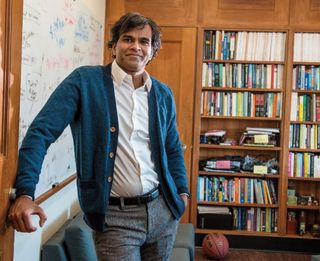
Though these odd behaviors were just a footnote in the original Minnesota study, toprofessor of economics Sendhil Mullainathan, who works on contemporary issues of poverty, they were among the most intriguing findings. Nearly 70 years after publication, that “footnote” showed something remarkable: scarcity had stolen more than flesh and muscle. It had captured the starving men’s minds.

More here.

A Crisis at the Edge of Physics

07GRAY-blog427

Adam Frank and Marcelo Gleiser in the NYT (image by Gérard DuBois):

DO physicists need empirical evidence to confirm their theories?

You may think that the answer is an obvious yes, experimental confirmation being the very heart of science. But a growing controversy at the frontiers of physics and cosmology suggests that the situation is not so simple.

A few months ago in the journal Nature, two leading researchers, George Ellis and Joseph Silk, published a controversial piece called “Scientific Method: Defend the Integrity of Physics.” They criticized a newfound willingness among some scientists to explicitly set aside the need for experimental confirmation of today’s most ambitious cosmic theories — so long as those theories are “sufficiently elegant and explanatory.” Despite working at the cutting edge of knowledge, such scientists are, for Professors Ellis and Silk, “breaking with centuries of philosophical tradition of defining scientific knowledge as empirical.”

Whether or not you agree with them, the professors have identified a mounting concern in fundamental physics: Today, our most ambitious science can seem at odds with the empirical methodology that has historically given the field its credibility.

How did we get to this impasse?

More here.

Monday, June 8, 2015

Sunday, June 7, 2015

Must We Mean What We Say? On Stanley Cavell

Charles Petersen in n + 1:

ScreenHunter_1214 Jun. 08 12.10Stanley Cavell, born in 1926 and now 86 years old, is one of the greatest American philosophers of the past half-century. He was also something of a musical prodigy and like many prodigies his accomplishments struck him as a matter of fraud. During his freshman year at Berkeley, he writes in Little Did I Know, his 2010 memoir, he walked into one of his first piano courses and was asked to prove he had the requisite chops by playing a piece on the spot. Not having practiced anything but jazz for years—this was 1944, and big band swing was at its peak—the budding pianist sat down at the bench, broke into a half-remembered theme from a Liszt impromptu, and “stopped playing as the theme was about to elaborate itself, as if I could have gone on to the end were there time and need.” He could not have gone on to the end, nor even a note further, but his teacher, a brilliant young pianist with some of the look of Marlene Dietrich, was nonetheless taken in. “Isn’t it fine to hear a man’s touch at the piano?” she said to the class. Cavell felt smitten, but also unmanned. “It is true that I had really done whatever . . . . I had done, but I could not go on.” Although he could play almost anything on demand—and would later win praise from Ernest Bloch, Milton Babbitt, and Roger Sessions, rescuing the premiere of one of the latter’s works through an emergency mid-concert transposition—for Cavell it was as if each new performance followed only from instinct, without the understanding that promised a way forward. No matter his successes, he couldn’t escape the feeling that he was a fraud.

Two decades later, in 1965, Cavell, having abandoned music for philosophy, returned to the problem of fraudulence in a now classic essay, “Music Discomposed.” (It would become a centerpiece in his landmark first collection, Must We Mean What We Say? [1969].) The motivating question of the essay — “How can fraudulent art be exposed?” — though couched in the nomenclature of composers like Cage and Stockhausen, seems now, in light of Cavell’s memoir, to be addressed as much to his own uncertainties as a young musician.

More here.

An interview with… Noël Carroll on the Philosophy of Art

Download (3)

Over at 5 Books:

Could you give an example of the kind of question that stimulated you to get into philosophy? Often practising artists and even critics are sceptical about the subject, saying that it misses the point of the arts.

Well, as both an artist — I was a fledgling poet, and I did go to film school — and then as a critic at that time of my life, which was the 1970s, I was vexed by the tendency towards relativism. When I made various things, I didn’t mean them to be open to any interpretation possible. I also felt that a number of critics were using works of art to ride their own hobbyhorses, and defending this on the grounds of relativism. I wanted to investigate the philosophical foundations of that kind of interpretive freedom, and to discover whether or not there might be a philosophical foundation to my own conviction that some interpretations were right and others were wrong.

Now, the Five Books that you’ve chosen are all from the twentieth century, which has probably been history’s greatest century in aesthetics. Do you agree?

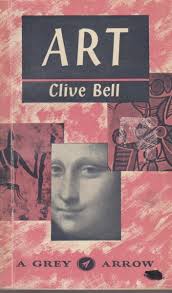
My view is that the philosophy of art is something that arose to deal with a specifically modern problem. Before the eighteenth century, people talked about the individual arts but they didn’t think of them as a unified system. In the eighteenth century you begin to get a feeling that certain things go together — poetry, theatre, dance, music, painting, and sculpture. Prior to that, things could be put together a little differently — music could go with mathematics, or painting could go with medicine, because both apothecaries and painters ground things in pestles. In the eighteenth century we get this formation of what we call the “Fine Arts” and what they called in those days the “Beaux Arts.” They were thought to be unified by the notion of the imitation of the beautiful in nature. But no sooner was that view afoot than there was a crisis: the crisis of absolute music. Absolute music — music without text or programmes — became more and more central. Other art was said to aspire to its condition but, of course, an imitation theory didn’t fit that view very well so other views had to be discovered and a whole range began to be fielded including expression theories, formal theories, and aesthetic theories. This, in turn, was exacerbated by the growing velocity of the appearance of an avant-garde. No sooner did one view of the nature of art appear than it had to be repaired because something else came down the pike. The reason I think that the philosophy of art is particularly modern, and the reason that the twentieth century was so involved with it, was that it had to deal with the constant challenge of the avant-garde. We see that in the first of the texts that I’ve chosen, by Clive Bell. His book,Art, is a defence of a then emerging avant-garde: the avant-garde movement of post-impressionism.

More here.

A Party of Latecomers

N+1-logo

Francis Mulhern in New Left Review:

A magazine, if it is not doctrinaire, should have a character rather than a programme—so wrote Roberto Schwarz in 1967, launching a new publishing initiative for the left in Brazil. His preferred comparison was ‘a good essay’, something both surefooted and unexpected, clearing an uncertain path by the light of interest and strict reasoning, and certainly not without guiding convictions. [1]Recall of this prospectus is prompted by the record of the New York-based n+1, which has now completed ten years of publication as a magazine devoted, in its own phrasing, to ‘literature, culture and politics’, establishing itself in that time as a distinctive presence on the intellectual left, in the United States and beyond. Convention alone suggests that this is a good time to make a provisional assessment of the project—or more aptly perhaps, to appraise its ‘character’.

An outline description of the practical ensemble called n+1 gives a first indication of the unfolding scope and spirit of the undertaking and at the same time suggests the necessary modesty of a small-scale account of it. The magazine itself is dual-platform, combining a print publication that has so far seen more than twenty book-length issues, and an online supplement that expands and also diversifies editorial capacity, creating space for special subject streams, accommodating shorter or more time-sensitive contributions, and in all ways enhancing the ability to manoeuvre. n+1 has spun out a book series under the same name, some but not all of the material originating in its pages, and also publishes a sister magazine, Paper Monument, devoted to contemporary art. These print and online manifestations take on immediate, face-to-face form in occasional panel discussions, public launch parties and other convivial events [2] —all this miniaturized, as it were, if only for a time, in a Tumblr-based personal ads service. More than a publication, n+1 is a micro-culture, a whole way of intellectual life.

For all that, the magazine, including its online supplement, amounting to an archive of texts in the high hundreds, will be the main reference in what follows. More programmatic ventures, being more tightly focused and (inevitably) more repetitious, offer interpretive economies. Here, the case is otherwise: in n+1, the essay has been foremost, and even paradigmatic, with all that implies of mobility and surprise—and for a reader, the counterpart risks of reductive generalization.

More here.

The Anatomy of a Massacre

Karachi-bus-243x366

Faisal Devji in the LA Review of Books:

ON MAY 13, nearly 50 Ismailis were massacred on a bus in Karachi. The attack was claimed by two militant groups, each referring in its statements to the Islamic State (ISIS) and events in the Levant as much as Pakistan. These murders seemed to constitute one more example of the globalization of sectarian violence in the Muslim world. The phenomenon had arguably begun in Pakistan, partly in the form of a proxy war between Iran and her enemies across the Persian Gulf following the Islamic Revolution. Apparently, it has now returned to its country of origin. But there was something new about the Karachi killings, not least because they targeted a community that hadn’t previously been on the frontline of religious conflict, having largely avoided politics and without any state backing it.

Prior to the bus attack, Ismailis, a small and globally dispersed branch of the Shia sect that subjects Islamic prescriptions to allegorical interpretation, had been targeted in Pakistan’s most populous city once before. In August 2013, bombs were thrown into two Karachi Jamat Khanas (places of worship), killing a couple of people. Ismailis had been the victims of low-grade sectarian violence, however, in the mountainous regions of Chitral and Gilgit, where they form significant rural populations alongside Sunni and other Shia groups. But even here they were not important actors. In addition to heresy, they were generally accused of being pro-Western, even of trying to carve out an American puppet state that would have brought together the Ismaili populations of northern Pakistan and Afghanistan with those of eastern Tajikistan — to say nothing of western China.

More here.

This Is My Vision Of “Life”: Richard Dawkins

Introduction by John Brockman in Edge:

Dawkins_4_11_15_web__0My vision of life is that everything extends from replicators, which are in practice DNA molecules on this planet. The replicators reach out into the world to influence their own probability of being passed on. Mostly they don't reach further than the individual body in which they sit, but that's a matter of practice, not a matter of principle. The individual organism can be defined as that set of phenotypic products which have a single route of exit of the genes into the future. That's not true of the cuckoo/reed warbler case, but it is true of ordinary animal bodies. So the organism, the individual organism, is a deeply salient unit. It's a unit of selection in the sense that I call a “vehicle”. There are two kinds of unit of selection. The difference is a semantic one. They're both units of selection, but one is the replicator, and what it does is get itself copied. So more and more copies of itself go into the world. The other kind of unit is the vehicle. It doesn't get itself copied. What it does is work to copy the replicators which have come down to it through the generations, and which it's going to pass on to future generations. So we have this individual / replicator dichotomy. They're both units of selection, but in different senses. It's important to understand that they are different senses.

Now, because the individual organism is such a salient unit, biologists after Darwin got into the habit of seeing the organism as the unit of action, and therefore they asked the question, what is the organism maximizing? What mathematical function is the organism maximizing? Fitness is the answer. So fitness was coined as a mathematical expression of that which the organism is maximizing. Of course, what fitness really is, or what it ought to be if we understand it properly, is gene survival. For a long time fitness was equated in people's minds with reproduction, with having a large number of children, grandchildren, great-grandchildren. Bill Hamilton and others, but mostly Bill Hamilton, realized that you had to generalize that because, if what's really going on is working to pass on genes, offspring, grandchildren, et cetera, are not the only ways of passing on genes. An organism can work to enhance the survival and reproduction of its siblings, its nephews, its nieces, its cousins and so on.

More here.

THE WEIGHT IS ALMOST OVER

Tom Whipple in More Intelligent Life:

KilheaderIN AN UNDERGROUND vault beneath a hill overlooking Paris, behind a steel door whose lock requires three keys—only two of which are in France—and protected by three glass covers, lives the kilogram. Not a kilogram but The kilogram. For the past 125 years, this sleek cylinder of platinum-iridium has defined mass for the world. The vault is buried under the Bureau International des Poids et Mesures (BIPM), a whitewashed stately home a discreet distance from Paris, with extensive gardens for physicists to roam in and views across a grand meander of the Seine. The BIPM exists to control, define and distribute the Standard International (SI) units by which science—and indeed non-science—makes its measurements: the second, the metre, the mole, the candela, the ampere, the kelvin and the kilogram. You might call it the spiritual centre of the metric system—if the rational world of revolutionary France’s metrification programme allowed room for anything as irrational as the spiritual.

…THE KILOGRAM AS we know it was created at the first General Conference on Weights and Measures, held in France in 1889 and attended by 20 of the world’s more science-minded nations. As the Enlightenment progressed, spreading knowledge and developing the modern empirical methods, it became clear that, for science to work, its practitioners had to agree on units. If an experiment in Rio de Janeiro used a gram of catalyst heated to 75 degrees, someone repeating that experiment in Tokyo needed to know that a gram and a degree meant the same on both sides of the Pacific. Following almost a century of discussion, the conference defined the key units of measurement, and the kilogram was forged and incarcerated. In the years since 1889, around 100 daughter kilograms have been made, some in platinum-iridium, others in stainless steel. Most have been distributed around the world to provide national mass standards. Six are kept here in Paris, to be used as a check on the main kilogram.

More here.

Sunday Poem

Rhubarb

My Clan Mother is the great she-devil
of the forest. She stands twenty feet
over fields of wild rhubarb, Dutch cabbage.

Her face is black, blacker than the blue
of night where stars shed tears into rivers,
lakes, onto the windscreen of my car.

If I weren’t in such a hurry
I would pull over, wait for her
to pluck me from the hard shoulder.

Together we could hunt boar
in the forest and at night stay dry
beneath the cauls of newborn children.
.

by Celia de Freine
from Faoi Chabáistí is Ríonacha
publisher: Cló Iar-Chonnachta, 2001

Saturday, June 6, 2015

You Won’t Believe What Word This Column Is About!

Ben Zimmer in the Wall Street Journal:

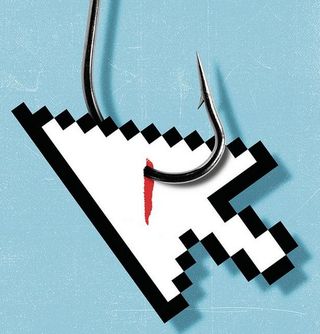
ScreenHunter_1211 Jun. 06 17.21What happens when a dictionary adds the word “clickbait” to its pages and publicizes the news with a bit of clickbait?

Last week, Merriam-Webster said it had added 1,700 new entries to its Unabridged Dictionary. It defined “clickbait,” one of the words featured, as “something (such as a headline) designed to make readers want to click on a hyperlink, especially when the link leads to content of dubious value or interest.”

And in a move that poked fun at the conventions of clickbait itself, Merriam-Webstershared a link to the announcement on Twitter with the come-on, “You won’t believe what we just added to the dictionary!” (Other additions include “emoji,” “meme” and “jegging.”)

Not everyone was amused.

More here.