the early meteorologists

Fara_06_15Patricia Fara at Literary Review:

The Greek origins of the word 'meteorology' indicate that trying to foretell the weather is nothing new. In Aristotle's model, the universe was divided, like a two-tiered gobstopper, into the heavens – where the planets serenely rotated in orderly circles – and the central chaotic terrestrial sphere, the skies of which extended out as far as the moon's orbit, home not only to birds, clouds and rainbows, but also to meteors. Like other transient phenomena, such as comets, meteors were often interpreted as messages from God. Only gradually were they relegated from terrestrial to astronomical science.

Following the invention of thermometers, barometers and other measuring instruments, Enlightenment gentlemen attempted to rationalise the cosmos, faithfully recording everything and anything that might help establish regular patterns of behaviour. To their humiliation, despite investing in the latest equipment, these meticulous observers were outperformed by illiterate farmers and sailors drawing on decades of experience. Even frogs and farm animals seemed more prescient, apparently possessing a sixth sense about trouble lying ahead. Self-styled experts remained fallible, especially when viewed in hindsight: in 1938, a British steam engineer correctly calculated that industrially generated carbon dioxide would cause the earth's temperature to rise, but concluded that the extra few degrees would help ward off an impending ice age.

more here.

The Downside of Treadmill Desks

Gretchen Reynolds in The New York Times:

DeskTreadmill desks are popular, even aspirational, in many offices today since they can help those of us who are deskbound move more, burn extra calories and generally improve our health. But an interesting new study raises some practical concerns about the effects of walking at your workspace and suggests that there may be unacknowledged downsides to using treadmill desks if you need to type or think at the office. The drumbeat of scientific evidence about the health benefits of sitting less and moving more during the day continues to intensify. One study presented last month at the 2015 annual meeting of the American College of Sports Medicine in San Diego found that previously sedentary office workers who walked slowly at a treadmill desk for two hours each workday for two months significantly improved their blood pressure and slept better at night. But as attractive as the desks are for health reasons, they must be integrated into a work setting so it seems sensible that they should be tested for their effects on productivity. But surprisingly little research had examined whether treadmill desks affect someone’s ability to get work done.

So for the new study, which was published in April in PLOS One, researchers at Brigham Young University in Provo, Utah, recruited 75 healthy young men and women and randomly assigned them to workspaces outfitted with a computer and either a chair or a treadmill desk. The treadmill desk was set to move at a speed of 1.5 miles per hour with zero incline. None of the participants had used a treadmill desk before, so they received a few minutes of instruction and practice. Those assigned a chair were assumed to be familiar with its use.

More here.

Tuesday Poem

Snow

Lost in an infinity of misted mirrors
among shelves of Optrex,

Pepsodent and pink calamine,
I dunked net petticoats into sugar solution

to froth out the nylon frills of that
first dance dress.

Hanging it to drip-dry over
the porcelain sink I squeezed

obdurate adolescent flesh
into a rubber roll-on that chaffed my thighs,

attaching 15 deniers
to silk suspenders,

before turning to straighten
the wayward seam along

a newly shaved leg and wriggle
into my strapless Wonderbra.

Then spitting into the little
Bakelite box to soften the black wax,

a flick of mascara
applied with a tiny brush.

Backcombing my hair, the lady
on the Elnett tin of hairspray

smiled with a poise
I could never muster.

So much preparation
to end alone

beneath the rotating mirror-ball,
as the last waltz faded

and flakes of light spangled
my bare arms in falling snow.

.
by Sue Hubbard
from Ink Sweat and Tears

Dinomania: the story of our obsession with dinosaurs

Tom Holland in The Guardian:

D04121df-ff90-4154-8dab-42b1d916dd46-1020x526Dinosaurs, though, have never just been for children. From the time when they were first classified, back in the days of the Napoleonic wars, up to the present, they have served as the focus for fittingly weighty themes: industrialisation, national rivalries, and survival and extinction. Their fascination reaches deep indeed.

There is certainly nothing new about the instinct to marvel at giant fossils, nor to dream of putting flesh back on their bones. At the height of the Roman empire, during the reign of Tiberius, a devastating earthquake – “the worst in human memory”, according to Pliny the Elder – exposed a series of colossal skeletons. The locals, convinced that these were the remains of ancient heroes, were reluctant to desecrate their graves; but knowing of the emperor’s interest in such matters, they reverently sent him a single, massive tooth. Tiberius, eager to see with his own eyes just how large the man from which it came would have stood, commissioned a mathematician to calculate the hero’s proportions, and then to build him a scale model. The tooth – which we are informed was over a foot long – was not, of course, human, but most likely from a mastodon. Elsewhere, though, in lands where rocks bore the fossils of dinosaurs, ancient peoples were perfectly capable of recognising them as the remains of non-human creatures. In China, they were identified as dragon bones, while in North America, as the historian Adrienne Mayor has convincingly demonstrated, tales told by the Plains Indians of the Thunder Bird were inspired at least in part by the spectacle of pterosaur fossils. There seems never to have been a time nor a culture in which mysterious bones did not captivate those who beheld them.

Even in early 19th-century Britain, where dinosaurs were first dated correctly and classified, flights of imagination were at least as important to the project of conceptualising them as painstaking anatomical study. The rocks of England were not, as those of Alberta would prove to be, rich in articulated skeletons. When, in 1824, an assortment of fossilised bones and teeth discovered in the depths of various Oxfordshire quarries were assembled in one place, it was not immediately apparent from what kind of animal they had come. William Buckland, a clergyman who was also a professor of geology at Oxford University, identified them as having belonged to a massive lizard, which produced the decorous Greek translation Megalosaurus. Meanwhile, at much the same time, other no less revelatory finds were being made along the length of the south coast. In Sussex, a local doctor uncovered the fragmentary remains of what appeared to have been two more species of colossal, extinct land-reptiles: Iguanodon and Hylaeosaurus, as they were named. Simultaneously, in Lyme Regis, a professional fossil hunter named Mary Anning was busy demonstrating that the seas and skies of prehistoric England had been no less the haunt of remarkable monsters than had been its swamps. Many, when they inspected the long-necked plesiosaurs, the shark-like ichthyosaurs and the bat-like pterosaurs discovered by Anning, found that only the language of epic was adequate to the primordial vistas that opened up before their gaze. The family likeness of Anning’s monsters, so her biographer declared rhapsodically, was “to the evil spirits who beset Aeneas or Satan in an old illustrated Virgil or Paradise Lost”.

Read the rest here.

Black Like Her

Cobb-Black-Like-Her-690

Jelani Cobb in The New Yorker (Photo by Colin Mulvany/The Spokesman Review via AP):

Among African-Americans, there is a particular contempt, rooted in the understanding that black culture was formed in a crucible of degradation, for what Norman Mailer hailed as the “white Negro.” Whatever elements of beauty or cool, whatever truth or marketable lies there are that we associate with blackness, they are ultimately the product of a community’s quest to be recognized as human in a society that is only ambivalently willing to see it as such. And it is this root that cannot be assimilated. The white Negroes, whose genealogy stretches backward from Azalea through Elvis and Paul Whiteman, share the luxury of being able to slough off blackness the moment it becomes disadvantageous, cumbersome, or dangerous. It is an identity as impermanent as burnt cork, whose profitability rests upon an unspoken suggestion that the surest evidence of white superiority is the capacity to exceed blacks even at being black. The black suspicion of whites thus steeped in black culture wasn’t bigotry; it was a cultural tariff—an abiding sense that, if they knew all that came with the category, they would be far less eager to enlist.

But this is precisely what makes the Dolezal deception complicated. Artists like Eminem and Teena Marie, white people who were by and large accepted by black people as a legitimate part of black cultural life, nonetheless had to finesse a kind of epidermal conflict of interest. Irrespective of their sincerity, a portion of their profitability lay in their status as atypically white. Dolezal’s transracialism was imbued with exactly the opposite undertaking. She passed as black and set about shouldering the inglorious, frustrating parts of that identity—the parts that allocate responsibility for what was once called “uplifting the race.” It’s an aspect of her story that at least ought to give her critics—black ones, particularly—a moment of pause.

Dolezal is, like me, a graduate of Howard University, a place where the constellation of black identities and appearances is so staggeringly vast as to ridicule the idea that blackness could be, or ever has been, any one thing. What I took from Howard, besides that broadened sense of a world I’d presumed to know, was an abiding debt to those who’d fought on its behalf and a responsibility to do so for those who came afterward. It’s easy to deride Dolezal’s dishonesty—to ridicule her hoax as a clever means of sidestepping the suspicion with which white liberals are commonly greeted—until we reflect on a photograph of Walter White, the aptly named man who served as the second black president of the N.A.A.C.P. Or one of Louis T. Wright, who served as the national chairman of the N.A.A.C.P. board during the Great Depression. In the nineteen-twenties, amid a feud with the organization, the black nationalist Marcus Garvey criticized the N.A.A.C.P. for being a organization whose black and white members were essentially indistinguishable.

More here.

No Reason To Blame Liberals (Or, The Unbearable Lightness of Perversity Arguments)

US-death-sentence-executions

Margo Schlanger reviews Naomi Murakawa's The First Civil Right: How Liberals Built Prison America, in The New Rambler:

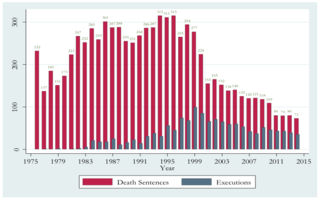
Moving then to what Murakawa demonstrates about federal law-and-order politics, I think it is useful to reslice her arguments a bit crosswise. Murakawa is most successful, but least novel, when she argues that liberals, or, at least, Democrats, have contributed importantly to mass incarceration. President Clinton’s 1994 Crime Bill was undoubtedly a highly punitive intervention in federal crime policy. And it must have had effects (though they are hard to quantify) on state incarceration levels too: All those thousands of cops must have arrested people. And federal truth-in-sentencing incentives had at least a marginal effect of increasing incarceration in a number of states. (Although abundant recent work undermines the claim that increased sentences, rather than changes in other aspects of the criminal justice process, have been the main drivers of increased incarceration in recent decades.) The 1984 Sentencing Reform Act was, likewise, a consequentially punitive change in federal policy, and likewise passed with Democratic support. But we didn’t need a new book to make those well-recognized points. The contribution of The First Civil Rightis not to argue that President Clinton’s 1994 Crime Bill was punitive and problematic, that Clinton was a triangulator, or more generally that sometimes Democrats aren’t very liberal. Nor is Murakawa’s novel contribution the argument that liberals in 1984 got rolled, when compromise after compromise led Ted Kennedy and his fellow Democrats to acquiesce to a punitive federal sentencing regime change.

Rather, Murakawa’s contribution—the attention-grabbing claim at the core of her book—is her argument that liberalism has built modern American mass incarceration. Her major point along these lines is that the liberal preoccupation with using fair, non-racist procedures has contributed importantly to the growth of the carceral state, taming reform urges, entrenching the punitive regime. This argument sounds in perversity—on Murakawa’s account, liberalism’s attempt to improve racial justice using procedural tools not only fails, it is counter-productive, entrenching and worsening the system’s inequities.

Albert Hirschman, in The Rhetoric of Reaction: Perversity, Futility, Jeopardy, analyzed the appeal of the perversity argument as a reactionary trope: “What better way to show him up as half foolish and half criminal than to prove that he is achieving the exact opposite of what he is proclaiming as his objective?”

More here.

Artless: Why do intelligent people no longer care about art?

Download (4)

Michael Lind tries to make the case in The Smart Set:

There is still an art world, to be sure, in New York and London and Paris and elsewhere. But it is as insular and marginal as the fashion world, with a similar constituency of rich buyers interacting with producers seeking to sell their wares and establish their brands. Members of the twenty-first century educated elite, even members of the professoriate, will not embarrass themselves if they have never heard of the Venice Biennale.

Many of the Arts Formerly Known as Fine seem to have lost even a small paying constituency among rich people, and live a grant-to-mouth existence. In the old days, bohemian painters lived in garrets and tried to interest gallery owners in their work. Their modern heirs — at least the ones fortunate to have university jobs — can teach classes and apply for grants from benevolent foundations, while creating works of art that nobody may want to buy. Born in bohemia, many aging arts have turned universities into their nursing homes.

What happened? How is it that, in only a generation or two, educated Americans went from at least pretending to know and care about the fine arts to paying no attention at all?

The late Hilton Kramer, editor of The New Criterion, blamed the downfall of the fine arts on purveyors of Pop Art like Andy Warhol. And Jeff Koons, who replaced Arnoldian “high seriousness” and the worship of capital-c Culture with iconoclasm, mockery, and irony. A Great Tradition of two millenia that could be felled by Andy Warhol must have been pretty feeble! But the whole idea of a Phidias-to-Pollock tradition of Great Western Art was unhistorical. The truth is that the evolution (or if you like the degeneration) from Cezanne to Warhol was inevitable from the moment that royal, aristocratic and ecclesiastical patronage was replaced by the market.

Having lost their royal and aristocratic patrons, and finding little in the way of public patronage in modern states, artists from the 19th century to the 21st have sought new patrons among the wealthy people and institutions who have formed the tiny art market. It was not the mockery of Pop artists but the capitalist art market itself which, in its ceaseless quest for novelty, trivialized and marginalized the arts.

More here.

Monday, June 15, 2015

Sunday, June 14, 2015

Did Wittgenstein use silly points to make profound ones?

James Gingell in The Guardian:

ScreenHunter_1223 Jun. 14 21.31Ludwig Wittgenstein, it is said, loved cricket. Curious, perhaps, for such a famously serious Austrian to have affection for so trivial and English a game, but I have a theory as to why.

Maybe he liked the game’s hypnotic rhythms, its genteel pace, the easy ebb and flow of an even match. Maybe his eyes and ears enjoyed the game’s distinctive sights and sounds: the flapping white flannels and the rounded knock of bat on ball. Maybe it was the drama, the gladiatorial confrontation of a furious quick bowler hurling rock-hard leather towards a belligerent batsman. All of this grand and strange theatre might have helped him unknit his brow, do some unthinking and achieve the kind of meditative state so important to big intellectual breakthroughs.

For me, though, the more likely draw for Wittgenstein was the game’s language. His whole life was spent attempting to deconstruct the lines of code underpinning evolution’s most fabulous app – verbal communication. And cricket, with its dense and extraordinary quilt of gorgeous words and phrases, must have utterly captivated him.

The complexity of cricket necessitates an equally complex language merely to describe the basics of the game. There’s quite a lot of vocab for a player to learn just to know where to stand on the field. Imagine a circle of radius three metres around a batsman. Any fielder brave enough to stand on that circle can be described as any of (the titular) silly point, silly mid-off, silly mid-on, short leg,backward short leg, leg slip, slip or gully, depending on which point of the compass they are standing on in relation to the batsman.

More here.

Militant Poetics: What the Taliban’s Verse Says About Them and Us

Faisal Devji in The Wire:

A journalist I know had the opportunity of meeting Mullah Mohammad Omar early in the Taliban’s career, just as they were embarking upon the conquest of Ghazni, in February 1995. The Taliban leader, he told me, extracted the gilded wrapping-paper from an empty pack of Silk Cut cigarettes and penned instructions for his army on the back of it. In a region where Silk Cut is known as a “woman’s brand,” this image is curious enough. More interesting, however, is the possibility that the shiny cigarette paper served as an impoverished descendant of the gilded edicts or farmans of past monarchs. Did Mullah Omar, I wondered, possess a collection of empty Silk Cut packets for his official pronouncements?

If nothing else, this story tells us how important the aesthetic dimension is for even the most utilitarian militant practices, and how intertwined it is with all that is modern, western and indeed “quotidian” about the world. There is no easy way of distinguishing tradition from modernity here.

The aesthetic dimension of Taliban life is even clearer in these verses from a poet named Sayyed:

I keep the arrows of expectation in my heart like flowers;
My friend, I keep the lamp of hope lit for your coming.
I incite many lovers’ hearts to dance to the sound of my voice;
Always, like the nightingale, I keep the melody of grief in my heart.
Yet it is too young to be hurt; I am afraid it may hurt itself;
I will certainly safeguard this lion from the forest.
Even if time brings the ugliest revolutions,
I will keep the fold of my turban pious.
Sayyed! Even if I am destined to live in far away cities,
I will remain the rough Pashtun of the mountains.

Taken from a collection of Taliban poetry put together by the Kandahar-based researchers Alex Strick van Linschoten and Felix Kuehn, and published under the title Poetry of the Taliban by Columbia University Press, these lines force us to think differently about a group that otherwise receives a great deal of attention, though for different reasons and along very narrow lines.

More here.

Milosz and His Fans

CzeslawMilosz

Molly Wesling in Brick (via Bookhaven):

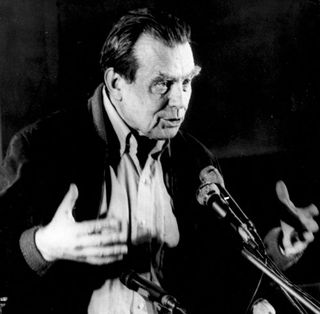
For five years I worked part-time for the poet and Nobel laureate Czesław Miłosz at his home in the Berkeley Hills. Miłosz was seventy-nine when I started taking dictation in Polish and English, helping him answer queries and invitations, mostly finding ways to say “no” in the gentlest of tones. Every so often though, I’d get to transcribe a gem like the letter above.

Once a week I caught the bus to 978 Grizzly Peak Boulevard. Miłosz would greet me at the door, shake my hand with a slight bow, and invite me to his study. By then he had a facial tic: his shaggy eyebrows twitched up and down as he talked. Carol, his American second wife, a lovely, funny woman with a southern twang, would bring Miłosz a glass of vodka. I’d whip out my steno notebook and get to work. Several hours later, Miłosz or Carol would drive me home, a steep descent and a slightly unnerving experience when Miłosz was at the wheel. The view was glorious—often the sun was setting over San Francisco Bay—but I would silently fret about the brakes on his mid-1980s sedan, and the odd headline a mishap might inspire.

To believe you are magnificent. And gradually to discover that you are not magnificent. Enough labor for one human life.

— Czesław Miłosz, Road-side Dog

At the top of his property near the street, Miłosz had a carriage house that he rented out to graduate students, including the sociologist Ted, with whom I fell in love, and, when Ted moved out to live with me, my old friend AnneMarie, a lawyer-in-training. Neither of them had much use for poetry or deference to the landlord called by Joseph Brodsky one of the greatest poets of our time. AnneMarie referred to him as “Cheesy Meatloaf”—her approximation of his Polish name. But she was impressed by the gold medallion that rested on a side table next to the phone in the living room. I’m pretty sure any visitor who used the phone took a surreptitious moment to trace the visage of Alfred Nobel and hold that orb up to the light. When Miłosz went to the University of North Carolina at Chapel Hill for a year as a writer-in-residence, leaving Ted in charge of his cat and his rhododendrons, the medallion remained in situ, just another knick-knack amid the piles of books and papers. Miłosz himself was not much impressed.

Another part of my job was to open and sort the mail, setting aside the letters from Miłosz’s admirers. I wondered about the crumbs tucked into letters from his Polish readers. Later it dawned on me that they were the bruised remains of communion wafers after a journey through the international post. Miłosz dutifully signed blank cards for autograph seekers and sent photos of himself when requested. He didn’t reply to everyone, but some letters caught his fancy, and he would strike up a correspondence—as with this aspiring writer, whose intelligence and longing jump out from the page:

Guilin, Guangxi 541001

P.R. China
October 14, 1993

Dear Mr. Miłosz,
. . . Perhaps having read western literature and philosophy too much, I appear to be a stranger in my own country. Now, I try hard to improve my English writing ability, hoping to express deeply my understandings of Chinese culture in Standard English someday.
As I have longed to be writer from a child, it is not my end to come to America to study Engineering, but I have no other choice. In China, it is difficult to change one’s occupation, at the same time, I am not willing to waste nine hours in a factory every day. I wish I will be admitted to a literary school to read William Faulkner, to study his cycle of stories about Yoknapatawpha County.
I have enjoyed reading an essay excerpted from “Native Realm: A Search for Self-Definition.” Would you please send me this book? For an ordinary Chinese youth like me, it is impossible to obtain any of the original masterpieces. I have taught myself Spanish in order to read Garcia Marquez, for example, but I never get “One Hundred Years of Solitude.”
With kindest regards,
Wei Rui

More here.

Behind Rachel Dolezal’s Invented Persecution

1434165525389.cached

Patrick Blanchfield in Daily Beast:

Her case suggests more than just a deep-seated problem, something more than just a highly narcissistic form of histrionic personal disorder, or an unhealthy need for obsession and approval.

Dolezal gives us stories replete with images of grotesque violence: beatings and whippings. Like slavery. Like torture. These are highly choreographed, ritualized sadomasochistic scenes, and to psychotherapists, they’re nothing new.

Therapists since Freud have listened to troubled patients tell stories, both plausible and more dubious, of such violence, and have regularly noticed that they are presented as stories of others being victimized when in fact it is the teller himself who is suffering from persecution that may be real or imagined or both.

And most people, rightly and compassionately, believe these stories. Until, it turns out, these stories are an emotional cover for something that could never be true.

This isn’t the first time this kind of thing has happened—even at this scale, and even with the same profoundly unsettling accusations.

Exactly twenty years ago, readers across Europe were absorbed by a remarkable, increasingly rare literary event: the revelation of a previously unknown Holocaust memoir. Published in German in 1995 as Bruchstücke: Aus einer Kindheit 1939—1948, a slim, hard-hitting first-person account offered a new, horrifying perspective on the Holocaust—that of an extremely young child, a Latvian named Binjamin Wilkomirski. Wilkomirski’s story, told in surreal, dreamlike patches punctuated by moments of stupefying violence, was riveting. Wilkomirski’s first memory, he claimed, was of witnessing his father being beaten to death.

Traveling between the concentration camps at Auschwitz and Majdanek, he claimed to have seen babies gnawing off their own frozen fingers, SS guards mutilating the penises of young boys, and more.

The account was met with considerable acclaim. For The New York Times, Wilkomirski’s prose, even in translation, conveyed “a poet’s vision; a child’s state of grace.” Fragments won the U.S. National Jewish Book Award, while Wilkomirski received numerous personal honors.

The only problem with Wilkomirski’s testimony is that it was full of lies.

More here.

Agents of Empire – a dazzling history of the 16th‑century Mediterranean

John Gallagher in The Telegraph:

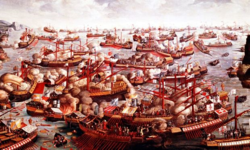
ShipsIn the last year of the 16th century, an English craftsman named Thomas Dallam found himself at the heart of the Ottoman empire. Dallam had been commissioned to build an organ to be presented to the Sultan, and he travelled with his creation through the Mediterranean as far as the court at Istanbul and back. Writing an account of his journey home, he remembered how the interpreter who accompanied him was not a local, but an Englishman named Finch, born in Chorley in Lancashire. Dallam wrote: “He was … in religion a perfit Turke [Muslim], but he was our trustie frende.” To run into an English convert to Islam on the shores of the Mediterranean was not as unlikely an event as it might seem. In the 16th century, the Mediterranean was what historians have called a “contact zone” – a region characterised not by rigid boundaries and borders, but by a bewildering mixture of faiths, peoples, languages and traditions. Classic narratives of a “clash of civilisations” may seem seductive (and serve contemporary political interests), but they are inadequate for thinking about the Middle Sea’s many overlapping histories: the reality on the ground was far more complex and infinitely more interesting than such a simplistic paradigm can account for.

What makes the Mediterranean fascinating is what makes writing its history such a challenge. Noel Malcolm’s magnificent Agents of Empire uses the intertwined stories of two Albanian families – the Brunis and the Brutis – as a prism through which to view the contacts and the conflicts that made the early modern Mediterranean. As diplomats, spies, bishops, soldiers, traders and interpreters, they were mobile and multilingual. From their Albanian roots, networks of kinship and contacts stretched in all directions, crisscrossing barriers of faith and nationality. At the Ottoman court, Bartolomeo Bruti became a protege of the military commander (and later Grand Vizier) Sinan Pasha, an Albanian convert to Islam who happened to be a family relation. Antonio Bruti bargained in Albania for the Ottoman grain necessary to feed Catholic Venice.

More here.

The Attack on Truth: We have entered an age of willful ignorance

Lee McIntyre in the Chronicle of Higher Education:

Photo_69995_landscape_600x400Humans have always held some wrongheaded beliefs that were later subject to correction by reason and evidence. But we have reached a watershed moment, when the enterprise of basing our beliefs on fact rather than intuition is truly in peril.

It’s not just garden-variety ignorance that periodically appears in public-opinion polls that makes us cringe or laugh. A 2009 survey by the California Academy of Sciences found that only 53 percent of American adults knew how long it takes for Earth to revolve around the sun. Only 59 percent knew that the earliest humans did not live at the same time as the dinosaurs.

As egregious as that sort of thing is, it is not the kind of ignorance that should most concern us. There is simple ignorance and there is willful ignorance, which is simple ignorance coupled with the decision to remain ignorant. Normally that occurs when someone has a firm commitment to an ideology that proclaims it has all the answers — even if it counters empirical matters that have been well covered by scientific investigation. More than mere scientific illiteracy, this sort of obstinacy reflects a dangerous contempt for the methods that customarily lead to recognition of the truth. And once we are on that road, it is a short hop to disrespecting truth.

More here.

‘Bold’ a reminder of how entrepreneurs will control the world’s fate

Vivek Wadhwa in The Washington Post:

BookJust as an asteroid wiped out the dinosaurs that ruled the Earth and made way for small furry mammals, a new wave of planetary disruptions is about to occur. The new asteroid is called “exponential technology.” It is going to wipe out industries in a similar manner to the rock which fell on Earth during the Cretaceous Period. That is the premise of a new book by Peter Diamandis and Steven Kotler, Bold: How to Go Big, Create Wealth and Impact the World. It makes bold predictions and teaches entrepreneurs how to thrive in the same way as our mammalian ancestors: by being nimble and resilient. In their previous book, Abundance: The Future Is Better Than You Think, Diamandis and Kotler discussed how advancing technologies are making it possible to solve problems that have long plagued humanity, such as disease, hunger, and shortages of energy. The authors analyzed the exponential progress of fields such as computing, medicine, 3D printing, robotics, and artificial intelligence and postulated that shortages of material goods and knowledge would soon be a thing of the past; that humanity is heading into an amazing era of abundance. As most people still are, I used to be pessimistic about the future. I feared overpopulation; worldwide shortages of food, water, and energy; pandemics and disease; and a bankruptcy of our health care and social welfare systems. Then, about three years ago, I joined the faculty of what is effectively an “abundance think-tank,” Singularity University, which had been founded by Diamandis and legendary futurist Ray Kurzweil. I learned that the future that Diamandis described in Abundance is actually coming true — and doing so faster than we would expect.

…The key premise of Bold –that entrepreneurs can solve global-scale problems — is based on a framework called the “six Ds of exponentials:” digitalization, deception, disruption, demonetization, dematerialization, and democratization. These are a chain reaction of technological progress, the path that technology takes, to create the upheaval — and the opportunity.

More here. (Note: Just read this and recommend highly…thanks to Dinesh Paliwal and Vania Apkarian)

Saturday, June 13, 2015

Milan Kundera’s ‘Festival of Insignificance’

La-la-ca-0605-milan-kundera-356-jpg-20150610David L Ulin at the LA Times:

There's not much to Milan Kundera's 10th novel, “The Festival of Insignificance” — his first work of fiction since 2000's “Innocence” — but then that's part of the point. Revolving around five middle-aged friends living in Paris, it offers not a narrative so much as a collection of vignettes, or reflections: the novel as a set of asides.

“Time moves on,” one of Kundera's characters tells us. “Because of time, first we're alive — which is to say: indicted and convicted. Then we die, and for a few more years we live on in the people who knew us, but very soon there's another change; the dead become the old dead, no one remembers them any longer and they vanish into the void; only a few of them, very, very rare ones, leave their names behind in people's memories, but, lacking any authentic witnesses now, any actual recollection, they become marionettes.”

This, of course — the issue of meaning in the face of human vanity — has long been at the center of Kundera's work. His first novel, “The Joke,” published in Czechoslovakia in 1967, describes in part the fallout from a satirical postcard (“OPTIMISM IS THE OPIUM OF THE PEOPLE!” it declares. “THE HEALTHY ATMOSPHERE STINKS! LONG LIVE TROTSKY!”) sent by a Czech student to a young woman he wishes to seduce: humor that cannot be read as humor, in other words.

more here.