
[Thanks to Georg Hofer.]
Category: Recommended Reading
Understanding Diversity and Empowerment
Madihah Akhter in The Feminist Wire:

…The first question the board faced in creating the Mosque was how to reflect an inclusive mindset in policy. The organizers tackled this issue by having a diverse set of khateebahs. Ideal khateebahs reflect the diversity the Mosque embraces, including diversity in ethnicity, background, and sectarian affiliation. This diversity is also reflected on the advisory board itself, which is composed of men and women, Shias and Sunnis, and members from the various schools of Islamic jurisprudence who maintain varying degrees of practice. Finally, diversity is reflected in the Mosque’s “come as you are” policy, which recognizes that there is no one definition of female modesty, and pluralism in religious practice should be respected and encouraged. The goal is to avoid policing among congregation members. On one hand, this view of diversity is beautiful. It is a much-needed reminder that the American Muslim community is not a monolith. We define ourselves according to a wide ranging set of beliefs and practices informed by family background, upbringing, and experiences, in addition to varying interpretations of religious texts. On the other hand, this idealism begs the question: how can the Mosque practically implement and maintain these policies? The first step, according to Sana Muttalib, a co-founder, is to make the Mosque’s policies clear to the entire congregation. The khateebah announces this policy before her sermon and board members to keep an eye out for women policing other women within the congregation during prayer.
More here.
Inuit Study Adds Twist to Omega-3 Fatty Acids’ Health Story
Carl Zimmer in The New York Times:
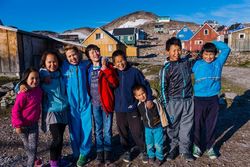
A study published last week in the journal Science reported that the ancestors of the Inuit evolved unique genetic adaptations for metabolizing omega-3s and other fatty acids. Those gene variants had drastic effects on Inuit bodies, reducing their heights and weights. Rasmus Nielsen, a geneticist at the University of California, Berkeley, and an author of the new study, said that the discovery raised questions about whether omega-3 fats really were protective for everyone, despite decades of health advice. “The same diet may have different effects on different people,” he said. Food is a powerful force in evolution. The more nutrients an animal can get, the more likely it is to survive and reproduce. Humans are no exception. When we encounter a new kind of food, natural selection may well favor those of us with genetic mutations that help us thrive on it. Some people, for example, are able to digest milk throughout their lives. This genetic adaptation arose in societies that domesticated cattle thousands of years ago, in such places as Northern Europe and East Africa. People who trace their ancestry to other regions, by contrast, tend to more often be lactose-intolerant.
More here.
Tuesday Poem
At One-ment
… —Yom Kippur, 9/22/15
To find the means to a mend
To try a new take to forsake a mistake
To unfold the past and straighten its bend
To un-muddy a pool and make it clear
To lift the flat rock of our self and let the sun do its work
To yank the inside out and give it some air
To make a whole man of the stuff of a jerk
To morph a long fall into a hairpin turn
To lance a boil and do what’s best for us
To kindle the badly done and watch it burn
To unbury the past and make its corpse a Lazarus
To sew a split in one cloth now two
To impossibly do what the humble do
To end a grudge and make us whole again,
atonement then
.
by Jim Culleny
9/13/13
Monday, September 21, 2015
perceptions
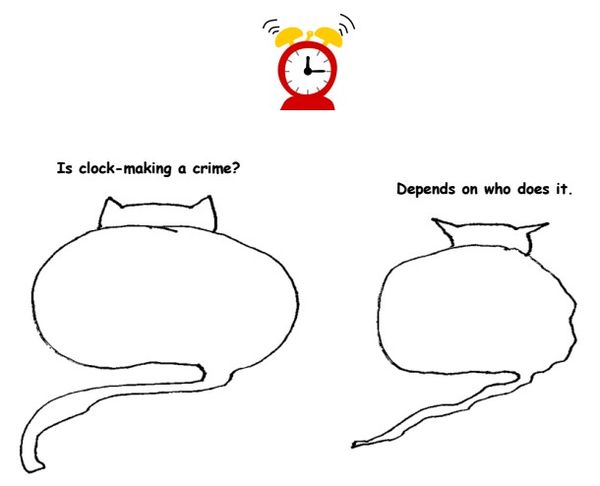
CATSPEAK
by Brooks Riley
Sunday, September 20, 2015
Anxieties of Democracy
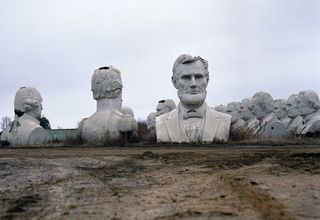
Over at the Boston Review, a forum on Ira Katznelson's piece on democracy, with responses from Larry Kramer, David M. Kennedy, Mark Schmitt, Rick Perlstein, Mohammad Fadel, Michael C. Dawson, Hélène Landemore, Michael Gecan, Martin O’Neill, Nadia Urbinati, Melissa S. Williams, Alex Gourevitch, and Richard Trumka:
Since the late eighteenth century, liberal constitutional regimes have recurrently collided with forms of autocratic rule—including fascism and communism—that claim moral superiority and greater efficacy. Today, there is no formal autocratic alternative competing with democracy for public allegiance. Instead, two other concerns characterize current debates. First, there is a sense that constitutional democratic forms, procedures, and practices are softening in the face of allegedly more authentic and more efficacious types of political participation—those that take place outside representative institutions and seem closer to the people. There is also widespread anxiety that national borders no longer define a zone of security, a place more or less safe from violent threats and insulated from rules and conditions established by transnational institutions and seemingly inexorable global processes.
These are recent anxieties. One rarely heard them voiced in liberal democracies when, in 1989, Francis Fukuyama designated the triumph of free regimes and free markets “the end of history.” Fukuyama described “the universalization of Western liberal democracy as the final form of human government,“ a “victory of liberalism” in “the realm of ideas and consciousness,” even if “as yet incomplete in the real or material world.” Tellingly, the disruption of this seemingly irresistible trend has recently prompted him to ruminate on the brittleness of democratic institutions across the globe.
Perhaps today’s representative democracies—the ones that do not appear to be candidates for collapse or supersession—are merely confronting ephemeral worries. But the challenge seems starker: a profound crisis of moral legitimacy, practical capacity, and institutional sustainability.
More here.
Salman Rushdie: By the Book
The author, most recently, of “Two Years Eight Months and Twenty-Eight Nights” says that more or less everything by Christopher Hitchens makes him laugh: “The laughter is what I miss most about the Hitch.”
From the New York Times:
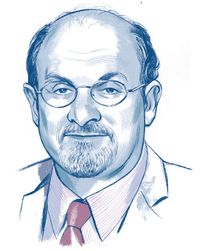
“Between the World and Me,” by Ta-Nehisi Coates, which I just finished and which impressed me; “Genghis Khan,” by Jack Weatherford, which is next up; “The White Album,” by Joan Didion, which is great to rediscover, and as good as I remembered it being; “The Heart of a Goof,” by P. G. Wodehouse, which can actually make me care about the game of golf, at least while reading it; and “Humboldt’s Gift,” by Saul Bellow, which seems to be on the night stand more or less permanently.
Who is your favorite novelist of all time?
“Of all time” is a long time. There are days when it’s Kafka, in whose world we all live; others when it’s Dickens, for the sheer fecundity of his imagination and the beauty of his prose. But it’s probably Joyce on more days than anyone else.
More here.
What does California have in common with a decades-old Saudi Arabian water mystery?
Nathan Halverson at PRI:
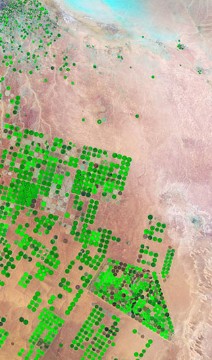
The springs fed the lush oases depicted in the Bible and Quran, and as the water disappeared, these verdant gardens of life were returning to sand.
“I remember flowing springs when I was a boy in the Eastern Province. Now all of these have dried up,” the head of the country’s Ministry of Water told The New York Times in 2003.
The springs had bubbled for thousands of years from a massive aquifer that lay underneath Saudi Arabia. Hydrologists calculated it was one of the world’s largest underground systems, holding as much groundwater as Lake Erie.
So farmers were puzzled as their wells dried, forcing them to drill ever deeper. They soon were drilling a mile down to continue tapping the water reserves that had transformed barren desert into rich irrigated fields, making Saudi Arabia the world’s sixth-largest exporter of wheat.
But the bounty didn’t last. Today, Saudi Arabia’s agriculture is collapsing. It’s almost out of water. And the underlying cause doesn’t bode well for farmers in places like California’s Central Valley, where desert lands also are irrigated with groundwater that is increasingly in short supply.
So what what happened? And what can the United States, China and the rest of the world learn from Saudi Arabia?
More here. [Thanks to Azeem Azhar.]
Robot swarms: scientists work to harness the power of the insect world
Sam Thielman in The Guardian:
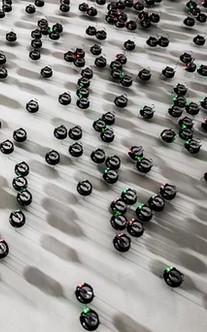
“Swarm robotics”, beyond being one of the scariest terms outside of a Terminator film, is the name roboticists give to robots that can coordinate behavior between multiple bodies, acting as a group. Thomas Schmickl of the Artificial Life Laboratory at the University of Graz in Austria, points out that robots as complex as humans or even dogs are a long way off, but the possibility in the insect world for simple animals to behave in ingenious ways as a group can provide some insight into how to simulate intelligence.
Schmickl’s current crop of robots work mostly underwater – his swarm of as many as 20 swimming robots, all named Jeff, imitates a shoal of fish. With the EU-supported Collective Cognitive Robots project, he hopes to develop not just hardware but algorithms and other software to make group behavior smarter.
“[M]onolithic, non-scaling technology is currently hitting the wall everywhere,” Schmickl said. He points out that computers now often have multiple central processing units, and says that swarms are not necessarily armies of robot bugs. “[W]e talk about the ‘internet of things’ – that might also be perceived as another kind of swarm.”
More here.
Istanbul and the coming neo-cosmopolitanism
Iason Athanasiadis in Al Jazeera:
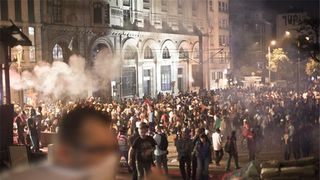
On the same day, the Wall Street Journal ran a beautifully-photographed feature titled The Discreet Charm of Istanbul, about a Turkish businesswoman, Asli Tunca, and her Belgian husband, Carl Vercauteren, who purchased a 19th century, five-story, 7,000sqr ft building with a garden in Istanbul's posh Beyoglu district and renovated it. The lady of the house called the house Hazz, Ottoman for “Enchantment”. The article concluded with Vercauteren saying that, “If there's a place on earth where God lives, it's Istanbul. The whole city has an energy and rich contrasts.”
After his cruel ordeal, TM would struggle to agree with the first part of Vercauteren's quote, but he might sympathise with his conclusion. TM and the Vercauterens inhabit the same city, yet they live in different worlds. Already an urban behemoth of 14 million, Istanbul continues its vertiginous ascent towards reclaiming its former cosmopolitan status.
More here.
the dead sea scrolls (BBC documentary)
The Great Gabbo (1929) – Erich von Stroheim
svetlana boym (1966 – 2015)
Existence as Resistance
Jenny Gathright in Harvard Magazine:
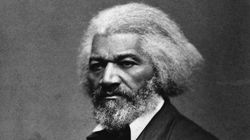
…In his 1861 address at Boston’s Tremont Temple, Frederick Douglass said, “Pictures, like songs, should be left to make [their] own way in the world. All they can reasonably ask of us is that we place them on the wall, in the best light, and for the rest allow them to speak for themselves.” The exhibit (which has minimal text accompanying the photos) seems to heed Douglass’s advice. Mussai wrote me, “The notion of the sitters’ gaze and a sense of agency, dignity, and beauty emanating from the portraits is crucial in the curatorial organization of the exhibition: especially as you sit in the final gallery, surrounded by the different members of the African Choir, each engaging the viewer directly.” To Mussai, the final gallery is a “space of transformative encounters, and a kind of sanctuary to appreciate, reflect, and imagine what their lives might have been like…and what our lives are like today.”
More here.
A Strangeness in my Mind
Max Liu in The Independent:
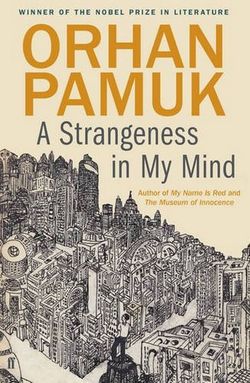
 are magnificent. If you haven’t enjoyed Pamuk’s books in the past then A Strangeness in My Mind might well be the one that wins you over.
Like James Joyce, Pamuk holds a looking-glass up to his city. Set between 1969 and 2012, his new novel describes the dizzying period when Istanbul’s population increased from three to 13 million. Weaving his way through this mutating landscape, where old meets new and east meets west, is Mevlut Karata, who, aged 12, migrates with his father from rural Anatolia. Mevlut sells yogurt, rice and boza (“a traditional Asian beverage made of fermented wheat, with a thick consistency, a pleasant aroma, a dark, yellowish colour, and low alcohol content”). He wanders “the poor and neglected cobblestone streets on winter evenings crying ‘Boo-zaa,’ reminding us of centuries past, the good old days that have come and gone.” At his cousin Korkut’s wedding, Mevlut is transfixed by the bride’s sister.
More here.
Sunday Poem
Sonnet 15
When I consider every thing that grows
Holds in perfection but a little moment,
That this huge stage presenteth nought but shows
Whereon the stars in secret influence comment;
When I perceive that men as plants increase,
Cheered and checked even by the self-same sky,
Vaunt in their youthful sap, at height decrease,
And wear their brave state out of memory;
Then the conceit of this inconstant stay
Sets you most rich in youth before my sight,
Where wasteful Time debateth with decay
To change your day of youth to sullied night,
And all in war with Time for love of you,
As he takes from you, I engraft you new.
.
Shakespeare
3QD Science Prize Finalists 2015
Hello,
On the right is a “trophy” logo that our finalists may choose to display on their own blogs.
So, here it is, the final list that I am sending to Nick Lane, who will select the 1st, 2nd, and 3rd prize winners from these: (in alphabetical order by blog or website name here)
- 3 Quarks Daily: On Optimal Paths & Minimal Action
- Curious Wavefunction: The fundamental philosophical dilemma of chemistry
- Nautilus: The Sound So Loud That It Circled the Earth Four Times
- No Place Like Home: When Hubble Stared at Nothing for 100 Hours
- Nova Next: From Discovery to Dust
- Roots of Unity: The Saddest Thing I Know about the Integers
- Scicurious: Serotonin and the science of sex
- Starts With A Bang: CONFIRMED: The Last Great Prediction Of The Big Bang!
- Thinking of Things: The Pain in the Brain Game
We'll announce the three winners on September 28, 2015.
Good luck!
Abbas
P.S. The editors of 3QD will not be making any comments on our deliberations, or the process by which we made our decision, other than to simply say that we picked what we thought were the best six posts out of the semifinalists, and added three others which we also liked.
Saturday, September 19, 2015
3QD Science Prize Semifinalists 2015
The voting round of our science prize (details here) is over. Thanks to the nominators and the voters for participating.
So here they are, the top 23 (there was a tie for the last six places), in descending order from the most voted-for:
Invariance: 3 myths of physics, especially in textbooks
- Nova Next: From Discovery to Dust
- Bekka S. Brodie: How Blow Flies find Corpses
- Thinking of Things: The Pain in the Brain Game
- Roots of Unity: The Saddest Thing I Know about the Integers
- Thinking of Things: All I Didn't Know About Cancer
- Companion Animal Psychology: How Does a Dog's Brain Respond to the Smell of a Familiar Human?
- 3 Quarks Daily: On Optimal Paths & Minimal Action
- Space Age Archaeology: Shadows on the Moon: an ephemeral archaeology
- 3 Quarks Daily: Artificially Flavored Intelligence
- 3 Quarks Daily: Fearing Artificial Intelligence
- Curious Wavefunction: The fundamental philosophical dilemma of chemistry
- Social Pulses: The public subsidy of scientific publishing monopolies
- Excursion Set: Destiny's Child
- Los Angeles Review of Books: Three Physicists Try Philosophy
- No Place Like Home: When Hubble Stared at Nothing for 100 Hours
- The Loom: Editing Human Embryos: So This Happened
- Wait But Why: The AI Revolution: The Road to Superintelligence
The editors of 3 Quarks Daily will now pick the top six entries from these, and after possibly adding up to three “wildcard” entries, will send that list of finalists to Nick Lane for final judging. We will post the shortlist of finalists tomorrow.
Interview: George Saunders and Ben Marcus
George Saunders and Ben Marcus in Granta:
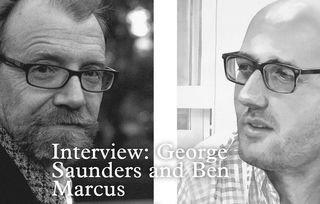
George Saunders: I thought your introduction to the anthology was so good – should be required reading for any workshop of young short-story writers. One of the things I admired about it is how succinctly you stated an essential and, I think, undervalued idea: that the primary storytelling goal is magic, achieved by mysterious means – that what we do isn’t ultimately an analytical or linear thing. And that its goal is . . . delight. You describe wrapping your young son up in a blanket and giving him a wild ride around the house and the pleasure he takes in this game: ‘he is asking to be amazed and afraid in this situation we’ve contrived’ – a perfect description of why we read fiction, and also a description that is very useful for writers – sort of freeing, to be given a charge like that (‘Go forth and delight!’). So I guess what I wanted to ask was: Did you always feel this way about fiction? That it is a sort of experiential machine, designed to do something to us? If not, how did you used to feel about it, and how did your current understanding of it evolve?
More here.