
Amanda Hess in the New York Times:
 In 2009, The New York Observer published “The Hipster Grifter,” an article identifying a small-time scammer prowling the Brooklyn scene, extracting cash from unsuspecting men. Her name was Kari Ferrell, and she was 22 and immensely charming. She left a flurry of notes in her wake, cocktail napkins etched with sexually explicit jokes, sometimes signed “Korean Abdul-Jabbar.” It worked as long as her marks didn’t Google her name and find that she was wanted for felony fraud in Utah.
Once exposed (and detained), Ferrell became a recurring obsession on Gawker.com. Napkins were auctioned on eBay. Nude photos appeared online without her consent. Though she briefly penned a jailhouse column, her motivations remained mysterious. She was flattened into a filthy erotic character, and then she disappeared.
In fact, Ferrell herself did not know why she was driven to lie and steal, but she seems to have spent much of the next 15 years figuring it out. She has re-emerged with “You’ll Never Believe Me,” her captivating, sharp and very funny memoir.
More here.
Enjoying the content on 3QD? Help keep us going by donating now.
 Watching television while using another smart device is so common that over
  Yascha Mounk: One of the things that I’ve really been trying to wrap my head around is the impact of AI. The launch of easily publicly accessible AI was now a little over two years ago, and it is clear that AI has tremendous capacities. At the same time, so far, its impact on the world has been a little bit more limited than might have been imagined two years ago. How do you see this panning out over the course of the next few years?
 Whether embedded in a hospital, a high school, a zoo, a welfare center, an army training camp, a public library, a city hall, or an entire neighborhood, his films are “stylistically ur-vérité,” as
 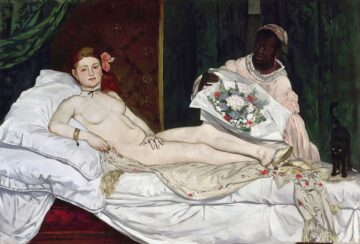 When Édouard Manet exhibited Olympia in the Salon of 1865, it unleashed a firestorm. Viewers were shocked by the subject matter—the sheer nakedness of the sitter—and by his formal treatment of the subject: critics lamented the lack of finish, the sharp contrast between light and dark, and, above all, the starkness of the model’s outward look at the viewer. For critics at the time, Manet’s shocking way with form went hand in hand with a sense of moral outrage, around gender and class. Olympia subtly but powerfully broke all the unspoken rules about the nude in painting and set the standard for a new form of revolutionary modern art.
 F
F H
H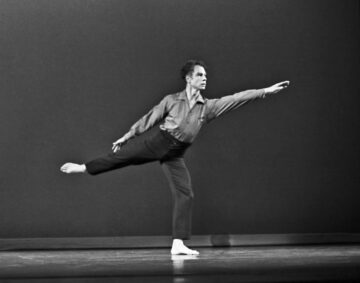 Now I’ll never have a chance to impress Arlene Croce.
 It brings me no joy to report the rebirth (or the renewed undeadness) of the zombie literary movement known as OuLiPo.
 P
P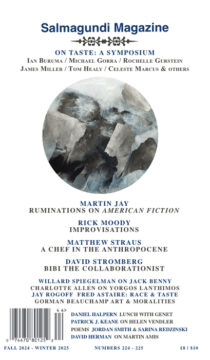 ROCHELLE GURSTEIN: In the course of writing my new book (on the ephemeral life of the classic in art), I was heartened to find that a standard of taste could be established when a work of art is felt to exemplify primary aspirations and excellences. Joshua Reynolds set out this understanding in his Discourses on Art (1790) when he located the standard of taste in “the authority and practice of those whose work may be said to have been consecrated by having stood the test of ages.” From the sixteenth century until the nineteenth, ancient sculpture such as the Venus de’ Medici and the Apollo Belvedere, which had been unearthed during the great building projects in Rome during the Renaissance, and also those artists who had most perfectly imitated them—Raphael and Michelangelo—met this test. These “true examples of grandeur,” as Reynolds called them, were regarded as models for artists to imitate and as the indisputable standard of taste. Exemplar and standard were synonymous. And as long as the practice was in good working order and artists and viewers felt part of its intellectual and aesthetic continuum, they could confidently judge works of art, both present and past.
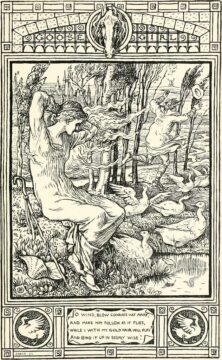 In an 1846 letter to the Athenaeum, English writer William Thoms coined a term, “folklore.” He wondered whether some new scholar might do for British culture what Jacob Grimm had done for German. Jacob was the more prominent of the Grimms, but his life and work were inconceivable without the companionship and contributions of his younger brother, Wilhelm. The work for which they are most celebrated today, Kinder- und Hausmärchen (Children’s and Household Tales), was a collaboration in which Wilhelm eventually played the dominant editorial role. The two brothers shared a bed when young, and lived side by side for most of their lives, pursuing some of the most prodigious scholarship imaginable. Since their deaths (Wilhelm in 1859, Jacob in 1863), so many legends have accrued about their lives and works that they almost seem fairy-tale figures themselves, quaint Hobbit-like creatures trawling the peasantry for stories. Nothing could be further from the truth, which is why Ann Schmiesing’s brief, eloquent and moving biography, The Brothers Grimm, is bound to prove enlightening to English-language readers.
 W
W T
T