
Ed Simon at Hyperallergic:

When the Hollywood sign was first unveiled in 1923, it read “Hollywoodland.” Surrounded by coastal sage scrub, chaparral, and invasive and highly flammable eucalyptus trees, that kitschy, iconic, and slightly absurd marker consisting of 50-foot-tall letters spread across nearly 500 feet atop Mount Lee has signified Los Angeles and its attendant associations for more than a century. But in some ways, that missing syllable gestures toward an even deeper truth about this region. The word “Hollywoodland” is slightly fantastical, evoking a southern California that’s as mythic as it is actual — a fitting moniker for the forge of American dreams, a place configured to generate spectacle and narrative, the maker of cellulose nitrate chimeras in the form of physical film often as combustible as the illusions it conveyed. A kingdom of imagery for an art form that, if not invented by Americans, was at least stoked to its potential here, at the western terminus of the continent. In 1923, Los Angeles was a dry, desert city of Art Deco skyscrapers and Modernist homes clinging to the hillsides of her craggy neighborhoods, an urban landscape of coyotes and bobcats. Today, the city of Los Angeles is home to nearly four million people, and the county a stunning 10 million. And it’s on fire.
more here.
Enjoying the content on 3QD? Help keep us going by donating now.
 During the past three decades, more people have begun viewing our ‘global’ world as a cursed fate. With its suffocating time-space compression, globalisation seems to have uncoupled us from the logic and flow of history. Our suspicious, bastard identities – patched together from a mishmash of cultures – appear incompatible with our ancestors’ ‘authentic’ traditions and ways of life. We have become strangers to the places they called home, to the ways they dressed, ate or communicated with one another. And, with no template for how to live and no experience to learn from, the deafening siren songs of anti-globalisation movements are now luring us back into the safer identities and boundaries of a lost, golden past.
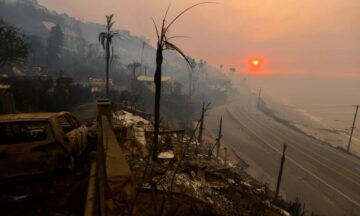 It was only last month that the Franklin fire, fanned by the dry Santa Ana winds from the east gusting up to 50 miles an hour, burned 4,000 acres around Malibu in 48 hours. The Station fire burned
 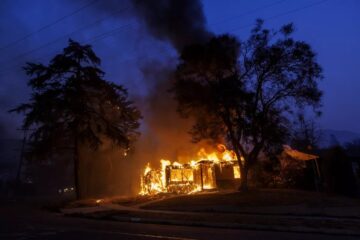 “When you study the destruction in Pacific Palisades and Altadena, note what didn’t burn — unconsumed tree canopies adjacent to totally destroyed homes,” he said. “The sequence of destruction is commonly assumed to occur in some kind of organized spreading flame front — a tsunami of super-heated gases — but it doesn’t happen that way.
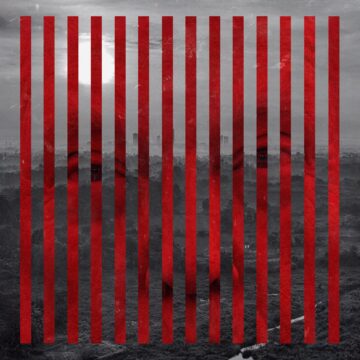 Donald Trump is returning, artificial intelligence is maturing, the planet is warming, and the global fertility rate is collapsing.
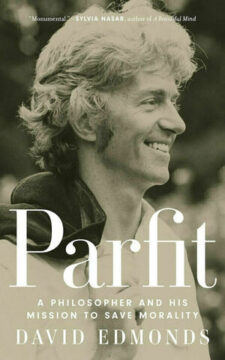 David Edmonds’ Parfit belongs to a burgeoning genre. There are the two recent collective biographies of Anscombe, Foot, Midgley and Murdoch (by Benjamin Lipscomb and by Claire Mac Cumhaill and Rachael Wiseman). There are M.W. Rowe’s J.L. Austin: Philosopher and D-Day Intelligence Officer and Nikhil Krishnan’s A Terribly Serious Adventure. Earlier works include Ray Monk’s Russell and Wittgenstein volumes, Tom Regan’s Bloomsbury’s Prophet, and Bart Schultz’s books on Sidgwick and the other classical utilitarians. And Edmonds himself is inter alia the author of The Murder of Professor Schlick and the coauthor of Wittgenstein’s Poker.
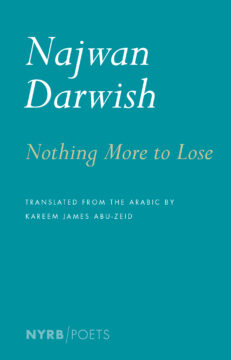 “No one will know you tomorrow. / The shelling ended / only to start again within you,” writes the poet Najwan Darwish in his new collection. Darwish, who was born in Jerusalem in 1978, is one of the most striking poets working in Arabic today. The intimate, carefully wrought poems in his new book, , No One Will Know You Tomorrow, translated into English by Kareem James Abu-Zeid, were written over the past decade. They depict life under Israeli occupation—periods of claustrophobic sameness, wartime isolation, waiting. “How do we spend our lives in the colony? / Cement blocks and thirsty crows / are the only things I see,” he writes. His verses distill loss into a few terse lines. In a poem titled “A Brief Commentary on ‘Literary Success,’ ” he writes, “These ashes that were once my body, / that were once my country— / are they supposed to find joy / in all of this?” Many poems recall love letters: to Mount Carmel, to the city of Haifa. To a lover who, abandoned, “shares my destiny.” He speaks of “joy’s solitary confinement” because “exile has taken / everyone I love.” Irony and humor are present (“I’ll be late to Hell. / I know Charon will ask for a permit / to board his boat. / Even there / I’ll need a Schengen visa”), but it is Darwish’s ability to convey both tremulous wonder and tragedy that make this collection so distinct.
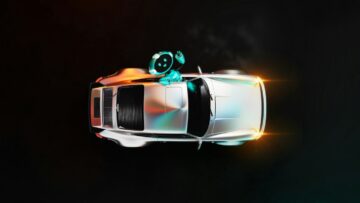 Interacting with AI chatbots like ChatGPT can be fun and sometimes useful, but the next level of everyday AI goes beyond answering questions: AI agents carry out tasks for you.
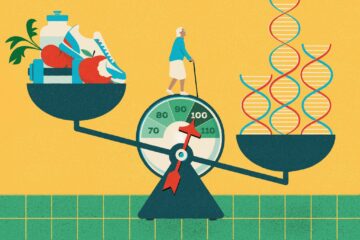 When Dr. Nir Barzilai met the 100-year-old Helen Reichert, she was smoking a cigarette. Dr. Barzilai, the director of the Institute for Aging Research at the Albert Einstein College of Medicine, recalled Mrs. Reichert saying that doctors had repeatedly told her to quit. But those doctors had all died, Mrs. Reichert noted, and she hadn’t. Mrs. Reichert lived almost another decade before passing away in 2011.
 F
F