Doing it Wrong

41ftvxnxT7L._SX327_BO1,204,203,200_

Stoya in The Smart Set:

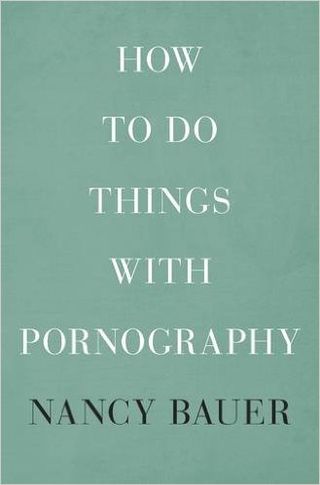
In How to Do Things with Pornography, feminist philosopher Nancy Bauer refers to a specific idea of pornography: the inherently harmful boogey creature that anti-pornography feminists have railed against since the 70s. A significant portion of her book is spent discussing the flaws in the anti-porn rhetoric of both Catharine MacKinnon and Rae Langton. All of which is in the service of what seems to be the true focus of the book: arguing against philosophers’ interpretations of J.L. Austin’s How to Do Things with Words.

Austin’s philosophical work centered on language, specifically focusing on illocutions, perlocutions, and speech acts — uses of language where saying something is also doing. In the 55 years since Austin’s death, a number of anti-pornography feminists have referenced Austin’s work in their attempts to undermine the protection that the First Amendment provides adult films and the people who make them by framing it as something other than speech. Speech has First Amendment protection, but if pornography is other, that issue becomes less clear. Bauer disagrees with some of these finer points.

Declaring that the idea of pornography as a form of speech is overly simplistic, Bauer asks a number of questions:

“Who is doing the speaking? The subjects of the photographs? (And are they subjects or objects—or both?) The pornographers? And what exactly is being said? And to whom?”

Instead of attempting to answer the questions, she expresses surprise that “none of the people on either side of the pornography debates appears to be interested in doing [this work].” Bauer suggests the reason that these questions are not explored is due to the amount of pornography one would need to view and the amount of introspection one would need to have regarding that pornography, as well as awareness of one’s feelings on it. This would be an understandably distasteful task for people who believe pornography is inherently abusive towards women as a gender.

More here.

The Truth in Midair

The-walk_jpg_600x470_q85

J. Hoberman over at the NYRB's daily blog:

Like a reel of film coursing through a movie projector, the history of motion pictures rolls on—if increasingly without the projector or the film.

Two twenty-first century phenomena have changed the way moving pictures are made and perceived. The first is the accelerating use of digital technology and the inexorable rise of a cyborg cinema that, by combining animated and photographic images, compromises the direct relationship to reality that had long been the medium’s claim to truth. The second is the trauma of September 11, 2001, which for many provided the ultimate movie experience that was more than a movie—spectacular destruction, broadcast live, and watched by an audience, more or less simultaneously, of billions.

Both events inform The Walk, the new 3-D movie by Robert Zemeckis that recounts and reconstructs the French aerialist Philippe Petit’s high-wire stroll between the Twin Towers of the World Trade Center in 1974. Although amply justified by its thrilling twenty-minute set piece, The Walk (unlike Gravity, Alfonso Cuarón’s marvelous 2013 exploration of the 3-D void) is not a fully sustained experience. But it is a milestone in the development of digitalized cinema and the memory of 9/11.

Zemeckis is an immensely successful commercial filmmaker whose oeuvre has been characterized by recurring concerns. These include a preoccupation with the ways the American past has been made malleable by the media, mainly TV; a not unrelated fascination with the digital reshaping (or recontextualizing) of the human form; and a fondness for isolated protagonists who develop obsessive bonds with imagined entities.

Back to the Future (1985), Zemeckis’s best-loved movie, is at once celebratory and parodic, with its naïvely oedipal hero, airbrushed sense of the 1950s, and theme-park notion of America. It is a crucial Reagan-era text; Reagan himself quoted the movie in his 1986 State of the Union address when he proclaimed, “where we are going there are no roads.” (Garry Wills referred to Back to the Future several times in a chapter of Reagan’s America that speaks of our fortieth president as “America’s ‘remembered’ self.”)

More here.

I’m Fine How I Am: A Response to Randall Kennedy’s Defense of Respectability Politics

Fatherson-web

Christopher Lebron in Boston Review:

On any given sunny afternoon, or appropriately dusky early evening, when the air seems filled with possibility and release, you can hear me coming a block away. Depending on your socio-cultural background you might not like what you hear. See, my car has thirteen speakers, two of which are subwoofers, and I get a great deal of gratification playing my rap music loud. I won’t reproduce any lyrics here, but suffice it to say, my preferred urban poets don’t always say very ‘respectable’ things. I often get side-eye from the police (playing my music the way I do is practically an open invitation to law enforcement to harass me), and from time to time white mothers and fathers clutch their sons’ and daughters’ hands a bit more tightly as I approach, leaning my lean, smirking my smirk (not at them, mind you).

I’m also the guy with a PhD from M.I.T and a faculty position at Yale. I’ve written a book that has won an important award in my field of political theory, I’ve published academic articles in good journals, and I’ve written for the New York Times as well as Boston Review. This despite having been on welfare, having collected unemployment, having been raised mostly poor, by a father without a high school education and a mother who never set foot in a university. I was the first in my entire extended family to get a four-year degree, much less a PhD, much less a PhD from the likes of M.I.T. Despite the fact that I’ve accomplished and produced more than many white counterparts, I’ve got to work hard to get what they tend to acquire with relative ease, which I do.

So, am I the that’s-what’s-wrong-with-black-people pariah or the that-goes-to-show-you-what-a-lot-of-hard-work-can-get-you-racism-be-damned exemplar? Am I respectable, or not? Some black elites believe I should care what you think. I don’t.

Being raced as I am, the politics of respectability should be a serious contender for my ethical commitments. But it is a position I find almost as confusing as figuring out what it would take for me simply to live without constant pre-meditation to get what others have in this society. In his recent Harper’s piece, ”Lifting As We Climb: A Progressive Defense of Respectability Politics,” Harvard professor Randall Kennedy offers about as coherent a defense of respectability politics as one can find. Yet, the whole position seems deeply muddled to me, despite Kennedy’s erudition and exceedingly clear and direct prose. However, I don’t think the fault is Kennedy’s. He is, so far as I can tell, accurately tracking a number of considerations that have beset the black intellectual and political tradition over the past 150 years.

More here.

franzen on re-claiming conversation in the digital age

1004-Franzen-Parks-master675Jonathan Franzen at the New York Times:

Sherry Turkle is a singular voice in the discourse about technology. She’s a skeptic who was once a believer, a clinical psychologist among the industry shills and the literary hand-wringers, an empiricist among the cherry-picking anecdotalists, a moderate among the extremists, a realist among the fantasists, a humanist but not a Luddite: a grown-up. She holds an endowed chair at M.I.T. and is on close collegial terms with the roboticists and affective-computing engineers who work there. Unlike Jaron Lanier, who bears the stodgy weight of being a Microsoft guy, or Evgeny Morozov, whose perspective is Belarussian, Turkle is a trusted and respected insider. As such, she serves as a kind of conscience for the tech world.

Turkle’s previous book, “Alone ­Together,” was a damning report on human relationships in the digital age. By observing people’s interactions with robots, and by interviewing them about their computers and phones, she charted the ways in which new technologies render older values obsolete. When we replace human caregivers with robots, or talking with texting, we begin by arguing that the replacements are “better than nothing” but end up considering them “better than anything” — cleaner, less risky, less demanding.

more here.

more patti smith

13pattismith_PA2631271David L. Ulin at The LA Times:

First, let's clear up a misconception: Patti Smith's “M Train” is not a sequel to her 2010 National Book Award-winning memoir “Just Kids.” In fact, “M Train” is not a memoir at all, except in the loosest sense — a book of days, a year in the life, a series of reflections, more vignettes than sustained narrative. By saying that, I don't mean to be critical, for vignettes are what Smith does best. Just listen to “Land” and “Birdland,” or read “Woolgathering,” originally published in 1992 as a limited-edition handbook and reissued 19 years later in expanded form.

“Woolgathering” may be my favorite of Smith's books, smart and subtle and full of inference, existing in the middle ground between prose and poetry, memory and daily life. When she writes, as she does there, of having “no task more exceptional than to rescue a fleeting thought, as a tuft of wool, from the combo of the wind,” she is describing her entire aesthetic, in which the internal becomes externalized, or vice versa, and we find ourselves moving through a landscape that is both utterly real and also strangely magical, one defined by myth and icons, “a silk of souls,” she sings in “Paths That Cross,” “that whispers to me.”

more here.

‘Ted Hughes: The Unauthorised Life’

829be3f6-c702-448b-bb5e-873358a5ce7cJohn Sutherland at the Financial Times:

Possessed of insatiable sexual appetite and film-star looks, Hughes was flagrantly unfaithful. Plath was, his supporters allege, unstable. His most extended adultery was with the poet Assia Wevill — his dark lady. There was, she said, an “animal thing” between them. He was unfaithful to Assia, and others, eventually choosing to marry Carol Orchard, a young woman who had minded his children. In a ghastly echo of Plath’s death, the betrayed Wevill had killed herself by gas oven. She took her and Hughes’s child, Shura, with her. “All the women I have anything to do with seem to die”, said Hughes.

It is too easy to see Hughes as a villain. Bate avoids such judgment and mounts a subtly constructed explanation (it is not an apology). Hughes, Bate points out, “believed that all artistic creativity came from a wound”. The wound in his late work, from Crow (1970) onwards, was, of course, Plath’s death.

Bate draws, as closely as he is legally able, on Hughes’s dream journals to argue that he was haunted by her. The image that recurs — one that was played with by Ted and Sylvia in their early relationship — is Wuthering Heights.

more here.

Saturday Poem

The Snake Handler

—After Dennis Covington

I’m not long for this
world, the young man

said nonchalantly.
The next night I

watch him at church. Why
would one take up

death, suicide? He
grasps the rattler

from the wooden box.
Horrified, I

can’t look away. He
lifts the serpent

slithering, tongue out
straight in my face—

all the madness and
insanity

of my faith I’ve tried
to keep hidden.
.

by Will Wellman
from Echotheo Review
4/30/2014

DEAR SOCIETY, PLEASE CHANGE

Jennifer Egbebike in The Feminist Wire:

Dear Guy-on-the-Subway,

Are you familiar with the term manspreading?*

BusWhile I struggle to keep my legs crossed and take up as little space as possible as a common courtesy to the other passengers on this train, it’s a wonder that you’re so comfortable taking up as much space as you possibly can. I bet you don’t even notice. You must just have some sort of subconscious entitlement to space that persuades you to mark your territory and display your “dominance.” We have been taught to act in opposites. I’ve tried to sit like you once before, and was quickly scolded to close my legs and behave more “lady-like.”

Why do we teach women to take up as little space as possible while we teach men the opposite?

More here.

Salman Rushdie’s ‘Two Years Eight Months and Twenty-Eight Nights’

Marcel Theroux in The New York Times:

SalmanSalman Rushdie’s literary immortality is assured. His second novel, “Midnight’s Children,” lit up fiction in English with the exuberance of a Diwali firework. It was uniquely honored, winning both the prestigious Man Booker Prize and the Booker of Bookers, for the best novel in the prize’s history. With his fourth novel, “The Satanic Verses,” Rushdie, like the sorcerer’s apprentice, inadvertently conjured a jinni of intolerance.

…As the storytelling grows more manic, what comes through clearly — much too clearly — is the novel’s controlling theme: an allegory about humanity’s struggle between superstition and reason. “The battle against the jinn was a portrait of the battle within the human heart, which meant that the jinn were somehow abstractions as well as realities, and that their descent to the lower world served to show that world what had to be eradicated within itself, which was unreason itself.” The book’s title is a nod to “One Thousand and One Nights,” but this kind of overt commentary is a long way from the ­authorlessness and economy of fairy tales, which never lecture and whose bareness — envious stepmother, noble prince, dark forest — extends a more subtle invitation to the reader. The most felt things in the book are about Geronimo the gardener, lonely and aging in an unfamiliar city. He is doubly uprooted, separated both from the earth itself and the Indian birthplace that he loved. The prose quickens with specific detail when he mourns the loss of his childhood home: “He wished he had never become detached from the place he was born, wished his feet had remained planted on that beloved ground, wished he could have been happy all his life in those childhood streets, and grown into an old man there and known every paving stone, every betel-nut vendor’s story, every boy selling pirated novels at traffic lights.” It’s a huge relief when Geronimo finds himself back on more solid ground; it will be an ever bigger one when his author does too.

More here.

Friday, October 2, 2015

The Trouble with Theories of Everything

Lawrence M. Krauss in Nautilus:

ScreenHunter_1408 Oct. 02 15.37Whenever you say anything about your daily life, a scale is implied. Try it out. “I’m too busy” only works for an assumed time scale: today, for example, or this week. Not this century or this nanosecond. “Taxes are onerous” only makes sense for a certain income range. And so on.

Surely the same restriction doesn’t hold true in science, you might say. After all, for centuries after the introduction of the scientific method, conventional wisdom held that there were theories that were absolutely true for all scales, even if we could never be empirically certain of this in advance. Newton’s universal law of gravity, for example, was, after all, universal! It applied to falling apples and falling planets alike, and accounted for every significant observation made under the sun, and over it as well.

With the advent of relativity, and general relativity in particular, it became clear that Newton’s law of gravity was merely an approximation of a more fundamental theory. But the more fundamental theory, general relativity, was so mathematically beautiful that it seemed reasonable to assume that it codified perfectly and completely the behavior of space and time in the presence of mass and energy.

The advent of quantum mechanics changed everything. When quantum mechanics is combined with relativity, it turns out, rather unexpectedly in fact, that the detailed nature of the physical laws that govern matter and energy actually depend on the physical scale at which you measure them. This led to perhaps the biggest unsung scientific revolution in the 20th century: We know of no theory that both makes contact with the empirical world, and is absolutely and always true. (I don’t envisage this changing anytime soon, string theorists’ hopes notwithstanding.) Despite this, theoretical physicists have devoted considerable energy to chasing exactly this kind of theory. So, what is going on? Is a universal theory a legitimate goal, or will scientific truth always be scale-dependent?

More here.

Kissinger poisoned the Middle East: America is living in a quagmire of his making

Greg Grandin in Salon:

ScreenHunter_1407 Oct. 02 14.16The only person Henry Kissinger flattered more than President Richard Nixon was Mohammad Reza Pahlavi, the Shah of Iran. In the early 1970s, the Shah, sitting atop an enormous reserve of increasingly expensive oil and a key figure in Nixon and Kissinger’s move into the Middle East, wanted to be dealt with as a serious person. He expected his country to be treated with the same respect Washington showed other key Cold War allies like West Germany and Great Britain. As Nixon’s national security adviser and, after 1973, secretary of state, Kissinger’s job was to pump up the Shah, to make him feel like he truly was the “king of kings.”

Reading the diplomatic record, it’s hard not to imagine his weariness as he prepared for his sessions with the Shah, considering just what gestures and words would be needed to make it clear that his majesty truly mattered to Washington, that he was valued beyond compare. “Let’s see,” an aide who was helping Kissinger get ready for one such meeting said, “the Shah will want to talk about Pakistan, Afghanistan, Saudi Arabia, the Gulf, the Kurds, and Brezhnev.”

During another prep, Kissinger was told that “the Shah wants to ride in an F-14.” Silence ensued. Then Kissinger began to think aloud about how to flatter the monarch into abandoning the idea. “We can say,” he began, “that if he has his heart set on it, okay, but the President would feel easier if he didn’t have that one worry in 10,000 [that the plane might crash]. The Shah will be flattered.” Once, Nixon asked Kissinger to book the entertainer Danny Kaye for a private performance for the Shah and his wife.

The 92-year-old Kissinger has a long history of involvement in Iran and his recent opposition to Barack Obama’s Iran nuclear deal, while relatively subdued by present Washington standards, matters. In it lies a certain irony, given his own largely unexamined record in the region.

More here.

Why one of Asia’s most open societies keeps turning to military rule

HA047__AdamFerguson-Harpers-1506-1Ian Buruma at Harper's Magazine:

As military coups go, Thailand’s putsch on May 22, 2014, was rather polite — no mass imprisonments, no stadiums full of students tortured and shot. The toppled prime minister, Yingluck Shinawatra, was detained for only three days. Before the coup, there had been months of street clashes between loyalist “red shirts” and opposition “yellow shirts,” and now General Prayuth Chan-ocha’s junta promised to “restore happiness to the people.”

There have since been some public protests against martial law. Students were arrested in Bangkok for flashing a three-finger salute copied from The Hunger Games, the novel and attendant movie about a rebellion against a fictional dictatorship. Modest three-finger student demonstrations have also taken place in Khon Kaen, a city in the rural northeast that is considered the main red-shirt stronghold. The salute is now banned in Thailand, as is public reading of George Orwell’s 1984. But so far, opposition to the junta has not found a popular voice — no great demonstrations, no acts of violence.

It is easy, under such relatively tranquil conditions, not to take Thailand and its coups entirely seriously. Military takeovers occur with some regularity there. Eight years before Yingluck Shinawatra was deposed, her brother, Thaksin Shinawatra — an ex-policeman who made a fortune in the cell phone business before being elected prime minister in 2001 — was similarly removed from office.

more here.

How Picasso the Sculptor Ruptured Art History

09-picasso-chair.w529.h352Jerry Saltz at New York Magazine:

We don’t think of Picasso as a sculptor, but we should. He was a great one. In the years after that summer with Braque, Picasso performed a vivisection of 500 years of Western spatial perspective. For much of the 19th century, artists like Constable, Corot, Courbet, Manet, and many others tried to break the rigid illusionistic strictures and the structure of vaunted Renaissance perspective. Yet no matter what artists did, including Monet — breaking down every brushstroke into a physical thing that functioned at once as a mark and a picture, each one being absolutely equal to every other stroke, all but doing away with illusionistic space altogether — still, the borders and surfaces of the object reasserted themselves. With collage and assemblage, Picasso finally jarred space from a kind of 500-year sleeping sickness, a system that had silted up, impeded, and confined vision. With these works, Picasso broke forever from Renaissance tradition into modernist, Einsteinian relativity, the paradoxical space where things exist in different dimensions at once. It’s important to remember, of course, that Renaissance perspective was maniacally practiced only in the West. In Asia, Africa, and most of the rest of the world, systematic illusionistic space never caught on. In the West, however, Picasso (and the others) set space free.

Now, for the first time since the Museum of Modern Art’s epic 1967 “The Sculpture of Picasso,” MoMA returns to this fertile delta with more than 150 of his slabbed, shattering, avian-shaped, hallucinogenically assembled sculptures. This is a fantastic show.

more here.

Aimé Césaire and Léopold Senghor: a radical vision

GettyImages-478479384-960x515Gary Wilder at Aeon Magazine:

From the perspective of power politics, Césaire and Senghor’s projects might be regarded as utopian schemes with little hope of being realised, out of sync as they were with the nationalist direction in which history seemed to be moving. They were not revolutionary nationalists, and revolutionary nationalism carried the day. Their untimely belief that decolonisation might not require national independence and that self-determination might not require state sovereignty helps to explain why Césaire and Senghor are neglected figures.

But from the present vantage point, their visions seem more pertinent than ever. Since the end of the Cold War, the limits of state sovereignty and the failures of internationalism have become more evident. Private economic actors, unaccountable international agencies, and technocratic experts have superseded state and democratic sovereignties. The failed promises of national self-determination and universal human rights are underscored by Fortress Europe’s handling of the Mediterranean refugee crisis, or the Greek debt crisis. The bankruptcy of international law is revealed by the Israeli occupation of Palestine and Russia’s annexation of Eastern Ukraine, not to mention the new forms of US imperialism that are legitimised through UN‑sanctioned policies regarding human rights, humanitarianism, and the ‘responsibility to protect’. The absence of a vital framework for internationalist solidarity is clear given the left’s inability to effectively challenge Islamic State’s assaults on Syrian Kurds.

more here.

The Black Family in the Age of Mass Incarceration

Ta-Nahisi Coates in The Atlantic:

“lower-class behavior in our cities is shaking them apart.”

BlackBy his own lights, Daniel Patrick Moynihan, ambassador, senator, sociologist, and itinerant American intellectual, was the product of a broken home and a pathological family. He was born in 1927 in Tulsa, Oklahoma, but raised mostly in New York City. When Moynihan was 10 years old, his father, John, left the family, plunging it into poverty. Moynihan’s mother, Margaret, remarried, had another child, divorced, moved to Indiana to stay with relatives, then returned to New York, where she worked as a nurse. Moynihan’s childhood—a tangle of poverty, remarriage, relocation, and single motherhood—contrasted starkly with the idyllic American family life he would later extol. “My relations are obviously those of divided allegiance,” Moynihan wrote in a diary he kept during the 1950s. “Apparently I loved the old man very much yet had to take sides … choosing mom in spite of loving pop.” In the same journal, Moynihan, subjecting himself to the sort of analysis to which he would soon subject others, wrote, “Both my mother and father—They let me down badly … I find through the years this enormous emotional attachment to Father substitutes—of whom the least rejection was cause for untold agonies—the only answer is that I have repressed my feelings towards dad.”

More here.

Rare Praise from a Philosopher: Jürgen Habermas on the Refugee Crisis

Juergen-habermas-by-Axel-Schmidt-ddp

Moritz Koch in Handelsblatt (image: Alex Schmidt, DDP):

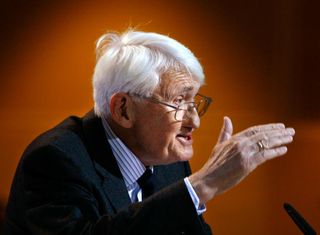
Handelsblatt: Professor Habermas, you criticized the German government for behaving like the “Europe’s chief disciplinarian” during the Greece debt crisis. Has Chancellor Merkel redeemed herself with her generosity in the refugee crisis?

Jürgen Habermas: I’m as surprised as I am delighted. For years, I haven’t been thought as highly of our government as I have since late August. Now, here in America, I keep referring to something she said which also keeps being mentioned in the German press.

You mean when she said, “we can manage?”

No, I mean her statement, “If we also have to apologize for showing a friendly face in emergency situations, then this is not my country.” That’s a very strong sentence. Who would have expected that from Ms. Merkel, who has stuck to pragmatic, hesitant statements, oriented towards popular opinion for years? That was a decisive, normative sentence. I was so happy when I read that. And it wasn’t only Ms. Merkel, it was the whole government, and supported by different statements, visits to Heidenau and so on.

You’re all enthusiasm…

What delights me is that once our government finally made a normative statement and took a stand – and then the public reacted in an almost fairy tale way.

You said Berlin was taking a “hegemonic attitude” with Greece, for the first time in the post war era. Now, the right wing is making this same criticism about immigration policy, calling Ms. Merkel’s welcome culture “moral imperialism.”

Well, it’s not surprising that there’s been a reaction to Germany’s decisive policy of opening the borders and our emphasis on the normative content of our already restricted right to asylum. But I can’t take that seriously, the idea that this policy is being associated with a hegemonic attitude from Germany. It’s true that Ms. Merkel’s immigration initiative was a solo effort – followed by a justifiable attempt to create a shared European response.

More here.

Particular brain connections linked to positive human traits

From Science Daily:

HappyA team of scientists led by the University's Centre for Functional MRI of the Brain has investigated the connections in the brains of 461 people and compared them with 280 different behavioural and demographic measures that were recorded for the same participants. They found that variation in brain connectivity and an individual's traits lay on a single axis — where those with classically positive lifestyles and behaviours had different connections to those with classically negative ones. The findings are published in Nature Neuroscience. The team used data from the Human Connectome Project (HCP), a $30m NIH-funded brain imaging study led by Washington, Minnesota and Oxford Universities. The HCP is pairing up functional MRI scans of 1,200 healthy participants with in-depth data gained from tests and questionnaires. “The quality of the imaging data is really unprecedented,” explains Professor Stephen Smith, who was the lead author of the paper. “Not only is the number of subjects we get to study large, but the spatial and temporal resolution of the fMRI data is way ahead of previous large datasets.” So far, data for 500 subjects have been released to researchers for analysis. The Oxford team took the data from 461 of the scans and used it to create an averaged map of the brain's processes across the participants. “You can think of it as a population-average map of 200 regions across the brain that are functionally distinct from each other,” explains Professor Smith. “Then, we looked at how much all of those regions communicated with each other, in every participant.”

…They found one strong correlation that relates specific variations in a subject's connectome with their behavioural and demographic measures. Interestingly, the correlation shows that those with a connectome at one end of scale score highly on measures typically deemed to be positive, such as vocabulary, memory, life satisfaction, income and years of education.

More here.

Thursday, October 1, 2015

Why People Who Read Should Care About Emojis

Jonathan Kalb in The Brooklyn Rail:

Emojis are an infantilization of language in the name of amusement. A New Yorkmagazine cover story last year compared them admiringly to ancient hieroglyphs without mentioning that civilization bounded forward after advancing from pictographs to symbolic language. Emojis are also a flagrant and increasingly common means of pandering to the young. What else are the White House’s emoji-peppered online notices to millennials about the Affordable Care Act, or The Guardian’s emoji translation of Obama’s 2015 State of the Union address?

The nadir of emoji pointlessness, in my view, is Fred Benenson’s Emoji Dick, a 736-page, crowd-sourced emoji translation of Melville’s Moby-Dick that was accepted into the Library of Congress in 2013. It beggars belief that anyone but Benenson has ever read this book cover to cover.

Small reason was there to doubt, then, that ever since that almost fatal encounter, Ahab had cherished a wild vindictiveness against the whale, all the more fell for that in his frantic morbidness he at last came to identify with him, not only all his bodily woes, but all his intellectual and spiritual exasperations.

The White Whale swam before him as the monomaniac incarnation of all those malicious agencies which some deep men feel eating in them, till they are left living on with half a heart and half a lung.

I am obviously an emoji skeptic, yet I found myself drawn to investigate them for deeply personal reasons. I have lived for more than a decade with facial palsy that distorts my smile and causes a lot of social misunderstanding. I employ a raft of improvised strategies to clarify the emotional intentions behind my quirky facial expressions, and emojis, I realized, were doing something similar for normal people. These tiny cartoonish faces and glyphs were deployed as digital masks. Millions were grasping at them to elucidate their feelings because their addiction to faceless communication modes had put them at a comparable disadvantage to mine.

More here.

German hegemony: Unintended and unwanted

Streeck_commoncurr_468w

Wolfgang Streeck in Eurozine:

The slogan with which the German government eventually sold the euro to the German electorate became: “The euro – as stable as the mark”. Germany's partners signed the treaty in the end, presumably hoping to amend it later under the pressure of economic realities, if not on paper then in practice. It helped that the 1990s were a period when, issuing from the United States, fiscal consolidation was a common political objective for the countries of OECD capitalism, in the context of financialization and the transition to a neoliberal, non-Keynesian money regime. It was in the spirit of the era to commit to a ceiling on public debt of sixty per cent of GDP and to budget deficits that would never exceed three per cent; financial markets would have looked with suspicion upon any country refusing to fall into line.

Today it is Germany, together with countries like the Netherlands, Austria or Finland, which is reaping the benefits of the EMU. But it is important not to forget that this has only been so since the financial collapse of 2008. During the first years of EMU, Germany was “the sick man of Europe”, and monetary union had a lot to do with it (Scharpf 2011). The common interest rate set by the European Central Bank, which had to take into account the economies of all member countries, was too high for a low-inflation political economy like Germany. A possible solution might have been wage increases forced by aggressive trade unions. In a heavily industrialized, export-dependent country like Germany, however, this would have meant not just fewer exports but also, in a time of increasing capital mobility, a drain of jobs to foreign countries. This explains the, to many outside observers, mysterious wage moderation of German unions since the early 2000s. By comparison, the more inflationary economies of the Mediterranean enjoyed negative real interest rates, coupled with a dramatic fall in the cost of public borrowing – the latter on the assumption by capital markets, encouraged by the European Commission, that with a common currency there would also be some sort of common responsibility for the solvency of member states. The result was a boom in the South and stagnation, along with high unemployment and growing public debt, in Germany.

That situation was reversed in 2008, and contrary to popular neoliberal mythology this had little to do with the “Hartz reforms”. They made a dent in public spending, especially as regards unemployment insurance, and opened the door to an expansion of low-wage employment outside of the core sectors of German economic strength. What really mattered was that the German economy, traditionally driven by foreign demand and due to its perennial “over-industrialization”, was in a position after 2008 to serve global markets in the high-quality manufacturing sector. As a result, it suffered much less from the fiscal crisis and the breakdown of credit than more domestic demand-led EMU countries.

More here.