Updike’s naked poetry

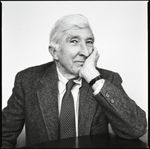
UpdikeBrad Leithauser at The New Criterion:

The body of his verse gives us a remarkably full autobiographical portrait. In this, he’s somewhat unusual. American poetry in the twentieth century abounded in wonderful poets from whose collected poetry it would be hard to concoct even a sketchy biography: John Crowe Ransom, T. S. Eliot, Marianne Moore, Weldon Kees, Louise Bogan, Elizabeth Bishop, Randall Jarrell, Donald Justice. For such writers, we must turn to their letters or to outside biographers to satisfy our hunger about the workings of their daily and their inner lives. But in Updike’s case, he is often most openly and freely himself in poetry. He comes to it with an assured ease, instinctively constellating his thinking in that reverse Heaven whose stars are black balls of type and whose sky is the unbroken field of whiteness between stanzas.

I’m tempted to call what he does naked poetry, not least because he so often focused on erotic and bodily functions. He wrote poems called “Fellatio” and “Squirrels Mating” and “Mouse Sex” and “Elderly Sex” and “Cunts” and “Two Cunts in Paris” and “Klimt and Schiele Confront the Cunt”; he wrote a poem about a memorable defecation (“The Beautiful Bowel Movement”) and gave us a detailed account of a colonoscopy. You could say that he offered us his body. It’s in his poetry that we learn which hand he relied upon to perform which intimate ministrations.

more here.

bill cosby: himself

Bill-cosby-himself-1Jonathan McDaniel at The Point:

As a ten or eleven year old, when cartoons and teenage sitcoms made up the majority of my entertainment, Bill Cosby was the only grown-up who could make me laugh until I couldn’t breathe. It was at that age that I first watched Himself, Cosby’s most memorable standup special. Himself, I presumed, was aptly titled: the stories about childhood and fatherhood, seasoned with a dash of exuberance, seemed genuine and personal. I remember getting hooked by Cosby’s exaggerated squeals and squinting eyes when he impersonated a stoner grabbing fast food—even though I had no idea what smoking weed meant—because I could identify the authenticity in the man behind the impression.

There is no way to measure what Bill Cosby took from the women he abused. And, to be clear, they are the only real victims of his actions. While I trusted Cosby as a wholesome TV dad, an imaginary, nightly stand-in for my absent father, these women trusted him with their lives, in the closeness and vulnerability of human interaction. Many of his accusers—still growing in number—entered into mentorships with Cosby, expecting to learn and laugh with the gentle, fatherly man they’d seen on TV.

“Listen, he was America’s favorite dad,” said Barbara Bowman, who met Cosby at seventeen and claims he drugged and raped her countless times for more than a year.

more here.

Hawthorne’s scariest story

Nathaniel_hawthorne_by_brady_1860-64Dan Piepenbring at The Paris Review:

“Guest” first appeared in The New-England Magazine in 1835; it’s hard to imagine that any magazine would touch it today, and not just because it contains such phrases as “pertinacious fancy” and “mountain nymph.” In its strident allegory and anticlimax, it breaks almost all the storytelling conventions we’ve come to cherish, or at least to believe we should cherish. Its characters are sketched-in at best; its foreshadowing is eye-rollingly bad; the few details it offers are often extraneous; and it has nothing in the way of a narrative arc. It’s a flat line that drops off at a ninety-degree angle.

Its Netflix synopsis might read thus: “When a stranger visits a family at a quaint New England mountain pass, they all die in an avalanche.”

Or: “After a candid discussion about their dying wishes, a modest family and their ‘frank-hearted’ guest are buried alive in a freak landslide.”

Or: “An anonymous man announces his intent to make a name for himself, only to perish suddenly in circumstances that doom him to be forgotten.”

more here.

Meat Is Linked to Higher Cancer Risk, W.H.O. Report Finds

Anahad O'Connor in The New York Times:

MeatAn international panel of experts convened by the World Health Organization concluded Monday that eating processed meat like hot dogs, ham and bacon raises the risk of colon cancer and that consuming other red meats “probably” raises the risk as well. But the increase in risk is so slight that experts said most people should not be overly worried about it.

The panel did not offer specific guidelines on red meat consumption. But its conclusions add support to recommendations made by other scientific groups like the federal government’s dietary guidelines advisory committee, which has long discouraged the consumption of red and processed meat. And the report could also influence health agencies such as the European Food and Safety Commission. Experts not involved in the report said that the findings should give people more reason to “moderate” their intake of processed meat. But they cautioned that any increased risk of cancer was relatively small.Nonetheless, the panel’s conclusions evoked strong responses, with significant resistance from the meat industry and from some environmental groups calling for warning labels on meat.

More here.

Monday, October 26, 2015

Sunday, October 25, 2015

Why Self-Driving Cars Must Be Programmed to Kill

From the MIT Technology Review:

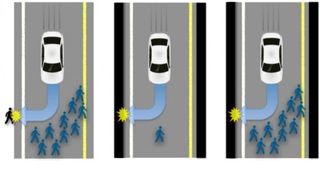
ScreenHunter_1463 Oct. 26 10.32When it comes to automotive technology, self-driving cars are all the rage. Standard features on many ordinary cars include intelligent cruise control, parallel parking programs, and even automatic overtaking—features that allow you to sit back, albeit a little uneasily, and let a computer do the driving.

So it’ll come as no surprise that many car manufacturers are beginning to think about cars that take the driving out of your hands altogether (see “Drivers Push Tesla’s Autopilot Beyond Its Abilities”). These cars will be safer, cleaner, and more fuel-efficient than their manual counterparts. And yet they can never be perfectly safe.

And that raises some difficult issues. How should the car be programmed to act in the event of an unavoidable accident? Should it minimize the loss of life, even if it means sacrificing the occupants, or should it protect the occupants at all costs? Should it choose between these extremes at random? (See also “How to Help Self-Driving Cars Make Ethical Decisions.”)

The answers to these ethical questions are important because they could have a big impact on the way self-driving cars are accepted in society. Who would buy a car programmed to sacrifice the owner?

More here.

Stanford Psychologist: Technology Is Ruining a Generation of Men

Orion Jones in Big Think:

ScreenHunter_1462 Oct. 26 10.28Stanford psychologist Philip Zimbardo, who became a household name after conducting the Stanford prison experiments, argues that our online culture is disproportionately harming boys, who watch more pornography, waste more time playing video games, and are increasingly bored with their sedentary office jobs.

The cause, Zimbardo explains in his new book “Man (Dis)connected: How Technology has Sabotaged What it Means to Be Male,” is biological in nature. Men have what psychologists call “single-cue arousability,” meaning one mere stimulus brings them closer to happiness, such as a naked person on a screen, when compared to women who require more complex stimuli to become aroused.

We've long wondered if the Internet is like the crack cocaine of entertainment, but talking about online addiction as a substance-abuse problem is a misleading metaphor, says Zimbardo. The Internet is not a drug because drug addiction supplies its users with more of the same experience. Arousal addiction, which the Internet does provide for, requires the addict to always receive new stimulation.

More here.

JEREMY ENGLAND, THE MAN WHO MAY ONE-UP DARWIN

Meghan Walsh in Today's Ozy:

ScreenHunter_1461 Oct. 26 10.25On a sunny afternoon, at a bustling cafe less than a mile from Stanford University’s campus, near Palo Alto, and more than 5,000 miles from his home, an assistant professor from MIT is telling me about science. Very advanced science. His name is Jeremy England, and at 33, he’s already being called the next Charles Darwin.

Say what?

In town to give a lecture, the Harvard grad and Rhodes scholar speaks quickly, his voice rising a few pitches in tone, his long-fingered hands making sudden jerks when he’s excited. He’s skinny, with a long face, scraggly beard and carelessly groomed mop of sandy brown hair — what you might expect from a theoretical physicist. But then there’s the street-style Adidas on his feet and the kippah atop his head. And the fact that this scientist also talks a lot about God.

The 101 version of his big idea is this: Under the right conditions, a random group of atoms will self-organize, unbidden, to more effectively use energy. Over time and with just the right amount of, say, sunlight, a cluster of atoms could come remarkably close to what we call life. In fact, here’s a thought: Some things we consider inanimate actually may already be “alive.” It all depends on how we define life, something England’s work might prompt us to reconsider. “People think of the origin of life as being a rare process,” says Vijay Pande, a Stanford chemistry professor. “Jeremy’s proposal makes life a consequence of physical laws, not something random.”

More here.

The Porn Business Isn’t Anything Like You Think It Is

Annie Marie Musselman in Wired:

ScreenHunter_1460 Oct. 26 10.20In the popular imagination, the eternal trope is that the porn industry drives the adoption of new technology; that it accounts for some astronomically large portion of all Internet traffic; and, yes, that it generates equally enormous sums of money for all the faceless people who run its operations. We picture these people as sleazy Southern Californians wearing pinkie rings and polyester. Or, if we’ve come to realize that the pinkie-ring caricature makes absolutely no sense in the age of the Internet, we see them as ruthlessly clever businesspeoplewith a sixth sense for where the big money lies. That’s the stereotype Silicon Valley embraces. Later in the episode, when Hendricks turns up at an adult industry conference, we encounter an army of porn execs dressed like bankers.

But it isn’t like that at all.

More here.

Confessions of an Israeli traitor

Assaf Gavron in The Washington Post:

IsraelI was an Israel Defense Forces soldier in Gaza 27 years ago, during the first intifada. We patrolled the city and the villages and the refugee camps and encountered angry teenagers throwing stones at us. We responded with tear gas and rubber bullets.

Now those seem like the good old days.

Since then, the conflict between Israelis and Palestinians has seen stones replaced with guns and suicide bombs, then rockets and highly trained militias, and now, in the past month, kitchen knives, screwdrivers and other improvised weapons. Some of these low-tech efforts have been horrifically successful, with victims as young as 13. There is plenty to discuss about the nature and timing of the recent wave of Palestinian attacks — a desperate and humiliated answer to the election of a hostile Israeli government that emboldens extremist settlers to attack Palestinians. But as an Israeli, I am more concerned with the actions of my own society, which are getting scarier and uglier by the moment.

…In this latest round of fighting, the volume has been turned up still another notch. While the knife attacks are going on, my family and I are in Omaha, where I’m teaching for the semester, and what I hear and read from Israel leaves me appalled. Again led by politicians from the right (with the perplexing support of members of the supposed opposition, such as Yair Lapid), then circulated by the sensationalist mainstream media, there has been a unified demonization of Palestinians and Israeli Arabs. One recent poll by the newspaper Maariv found that only 19 percent of Israeli Jews think most Arabs oppose the attacks. This past week, the trend reached its absurd peak, with Prime Minister Benjamin Netanyahu’s ridiculous claim that Hitler decided to annihilate the Jews only after being advised to do so by Jerusalem Mufti Haj Amin al-Husseini, the leader of Palestinian Arabs at the time. (Israeli Twitter was full of jokes and memes about the speech, which one image in circulation dubbed “Hitlerious.” Even for Netanyahu’s supporters, apparently, this was too much.)

More here.

An epic fusion reactor, life trapped in crystal, and risky antibody business

Alison Crawford in Science:

Weekly-102315The bizarre reactor that might save nuclear fusion:

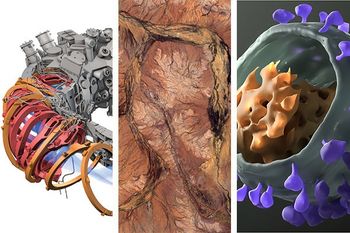
Tokamak or stellarator? That’s the question fusion enthusiasts are asking as a research lab in Germany prepares to flip the switch on the largest fusion device ever built, dubbed the “stellarator.” For Star Wars lovers, this epic construction device looks like Han Solo’s Millennium Falcon and sports some of the most complex engineering models ever devised. We’ll soon find out if the stellarator is strong enough to withstand the enormous forces and temperature ranges in order to surpass tokamaks in the effort to advance nuclear fusion.

Scientists may have found the earliest evidence of life on Earth

When did life on Earth begin? A controversial new study presents potential evidence that traces of life arose more than 4 billion years ago. Clues lie hidden in microscopic flecks of graphite trapped inside a single large crystal of zircon found in the Jack Hills in Western Australia. These zircon crystals barely span the width of a human hair, but they are nearly indestructible and provide a rare glimpse into Earth’s earliest history.

Designer antibodies may rid body of AIDS virus

Anti-HIV drugs have extended life for millions of people, but they have never eliminated the virus from anyone because HIV integrates its genetic material into the chromosomes of some white blood cells, helping it escape notice of the immune system. New findings show that artificial antibodies could “redirect” the immune response to latently infected cells and help drain the HIV reservoirs into the body. The dual-action concept to reverse latency and then do the mop-up work is both promising and exciting, but it is also risky and won’t be tested in people for at least a year.

More here.

Sunday Poem

Now Sing

NOW sing: the guards howling
beat him with obscenities.
…….. But he did.
His legend is
He was singing
……………….. Venceremos
when they shot him.
Even for them, it was too much

The killed him,
they couldn't kill him enough,

Victor Jara
…………… sin guitarra,
who'd held out with bloody stumps
………………………………………….. and sung

by James Scully
from Poetry Like Bread
Curbstone Press, 1994

****

Victor Jara:

“Jara composed 'Venceremos' (We Will Triumph), the theme song of Allende's Unidad Popular (Popular Unity) movement, and he welcomed Allende's election to the Chilean presidency in 1970. Jara and his wife were key participants in a cultural renaissance that swept Chile, organizing cultural events that supported the country's new socialist government. He set poems by Chilean writer Pablo Neruda to music and performed at a ceremony honoring Neruda after the famous writer received the Nobel Prize for literature in 1972. Throughout rumblings of a right-wing coup, Jara held on to his teaching job at Chile's Technical University.

“On September 11, 1973, however, Chilean troops under the command of General Augusto Pinochet mounted a coup against the Allende government. Jara was seized and taken to the Estadio Chile, a large sports stadium. There he was held for four days, deprived of food and sleep. He was tortured, and his hands were broken by soldiers who told him to try to keep on playing the guitar with his damaged hands.

Read more:

Saturday, October 24, 2015

How Long-Necked Dinosaurs Pumped Blood to Their Brains

Brian Switek in Smithsonian Magazine:

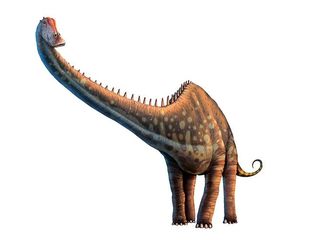
Diplodocus.jpg__800x600_q85_crop_subject_location-237,150Living large isn’t easy. The sauropod dinosaurs—the biggest creatures to ever walk the Earth—required rapid growth rates, skeletons that were both light and strong and copious amounts of food, just for starters.

Now, paleontologists may have cracked one of the remaining mysteries about these giant dinosaurs: How did they pump enough blood up their long necks to feed their brains?

University of Southern California paleontologist Michael Habib was inspired to investigate sauropod necks after seeing bones from a giant titanosaur found in the New Mexico desert. The well-preserved neck bones included spines called cervical ribs that stretch almost six feet long. These rods, Habib says, turned out to be made of a very flexible sort of bone that “made pretty darn good springs.”

As the giant dinosaurs walked, the motion would have created an “inertial problem” for the sauropods. Without something to dampen this effect, Habib says, “the neck is going to start to sway back and forth like a badly mounted crane or tree in a breeze.”

This is where the cervical ribs came in. These springy bones dampened that effect, allowing the dinosaurs to keep their necks relatively steady as they plodded along, Habib told researchers gathered last week at the Society of Vertebrate Paleontology meeting in Dallas, Texas.

More here.

Gloria Steinem Has a Theory About Why Women Don’t Like Hillary Clinton

Michelle Goldberg in DoubleXX:

GloriaGloria Steinem has a theory about liberal women who feel, or have felt, antipathy towards Hillary Clinton. They are insecure about their own bad marriages. That, at least, is the implication of an astonishingly condescending passage in her new book, My Life on the Road, excerpted in the Guardian. Steinem describes herself as “blindsided by the hostility” toward Clinton from some white liberal women during her first run for Senate. Eventually, Steinem developed an idea about where that animus came from. “If Hillary had a husband who regarded her as an equal—who had always said this country got ‘two presidents for the price of one’—it only dramatised their own lack of power and respect,” she writes. “After one long night and a lot of wine, one woman told me that Hillary’s marriage made her aware of just how unequal hers was.” There are a lot of theories out there about the very real resistance to Clinton among women who, on the demographic surface, should be her base. This, however, is the first time I’ve seen it suggested that they wish their husbands would be more like Bill Clinton.

And what about those women who condemned Clinton for remaining with a husband who humiliated her? “It turned out that many of them had suffered a faithless husband, too, but lacked the ability or the will to leave,” writes Steinem. “They wanted Hillary to punish a powerful man in public on their behalf.”

More here.

What the Heck is Cuneiform, Anyway?

Anne Trubek in Smithsonian:

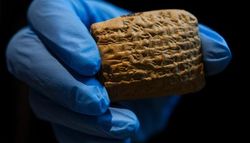
Cuneiform Cuneiform made headlines recently with the discovery of 22 new lines from the Epic of Gilgamesh, found on tablet fragments in Iraq. As remarkable as is the discovery of new bits of millennia-old literature is the story of cuneiform itself, a now obscure but once exceedingly influential writing system, the world’s first examples of handwriting. Cuneiform, was invented some 6,000 years ago in what is now southern Iraq, and it was most often written on iPhone-sized clay tablets a few inches square and an inch high. Deciding to use clay for a writing surface was ingenious: vellum, parchment, papyrus and paper—other writing surfaces people have used in the past—deteriorate easily. But not clay, which has proven to be the most durable, and perhaps most sustainable, writing surface humanity has used.

Cuneiform means “wedge-shaped,” a term the Greeks used to describe the look of the signs. It was used to write at least a dozen languages, just as the alphabet that you are reading now is also (for the most part) used in Spanish, German and many other languages. It looks like a series of lines and triangles, as each sign is comprised of marks—triangular, vertical, diagonal, and horizontal—impressed onto wet clay with a stylus, a long thin instrument similar to a pen. Sometimes cuneiform was formed into prisms, larger tablets and cylinders, but mainly it was written on palm-sized pieces of clay. The script is often tiny—almost too small to see with the naked eye, as small the smallest letters on a dime. Why so tiny? That remains one of cuneiform’s biggest mysteries.

More here.