A history of science at its intricate best: Ivan Pavlov’s story of Marxism, digestion, excitation and terror

E4104584-7d50-11e5_1187907kStephen Lovell at the Times Literary Supplement:

The twists and turns of Pavlov’s biography were matched by the tensions in his personality. Although himself a convinced atheist, in 1881 he married a devout fellow provincial who had come to St Petersburg to study on the recently established pedagogical courses for women. In the days of their courtship, he had to reckon with her enthusiasm for the messianic Fyodor Dostoevsky, swapping impressions of The Brothers Karamazov as it first came out. Much later, after more than twenty years of impeccably patriarchal family life, he formed a romantic attachment that would last the rest of his days. Pavlov’s lover and confidante after 1912 was Maria Petrova, by then only nominally the wife of the celebrity priest Grigory Petrov, who had thrown herself into a medical career in her late twenties and became Pavlov’s most devoted lab worker. Although Pavlov adhered to a strict daily routine, professed the value of self-discipline, and envisaged his labs as the domain of dispassionate rationality, he was possessed of a volcanic temper and regularly browbeat assistants who had the temerity to disagree with him or to follow their own hunches. Pavlov’s near fanatical pursuit of orderliness in his domestic and professional lives was evidently a way of taming his tempestuous nature and of minimizing the effects of the “random events” (sluchainosti) that he identified as the source of much human unhappiness.

More interesting still is the extent to which these tensions were also present in Pavlov’s thinking. Like most other scientists of his generation, he professed the absolute authority of the “fact”. The task of the scientist was to accumulate a large amount of data from rigorously controlled and meticulously conducted experiments. The conclusions would then take care of themselves.

more here.
How Proust’s ‘madeleine moment’ changed the world forever

Simon Heffer in The Telegraph:

Young-proust-xlargeIn one respect Marcel Proust is like Richard Wagner: each created one world-famous work of such scope and depth that people hesitate to explore them. Complexity should never be a barrier to intellectual curiosity, especially when the pleasure and enlightenment to be obtained are of the magnitude both these artists offer. Wagner's Ring cycle, around 16 hours of drama and music in four separate operas, is one of the greatest achievements in music and also one of the most rewarding. Likewise, the sequence of seven novels that make up Proust's À la recherche du temps perdu is to my mind the finest work of fiction ever written in any language. It leaves the reader with an altered understanding of the nature of reality, human relationships and perceptions. Proust wrote the novels between 1909 and his death in 1922 at the age of 51. One wonders what he might have accomplished had he lived a normal span. In one sense he was a late casualty of the Franco-Prussian war of 1870-71: he was born not long after the lifting of the Siege of Paris to a mother whose considerable wealth had not helped her, in those circumstances, find sufficient food to sustain her during her pregnancy. Her baby was a weakling and it was feared he would not live. Throughout his life Proust was subject to ill health, its effect made worse by his resolute hypochondria.

…The novels were hugely influential on writers all over the world, in that they introduced the idea of writing about “streams of consciousness”. Through Proust's ubiquitous narrator, they relay in great detail not just what is perceived, but also what is remembered, and the repeated and constant links between perception and memory. Even those who have not read the novels are aware of the journey of memory on which the narrator goes when he tastes a madeleine dipped in tea; it has become “the Proustian moment”.

More here.

Paradigms lost

David P Barash in Aeon:

BarashComing from a scientist, this sounds smug, but here it is: science is one of humanity’s most noble and successful endeavours, and our best way to learn how the world works. We know more than ever about our own bodies, the biosphere, the planet and even the cosmos. We take pictures of Pluto, unravel quantum mechanics, synthesise complex chemicals and can peer into (as well as manipulate) the workings of DNA, not to mention our brains and, increasingly, even our diseases.

Sometimes science’s very success causes trouble, it’s true. Nuclear weapons – perhaps the most immediate threat to life on Earth – were a triumph for science. Then there are the paradoxical downsides of modern medicine, notably overpopulation, plus the environmental destruction that science has unwittingly promoted. But these are not the cause of the crisis faced by science today. Today science faces a crisis of legitimacy which is entirely centred on rampant public distrust and disavowal. A survey by the Pew Research Center in Washington, DC, conducted with the American Association for the Advancement of Science, reported that in 2015 a mere 33 per cent of the American public accepted evolution. A standard line from – mostly Republican – politicians when asked about climate change is ‘I’m not a scientist’… as though that absolved them from looking at the facts. Vaccines have been among medical science’s most notable achievements (essentially eradicating smallpox and nearly eliminating polio, among other infectious scourges) but the anti-vaccination movement has stalled comparable progress against measles and pertussis.

How can this be? Why must we scientists struggle to defend and promote our greatest achievements?

More here.

Thursday Poem

Rhythm

What harm could there be in following
the hidden rhythm of things.
What harm in tapping with my feet
the beat of the rain pounding puddles.

What, in turning noise into beat,
blinking eyelids into tambourines.
Carrying with my feet
the tired passage of secret things.

Like when the cats were
one single ruckus overhead.
The rooftiles groaned like
pins of a broken piano.

What harm will there be in following the rhythm
of things. The form of the curve
the oat fields take
when the wind caresses their back.

What, in turning noise into beat,
fluttering eyelashes into tambourines.
Sealing with soft lips the slow
passage of secret things.

Read more »

Wednesday, October 28, 2015

Comparing smoking to bacon in terms of risk of cancer is extremely misleading, despite the strength of evidence being similar

ScreenHunter_1472 Oct. 28 20.49

Suzi Gage in The Guardian:

Vegetarians are probably breathing a sigh of relief today as headlines are warningus that processed and cured meats cause cancer. But the way this message has been framed in the media is extremely misleading.

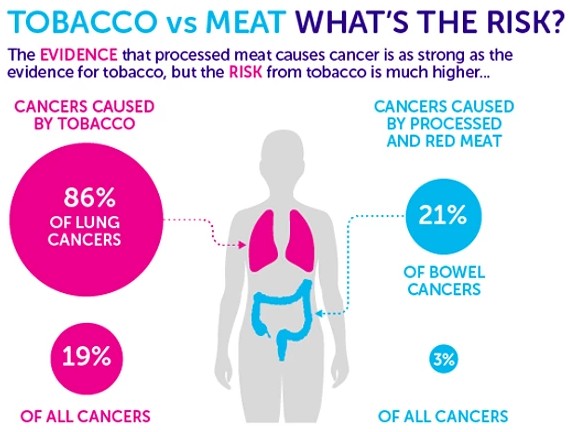
Comparing meat to tobacco, as most news organisations who’ve chosen to report this have done, makes it seem like a bacon sandwich might be just as harmful as a cigarette. This is absolutely not the case.

The headlines are referring to the news that the World Health Organisation has classified cured and processed meats (bacon, salami, sausages, ham) as group 1 carcinogens, because there is a causal link between consuming these meats and bowel cancer. This group also includes tobacco, alcohol, arsenic and asbestos, all known to cause certain cancers.

But just because all these things cause cancer, doesn’t mean they’re all as risky as each other. A substance can increase your risk of cancer a small amount, or, like tobacco, a huge amount. Comparing them like for like is just really confusing to anyone trying to work out how to lead a healthy life.

These brilliant infographics from Cancer Research UK illustrate this perfectly. The risk of lung cancer from smoking is extremely high. Of all cases of lung cancer (44,488 new cases in the UK in 2012), evidence suggests that 86% of these are caused by tobacco. And lung cancer isn’t the only type of cancer caused by smoking. CRUK estimate that 19% of all cancers are caused by smoking. Another way of looking at this is that if smoking was completely eliminated, there would be 64,500 fewer cases of cancer in the UK per year.

More here.

Poisonous Problems: Chemical Defenses Come With Evolutionary Cost

Christie Wilcox in Discover Magazine:

ScreenHunter_1471 Oct. 28 20.45Poison dart frogs are some of the most stunning species on Earth. But their vivid colors aren’t for aesthetics: they’re meant as a warning to potential predators. For while these frogs are visually stimulating, they are also armed with potent toxins. The poisons in their skin are so powerful that local tribes have been known to create deadly darts simply by rubbing them on the frogs’ backs — hence the name.

One might expect that the evolution of such a successful defense would allow these frogs to diversify faster than their relatives and outcompete their kin for resources and habitats — and, according to a study published in the early edition of Proceedings of the National Academy of Sciences this week, their toxins do give them a speciation advantage. But, their defenses don’t come cheap: poisonous frog species also go extinct at a faster rate.

“Amphibians are facing global population declines and extinctions,” explained Kevin Arbuckle, a herpetologist and evolutionary biologist at the University of Liverpool. “I thought it might be useful to figure out whether defense can influence their chances of diversifying or going extinct.”

More here.

A theorem for coloring a large class of “perfect” mathematical networks could ease the way for a long-sought general coloring proof

Natalie Wolchover in Quanta:

ScreenHunter_1470 Oct. 28 20.41Four years ago, the mathematician Maria Chudnovsky faced an all-too-common predicament: how to seat 120 wedding guests, some of whom did not get along, at a dozen or so conflict-free tables. Luckily, the problem fell squarely in her realm of expertise. She conceived of the guests as nodes in a network, with links between incompatible nodes. Her task was to color in the nodes using a spectrum of colors representing the different tables. As long as connected nodes never had the same color, there would be no drama at the reception.

As a master of this pursuit, known as “graph coloring,” Chudnovsky did the whole thing in her head and finished the seating chart in no time. “My husband was very impressed,” she said.

Networks of related objects, be they nodes or wedding guests, are known to mathematicians as “graphs,” and graph coloring is the much-studied act of partitioning these objects into conflict-free sets. Most graphs, with their tangle of interconnections, are impossible to color with a limited palette. The larger they are, the more colors you need. Moving from node to node, alternating between colors, you inevitably get into traffic jams that force you to pull new hues out of the box. Likewise, in the real world, seating charts, meeting schedules and delivery routes can seldom be made optimal. But since the 1960s, mathematicians have escaped these coloring frustrations by working with so-called perfect graphs, which “behave very nicely with respect to coloring,” said Chudnovsky, a 38-year-old math professor at Princeton University.

More here.

Art after Art after Art

Ray_1v8-600x474Nicholas Brown at nonsite:

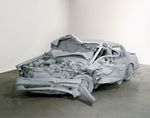
Charles Ray’s Unpainted Sculpture is a full-scale, monochrome rendering in fiberglass, duplicated piece by piece through a mechanical process, of a totaled Pontiac Grand Am. The accident that wrecked the original car was a fatal one:

If ghosts existed, would they haunt the actual substance of a place or object? Or would the object’s topology, geometry, or shape be enough to hold the ghost? Unpainted Sculpture began as an investigation into the nature of a haunting. I studied many automobiles that were involved in fatal collisions. Eventually I chose a car that I felt held the presence of its dead driver. (Charles Ray 106).

It is initially difficult to imagine a non-bullshit meaning for this paragraph, whose form acknowledges its own nonsensicality. One cannot run an experiment on initial conditions that are themselves counterfactual: since ghosts are acknowledged not to exist, the success or failure of the sculpture can’t establish how they would act if they did. When one begins to examine the sculpture, however, it is hard not to be struck by a certain presence, physical (or better, indexical) rather than ghostly, in the force with which the steering wheel has been smashed in by the body of the driver, and in the tremendous crumpling of the front of the car on the driver’s side. It is hard not to narrativize this observation as a kind of shock: “Something has happened here, someone has died.”

more here.

Crackpot Gothic

Shaw-jefferson-memorial_jpg_780x550_q85J. Hoberman at The New York Review of Books:

The term “outsider art” was coined in 1972 by the British art historian Roger Cardinal as a way to categorize work that might otherwise be described as naïve, fanatical, eccentric, autistic, or insane. The Los Angeles artist Jim Shaw is a connoisseur and collector of such things—he’s an esoteric populist who doesn’t only make art but, since he began exhibiting found “thrift store paintings” in 1991, has created his own tradition, an American vernacular surrealism that might be termed “crackpot gothic.”

“The End is Here,” which is the sixty-three-year-old artist’s first American retrospective, occupies three floors at the New Museum. The first floor is mainly devoted to Shaw’s paintings and drawings, which range from crude psychedelic mandalas and parodies of Hieronymus Bosch’s Garden of Earthly Delights to fastidious sketches of imaginary insects and distorted portraits of celebrities like Clint Eastwood.

The third floor features larger works—including muslin banners that, among other things, use the 1950s comic book character Plastic Man to suggest Picasso’s “Guernica,” and large free-standing pieces, full of discordant cartoon creatures and political caricatures, including a ski-nosed Richard Nixon, that have been fashioned from old wooden theatrical flats.

more here.

David Lynch’s Elusive Language

Lim-DavidLynchsElusiveLanguage1-690Dennis Lim at The New Yorker:

Lynch’s films abound with gnomic pronouncements and incantations. “Now it’s dark,” the maniacal Frank Booth hisses in “Blue Velvet.” “This is the girl,” the mobster financiers keep insisting in “Mulholland Drive.” (The key to Transcendental Meditation, which Lynch has practiced for more than four decades, is the repetition of a personal mantra.) Lynch’s mistrust of words means that his films often resist the expository function and realist tenor of dialogue, relying instead on intricate sound design to evoke what lies beyond language. Conversely, his studio art is notable for a perverse preponderance of text. Many of Lynch’s large, tactile art-brut canvases feature variously cryptic, comic, and ominous inscriptions (“Suddenly My House Became a Tree of Sores,” “There Is Nothing Here, Please Go Away”). Especially in his recent series of smudgy black-and-white lithographs, the verbiage comes to seem obsessive: a compulsion to name, label, and caption which, in heightening the absurdity of words, strips them of their power.

In Lynch’s own speech and in the speech patterns of his films, the impression is of language used less for meaning than for sound. To savor the thingness of words is to move away from their imprisoning nature. Lynch has said, more than once, that he had to “learn to talk,” and his very particular, somewhat limited vocabulary seems in many ways an outgrowth of his aesthetic.

more here.

the future of girls’ education in Afghanistan, “white savior narratives,” and documentary as an antidote to compassion fatigue

Daniela Petrova interviews Beth Murphy in Guernica:

Beth-Murphy-min“En route to Kabul…I met an elderly woman who was traveling from Omaha to visit her extended family in Afghanistan,” writes documentarian Beth Murphy in the Huffington Post. “When I told her I was on my way to work on a project focused on girls’ education, she shook her head at me and drew a finger across her throat.” For the past six years, Murphy has ignored spoken and unspoken dangers and continued making regular trips to a village outside of Kabul to film her latest feature documentary, What Tomorrow Brings. The film chronicles life in a K-12 girls’ school from its inception to the first class of graduating students.

Murphy’s belief in the power of education stems from her upbringing as the daughter of teachers. “The love of learning was with me every day,” she explains in the interview that follows. Growing up in a small New England town in the ’70s and ’80s, Murphy experienced the ascent of second-wave feminism. In college, she took classes that explored women’s rights, but didn’t have to look far for proof that the empowerment of girls and women started with education: her own mother was the first in her family to attend college. After studying history and, later, working in radio news, Murphy first tried her hand at documentary filmmaking while completing a program at George Washington University’s Documentary Center. She later earned a master’s degree in international relations and international communications from Boston University. Murphy’s skill for storytelling seems at once innate and a product of early experiences. She credits the CBS Reports she watched growing up for inspiring an interest in documentary.

More here.

Wednesday Poem

The Chicken Coop

The house my parents had built
for them went back to the bank
and we moved three miles down
the road to a chicken coop converted
to a crude home, and that's where I
learned first to crawl, then
to walk. Later, we moved deep
into an orchard of apples and pears
to an abandoned farmhouse
with a pond and snapping turtles
and eels. No chickens but geese
chasing the dogs with their eel necks
curved and it's here that I learned
to run, to talk, that I became the first part
of what I am. My father never overcame
his sadness at the loss of the house
he’d first drawn on a napkin at the Automat
on Lower Broadway. The house was gone
but he still had that napkin, crumpled
in the dresser drawer where he kept
folded money and his glasses. “It doesn't matter
how many new floors, how many coats
of paint,” he would complain in his glass
of port, “you never get rid of the stink
of chickens.” And he'd point
an uncertain finger at me. “Don't you
forget that. It’s who you are.”

by Dave Margoshes
from
The Horse Knows the Way
Ottawa: BuschekBooks, 2009.

Cancer-fighting viruses win approval

Heidi Ledford in Nature:

VirusAn engineered herpesvirus that provokes an immune response against cancer has become the first treatment of its kind to be approved for use in the United States, paving the way for a long-awaited class of therapies. On 27 October, the US Food and Drug Administration (FDA) approved a genetically engineered virus called talimogene laherparepvec (T-VEC) to treat advanced melanoma. Four days earlier, advisers to the European Medicines Agency had endorsed the drug. With dozens of ongoing clinical trials of similar ‘oncolytic’ viruses, researchers hope that the approval will generate the enthusiasm and cash needed to spur further development of the approach. “The era of the oncolytic virus is probably here,” says Stephen Russell, a cancer researcher and haematologist at the Mayo Clinic in Rochester, Minnesota. “I expect to see a great deal happening over the next few years.”

Many viruses preferentially infect cancer cells. Malignancy can suppress normal antiviral responses, and sometimes the mutations that drive tumour growth also make cells more susceptible to infection. Viral infection can thus ravage a tumour while leaving abutting healthy cells untouched, says Brad Thompson, president of the pharmaceutical-development firm Oncolytics Biotech in Calgary, Canada.

More here.

Tuesday, October 27, 2015

Bill Gates: The Private Sector Is Inept

James Bennet in The Atlantic:

ScreenHunter_1468 Oct. 28 10.07In his offices overlooking Lake Washington, just east of Seattle, Bill Gates grabbed a legal pad recently and began covering it in his left-handed scrawl. He scribbled arrows by each margin of the pad, both pointing inward. The arrow near the left margin, he said, represented how governments worldwide could stimulate ingenuity to combat climate change by dramatically increasing spending on research and development. “The push is the R&D,” he said, before indicating the arrow on the right. “The pull is the carbon tax.” Between the arrows he sketched boxes to represent areas, such as deployment of new technology, where, he argued, private investors should foot the bill. He has pledged to commit $2 billion himself.

“Yes, the government will be somewhat inept,” he said brusquely, swatting aside one objection as a trivial statement of the obvious. “But the private sector is in general inept. How many companies do venture capitalists invest in that go poorly? By far most of them.”

Gates is on a solo global lobbying campaign to press his species to accomplish something on a scale it has never attempted before. He wants human beings to invent their way out of the coming collision with planetary climate change, accelerating a transition to new forms of energy that might normally take a century or more.

More here.

How DNA Evidence Incriminated an Impossible Suspect

Erin E. Murphy in The New Republic:

ScreenHunter_1467 Oct. 28 09.54In 2009, a horrific murder occurred in a place rarely associated with violence: a Yale graduate scientific laboratory. On what was to be her wedding day, a graduate student’s body was found head down within a small mechanical chase behind a wall in the laboratory. As she fell, her underwear snagged and entangled on a vent pipe that spanned the length of the chase. Extensive DNA samples were taken from the victim, her clothing, and spaces around the chase. Testing revealed two profiles, one of which matched a co-worker later implicated in the crime through other evidence. But a second person’s DNA was also found, ominously recovered in significant quantities from samples that included the waistband of the victim’s underwear. When the profile was submitted to the DNA database, a match returned the name of a convicted offender living nearby.

Further investigation, however, turned up something mysterious. The database match suspect had died two years prior to the Yale attack. Stumped, investigators first ruled out an identical twin or other relative, as well as laboratory contamination errors.

More here.

Jack the Ripper ‘nailed’: has Bruce Robinson solved crime’s greatest mystery?

Mick Brown in the Sydney Morning Herald:

ScreenHunter_1466 Oct. 27 21.01“I honestly think,” Bruce Robinson says, “I've nailed the horrible f—er.” He points to the photograph on the desk. A Victorian gent. Moustachio'd, dressed in a black frock coat, silk trimming on the lapels; a black cravat with a decorative pin. A certain understated style. An artist of some sort, perhaps? The expression blandly neutral – although looking closely there is something a little unsettling in the gaze, a certain cold indifference. But perhaps that's one's own projection.

So that, I say, is Jack the Ripper.

Robinson nods. “It is.”

Robinson is probably best known for writing and directing the 1987 film Withnail and I – a black comedy about two impecunious actors who go on holiday in the Lake District, “by mistake”. In 1985 he was nominated for an Academy Award for his screenplay for The Killing Fields. More recently he scripted and directed The Rum Diary, starring his friend Johnny Depp.

But for much of the past 15 years he has been absorbed in an extraordinary – and, frankly, improbable – quest. The identity of the man who was responsible for the horrific murders of five women in the East End of London over a nine-week period in 1888 remains one of the great mysteries in British criminal history. Robinson is convinced he has solved it.

This month sees the publication of They All Love Jack: Busting the Ripper. More than 800 pages in length, it is the fruit of intense, one might say obsessive, dedication. “I thought it would take me two years – a year to research and a year to write,” Robinson sighs. “Had I known – truly known – then what I know now, I would never have started.”

More here.

The Real Power of ISIS

Scott Atran in The Daily Beast:

ScreenHunter_1465 Oct. 27 16.14As U.S. troops and their allies stage commando raids to rescue prisoners slated for slaughter by the so-called Islamic State, and the Russians mount bombing raids to bolster the dictatorship of Syrian President Bashar al-Assad, it’s easy amid the kinetics to lose sight of a central and potentially determining fact about the fight against ISIS (or ISIL, or Daesh): This is, fundamentally, a war of ideas that the West has virtually no idea how to wage, and that is a major reason anti-ISIS policies have been such abysmal failures.

It’s not as if the core approach of ISIS is a mystery. Required reading for the emirs of the Islamic State is Abu Bakr Baji’s The Management of Savagery, a detailed manifesto, published a decade ago, looking at the West’s debilities and the potential strengths of a rising, ruthless caliphate. One typical maxim: “Work to expose the weakness of America’s centralized power by pushing it to abandon the media psychological war and the war by proxy until it fights directly.” That is, suck U.S. troops into the fight.

In the meantime ISIS is reaching out, especially in Africa but also in Central Asia and wherever a state of “chaos” or “savagery” (at-tawahoush) exists, to fill the void. It is establishing its caliphate as a global archipelago where “volcanoes of jihad” erupt, so that it may survive even if its current core base between the Euphrates River in Syria (Raqqa) and the Tigris in Iraq (Mosul) is seriously degraded. Libya is a prime target as the gateway to a continent in chaos, where ISIS is investing heavily. Over 700 Saudi fighters have gone there in recent months, according to evidence Saudi leaders presented to me in August.

More here.

Inside the Secretive World of Tax-Avoidance Experts

A sociologist realized that if she were ever going to understand global inequality she would have to become one of the people who helps create it. So she trained to become a wealth manager to the ultra-rich.

Brooke Harrington in The Atlantic:

ScreenHunter_1464 Oct. 27 16.09Shakespeare said that all the world’s a stage, but the sociologist Erving Goffman added that most of the interesting stuff lies behind the scenes, in what he called the “backstage” areas of everyday life.

Having spent the past eight years doing research on the international wealth-management profession, I have to agree with Goffman: The most revealing information comes from the moments when people stop performing and go off-script. Like the time one of the wealth managers I interviewed in the British Virgin Islands lost his composure and threatened to have me thrown out of the country. His ire arose from an unexpected quarter: He took offense to my use of the term “socio-economic inequality” in the two scholarly articles I had published on the profession. I thought the articles were typically academic, which is to say, the opposite of sensationalizing and of little interest to anyone outside my field. But my suggestion that wealth managers might be connected to inequality in any way seemed alarmingly radical to this gentleman.

I was lucky that he merely threatened me. A journalist from Newsweek actuallywas deported from a different tax-haven island (Jersey) for her reporting there, and was banned from re-entering the island, or any part of the U.K., for nearly two years. Even though her story was unrelated to the financial-services industry, it was expected to bring negative publicity to the island, threatening its reputation as a place to do business. The message was therefore quashed by banishment of the messenger. The wealth-management industry does not mess around.

More here.