
Yascha Mounk at his Substack:
 Yascha Mounk: I’ve been trying to think through the state of economic policy at the moment, and it seems to me that we’re in a strange moment where there was a clear paradigm that economists followed in the ‘90s and perhaps the early 2000s, and that ran aground. Then there was a principled alternative to it that parts of the left tried to put forward, but that seems to have run aground as well.
Do you think there’s a kind of clear structure to how, let’s say, the mainstream of the Democratic Party thinks about economic policy right now?
Noah Smith: Well, in the 2000s, a kind of an intellectual movement among progressives started to crystallize, which I guess for want of a better term you could call anti-neoliberalism. People basically got a short list of things they thought the market got wrong and told this sort of simplified, potted history: In the 1980s, we decided markets could do everything, cut the government, and then this led to rising inequality, falling worker power, environmental degradation, etc.. And they thought that in order to get rid of those, we need to basically reverse the neoliberal changes—to strengthen unions, various kinds of regulations, and the welfare state. And that was the basic progressive program. And you saw some elements of that program get implemented by Biden, but a lot got blocked.
But the neoliberal turn was a lot less dramatic, I think, than people realize.
More here.
Enjoying the content on 3QD? Help keep us going by donating now.
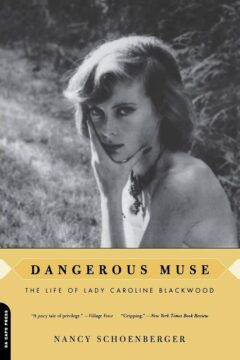 In the room devoted to the archives of Lucian Freud in London’s National Portrait Gallery, a strikingly tender painting depicts a young woman with waifish features, blond tresses, and enormous slate-blue eyes. The portrait, “Girl in Bed,” has a delicacy that stands out amid the characteristically mottled, fleshy faces of Freud’s subjects—the slender fingers and crumpled duvet, the high blush on the cheeks. The girl in question is Caroline Blackwood, a twenty-one-year-old heiress of aristocratic extraction, who would soon become the artist’s wife. Freud made ten-odd paintings of Blackwood, charting the zigzag of their relationship, from the sensitive, alluring “Girl Reading” and “Girl in Bed” (both produced in 1952, at the height of their courtship), to the abject “Hotel Bedroom,” from 1954, in which Blackwood appears wizened and withdrawn, while Freud himself stands by the window, lost in shadow.
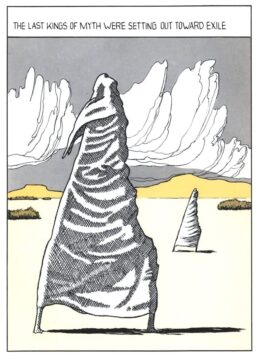 I
I In seventeenth-century England, people often commented after a meal: “We ourselves have had ourselves upon our trenchers”. This is an early version of today’s well-worn aphorism, ‘
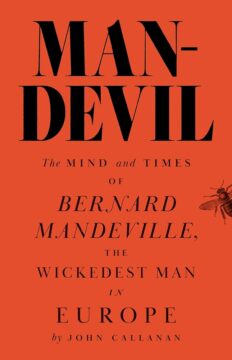 Man-Devil is an entertaining exploration of Mandeville’s ideas, which he set out in The Fable of the Bees and other works. Callanan does not pretend that it is a full-scale biography of Mandeville. Indeed his life story, as far as we know it, could be told in a couple of pages. From a relatively prosperous Rotterdam family, educated in medicine at Leiden University, Mandeville was forced into exile in 1693 as a result of the family’s involvement in the Costerman riots, a protest against the activities of tax farmers, private citizens who collected revenue for the government in return for a large cut. He spent the rest of his life in London, working as a kind of psychiatrist with a particular interest in hypochondria. He died there in 1733.
 The very first gay bar I regularly attended in San Francisco was this little hole-in-the-wall called Aunt Charlie’s. In 2003 (the literal second I turned 21), I began to attend their Thursday night party (a party that went on for 20 years, mind you). It was all post-disco freestyle, Hi-NRG, urban—the span of music was from about 1978 to 1982. To paint a picture, the songs would be shit like Gwen McCrae’s “Keep the Fire Burning,” Carol Hahn’s “Do Your Best,” Erotic Drum Band’s “Touch Me Where It’s Hot”—you get the idea. One day, the resident DJ pulled out the 1983 single of Madonna’s “Everybody,” with the iconic collage cover done by Lou Beach. At the time I was in an electroclash band—electroclash being an era of 2000s music that imitated the ’80s. I danced to this Madonna song that I had heard all through my childhood. Now I was an adult, drinking in bars, wondering how a song from 30 years ago felt more like “the future” than anything my friends and I were currently doing. This here is the magic of Madonna. All classics defy time. Every time “Everybody” is played, I come alive on the dance floor.
 As reported credulously and breathlessly by just about every major media outlet, there are strange lights in the night sky all over the East Coast; particularly, it seems, in areas
  A novelist’s name is writ in water, and come a drought may be reduced to a wisp of spume. In his day Anthony Burgess was a very big fish in the literary pond, most famous, or infamous, for the 1962 novel A Clockwork Orange, written in a wonderfully clever Russo-English patois of the author’s invention. The book was adapted for the screen by Stanley Kubrick, who later suppressed the film because of its perceived infatuation with or even encouragement to extreme violence.
 When Javier Milei was sworn-in as Argentinian president a year ago, the smart money was on a spectacular train wreck. Impulsive, thin-skinned, hyper-ideological and irresistibly drawn to every culture war controversy, no matter how dumb, Milei doesn’t immediately strike you as the kind of leader that gets results. Taking over one of the world’s most notorious economic basketcases at a time of absolute fiscal disarray, Milei’s coming doom seemed all too predictable.
 Nate Bargatze loves fast food. He loves big-box stores and the suburbs and TNT marathons of Die Hard. He finds felicity in the familiar, comfort in the caloric, originality in the ordinary.
 I’ve often considered poetry as a core piece of therapy for myself. Ever since I was a child, it’s been my biggest way of understanding the world and my own experiences. I see my life through the lens of a poem, and it helps me process and heal whatever I may be going through. I’ve been writing poetry since I was six, and I have always credited it for getting me through traumatic experiences and helping me celebrate the beautiful ones.
 The town of Macondo never existed. It was never supposed to. And yet, here it is.
 I
I