
Scott Alexander at Astral Codex Ten:
In 2021, a researcher named Daniel Kokotajlo published a blog post called “What 2026 Looks Like”, where he laid out what he thought would happen in AI over the next five years.
The world delights in thwarting would-be prophets. The sea of possibilities is too vast for anyone to ever really chart a course. At best, we vaguely gesture at broad categories of outcome, then beg our listeners to forgive us the inevitable surprises. Daniel knew all this and resigned himself to it. But even he didn’t expect what happened next.
He got it all right.
Okay, not literally all. The US restricted chip exports to China in late 2022, not mid-2024. AI first beat humans at Diplomacy in late 2022, not 2025. A rise in AI-generated propaganda failed to materialize. And of course the mid-2025 to 2026 period remains to be seen. But to put its errors in context, Daniel’s document was written two years before ChatGPT existed. Nobody except researchers and a few hobbyists had ever talked to an AI. In fact, talking to AI was a misnomer. There was no way to make them continue the conversation; they would free associate based on your prompt, maybe turning it into a paragraph-length short story. If you pulled out all the stops, you could make an AI add single digit numbers and get the right answer more than 50% of the time. Yet if you read Daniel’s blog post without checking the publication date, you could be forgiven for thinking it was a somewhat garbled but basically reasonable history of the last four years.
I wasn’t the only one who noticed.
More here.
Enjoying the content on 3QD? Help keep us going by donating now.
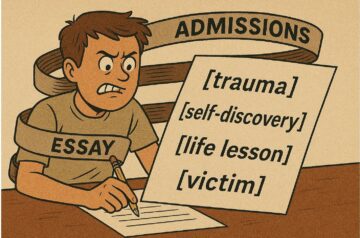 The college essay is a deeply unfair way to select students for top colleges, one that is much more biased against the poor than standardized tests. The college essay wrongly encourages students to cast themselves as victims, to exaggerate the adversity they’ve faced, and to turn genuinely upsetting experiences into the focal point of their self-understanding. The college essay, dear reader, should be banned and banished and burned to the ground.
 “T
“T A half generation
 M
M Five scientists who contributed to the development of the
  Back in 2014, a woman with advanced cancer pushed Adrienne Boire’s scientific life in a whole new direction. The cancer, which had begun in the breast, had found its way into the patient’s spinal fluid, rendering the middle-aged mother of two unable to walk. “When did this happen?” she asked from her hospital bed. “Why are the cells growing there?” Why, indeed. Why would cancer cells migrate to the spinal fluid, far from where they’d been birthed, and how did they manage to thrive in a liquid so strikingly poor in nutrients? Boire, a physician-scientist at Memorial Sloan Kettering Cancer Center in New York, decided that those questions deserved answers.
 Four years ago, I made a series for the BBC in which I
  It is among the most memorable moments in American literature. At the start of Chapter Three of his masterwork, Moby-Dick (1851), Herman Melville has his protagonist, the existential castaway Ishmael, newly embarked on his fateful commitment to go a-whaling (is it a kind of suicide? a mere lark? both?), push open the door of a port-side rough-house for boozing mariners: the so-called “Spouter-Inn”. It is dark. It is dank. Savage weaponry from cannibal isles spikes the walls. And those who hunker at the bar are renegades and isolatoes, gruff men of the sea. In the half-light, Ishmael immediately discerns, in the entryway itself, like a warning over the threshold, “a very large oil-painting”.
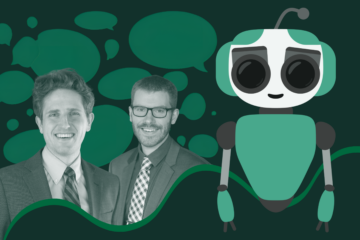 Dartmouth researchers conducted the first-ever clinical trial of a generative AI-powered therapy chatbot and found that the software resulted in significant improvements in participants’ symptoms, according to results