Veronique Greenwood in The New York Times:
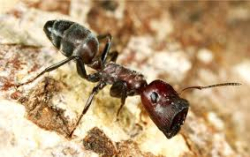
This colony was studied in depth by scientists who, last week in the journal ZooKeys, published an in-depth description of the newly named species, called Colobopsis explodens, including a portion of their genome sequence. Workers of C. explodens have a distinctive, rather foul talent. When their nest is invaded, they rupture their own abdomens, releasing a sticky, bright yellow fluid laced with toxins on their attackers. Similar to honey bees that die after stinging, the exploded ants do not survive, but their sacrifice can help save the colony. Exploding ants have been known to science for more than 200 years, and the special ability for which they are named was first documented in 1916. But since 1935, no new species from the group had been officially named and described. To do this, ideally one needs to collect members of all the different castes in the colony, from worker to queen, write a detailed description of their appearance, and give the species a Latin name, among other things, said Alice Laciny, a graduate student at the Natural History Museum Vienna who is an author of the new paper.
“We knew they existed, and we did experiments on them,” she said, “but it wasn’t described as an official species yet.”
More here.






 The marriage of sated appetites and adventurous conversation has a long history. In Ancient Greece, philosophical discourses were washed down with jugs of wine at banquets known as symposia. There was always a risk that some people would over-indulge. In the most famous description of a symposium, Plato describes how the guests, who included Socrates and Aristophanes, were expounding on the nature of love when they were interrupted by the arrival of a boozed-up general, Alcibiades. Table talk was considered an art to be mastered. Athenaeus, a Greek grammarian of the third century AD, wrote a 15-volume work entitled Deipnosophistae (“The Learned Banqueters”) about a series of dinners in which conversation ranged from philology to homosexuality.