
Natalie Wolchover in Quanta:
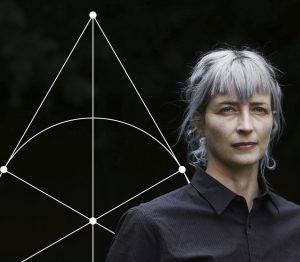 In 2014, a graduate student at the University of Waterloo, Canada, named Cohl Furey rented a car and drove six hours south to Pennsylvania State University, eager to talk to a physics professor there named Murat Günaydin. Furey had figured out how to build on a finding of Günaydin’s from 40 years earlier — a largely forgotten result that supported a powerful suspicion about fundamental physics and its relationship to pure math.
The suspicion, harbored by many physicists and mathematicians over the decades but rarely actively pursued, is that the peculiar panoply of forces and particles that comprise reality spring logically from the properties of eight-dimensional numbers called “octonions.”
As numbers go, the familiar real numbers — those found on the number line, like 1, π and -83.777 — just get things started. Real numbers can be paired up in a particular way to form “complex numbers,” first studied in 16th-century Italy, that behave like coordinates on a 2-D plane. Adding, subtracting, multiplying and dividing is like translating and rotating positions around the plane. Complex numbers, suitably paired, form 4-D “quaternions,” discovered in 1843 by the Irish mathematician William Rowan Hamilton, who on the spot ecstatically chiseled the formula into Dublin’s Broome Bridge. John Graves, a lawyer friend of Hamilton’s, subsequently showed that pairs of quaternions make octonions: numbers that define coordinates in an abstract 8-D space.
More here. [Thanks to Ali Minai.]
 Carol Dweck, a psychology professor at Stanford University, remembers asking an undergraduate seminar recently, “How many of you are waiting to find your passion?”
 Bilal Abdul Kareem is an expert in staying alive.
 Amitava Kumar in The Baffler:
 Early on in Helen Jukes’s A Honeybee Heart Has Five Openings she ponders the increasing popularity of urban beekeeping, referring to the idea that “one possible psychological response to the apprehension of a threat is to begin producing idealised versions of the thing we perceive of as being at risk”. That’s also a good explanation for the current crop of bee books: not just A Honeybee Heart and Thor Hanson’s Buzz, but Kate Bradbury’s wonderful The Bumblebee Flies Anyway and Maja Lunde’s The History of Bees, among others. Books, like hives, are ways of capturing something and holding on to it: either helping to preserve it, or looking at it closely before it’s gone.
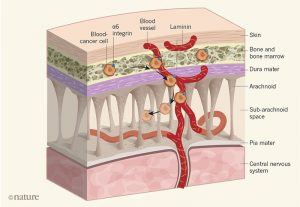 If malignant cells from solid or blood cancers enter the central nervous system (CNS) and grow there, the treatment options and clinical outlook deteriorate rapidly. In a type of leukaemia called acute lymphoblastic leukaemia (ALL), invasion of the CNS commonly occurs. To try to limit this, people with the condition often receive radiation or chemotherapy that targets the CNS. If more-effective and less-toxic approaches became available to prevent disease spread to the CNS, this might benefit many people with ALL.
  Sheri Berman in The Guardian:
 In his book The Main Questions of Modern Culture from 1914, the German philosopher Emil Hammacher wrote about the questions of his time—among them the social, woman, and worker questions—their causes, and the longstanding desire to solve them and others, tracing their causes and solution-seeking back to
  CRISPR has been heralded as one of the
  Jamelle Bouie, the chief political correspondent for Slate, recently penned an essay suggesting that the Enlightenment was racist — though the real point seemed to be that liking the Enlightenment too much is kind of racist. Regardless, the essay set off quite a hullabaloo, mostly on Twitter. His main targets were two new books, Enlightenment Now, by Steven Pinker, and Suicide of the West, by yours truly. Jordan Peterson, the controversial Canadian psychologist bogeyman of the moment for many liberals, was namechecked for good measure.
 S
S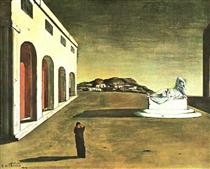 Still, the application of the idea of the history of vision does not stop, and does not begin, with modernity. As Jonathan Crary argues at length, the general mode of perception may have undergone some important form of change already in the first half of the 19thcentury. And theorists of postmodernism rely on the principle of the history of vision as much as theorists of modernity do. Frederic Jameson, for example, argues that postmodernism offers “a whole new Utopian realm of the senses.” The premise all these arguments share is that history, and art history, can be understood, at least partially, as the history of perception. This assumption is so deeply ingrained in much of the discourse on 19th and 20th century art and culture and in (at least some branches of) art history and aesthetics that it has been taken for granted without further discussion. As Whitney Davis summarized, “according to visual-culture studies, it is true prima facie that vision has a cultural history.” And one of the guiding ideas of post-formalism has become the claim that vision (and imagination) has an (art) history.
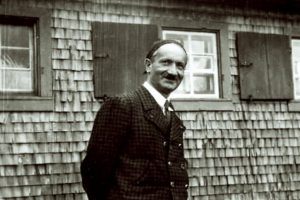 Martin Heidegger’s writings owe their fascination to their fusion of radical criticism of the Western philosophical tradition with a dark, trenchant diagnosis of the “homelessness” and “destitute” condition of human beings in modernity. Heidegger’s work has enjoyed unrivalled influence in a wide range of twentieth-century philosophical movements or fields – phenomenology and existentialism, pragmatism and postmodernism, hermeneutics and poetics, theology and environmental ethics. Phenomenologists and pragmatists could applaud his “destruction” of Cartesian rationalism, existentialists his call to “authenticity”, and environmentalists his reflections on “the devastation of the earth”. Heidegger’s influence might have been greater still if potential admirers had not been deterred by his challenging vocabulary or by his connection to Nazism.
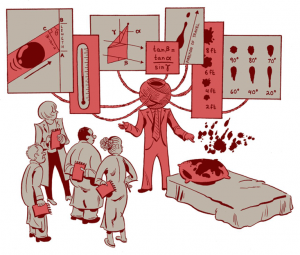 By the time Donald Johnson got the call to come to the crime scene, the victim had been dead for hours. A first responder opened the apartment door to find a woman lying on the edge of her bed, nude from the waist down, bound and gagged with duct tape. She had been bludgeoned to death. The homicide detectives needed an expert to gather the evidence. That was where Johnson came in. Then a senior criminalist for the Los Angeles County Sheriff’s Department, Johnson surveyed the apartment. Shards of ceramic lay on the kitchen floor, remnants from a broken jar that once held flour. Johnson noticed two sets of footprints in the flour, ignaling to him that there were two assailants. Clothes spilled from a chest against the wall across from the bed. From the mangled lock, Johnson could tell the chest had been forcibly opened, perhaps with a crowbar. There was also blood on the lock, with a trail of drops on the floor leading to the sink where the assailant had washed his hands.