
Leo Robson at The New Statesman:
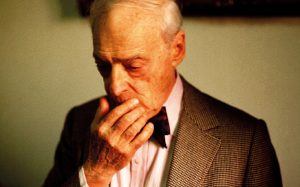 Is this a good moment – propitious, welcoming – for the appearance of a long, rich and unflaggingly detailed account of the later life of Saul Bellow? Ten years in the making, Zachary Leader’s biography was rubber-stamped at an earlier and distinctively different point in time. Then, the writer still reflected the glow of adulation – from the reviews of James Atlas’s single-volume biography Bellow(2000); his final novel Ravelstein (2000) and his Collected Stories (2001); from the 50th-anniversary tributes to The Adventures of Augie March in 2003 and the appearance, the same year, of the Library of America compendium, Novels 1944-1953; and from the obituaries and memorial essays that appeared on his death in 2005, aged 89. When, around that time, I starting getting interested in fiction, I was made to feel about Bellow’s writing more or less what Charlie Citrine, in Humboldt’s Gift (1975), recalls feeling about Leon Trotsky in the 1930s – that if I didn’t read him at once, I wouldn’t be worth conversing with.
more here.
 “I was a human first, and then I learned to be a
 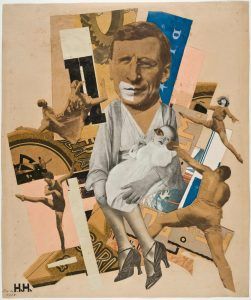 In 1919 the German Dada artist Raoul Hausmann dismissed marriage as “the projection of rape into law”. It’s a statement that relishes its own violence: he is limbering up to fight marriage to the death. A strange mixture of dandy, wild man, provocateur and social engineer, Hausmann believed that the socialist revolution the Dadaists sought couldn’t be attained without a corresponding sexual revolution. And he lived as he preached. He was married, but was also in a four-year relationship with fellow artist
  Last November, on the Monday before Thanksgiving, David* was sitting in traffic on his drive home from work. He was suddenly overwhelmed by the realization that everything he experienced was filtered through his brain, entirely subjective, and possibly a complete fabrication.
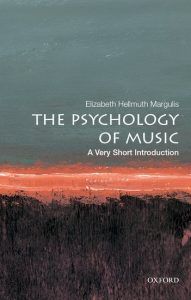 Music can intensify moments of elation and moments of despair. It can connect people and it can divide them. The prospect of psychologists turning their lens on music might give a person the heebie-jeebies, however, conjuring up an image of humorless people in white lab coats manipulating sequences of beeps and boops to make grand pronouncements about human musicality.
 I was born in Hamburg, Germany, in 1949, so I grew up playing cowboys and Indians with my cousins in the rubble fields of my native city. Family lore had it that my mother, who had survived the Hamburg firestorm of 1943, made me baby shirts from the sugar bags that came in American care packages. Her father had been sent to a concentration camp during the early days of the Nazi dictatorship because he collected dues for an illegal union; fortunately, he survived. Because of the housing shortage caused by the bombings, my parents and I, for the first 11 years of my life, lived in a one-room apartment. Suffice it to say my childhood was a daily reminder of the catastrophic consequences of the destruction of the Weimar democracy and the rise of Adolf Hitler.
 The pyramids and the Great Sphinx
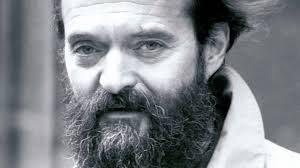 Arvo Pärt (b. 1935) is one of those fortunate composers who has created his own world in music—and is beloved for it in his lifetime. The Estonian, who for the last decade has been the world’s most performed living composer, started his career writing neoclassical pieces influenced by the Russian greats, chiefly Prokofiev and Shostakovich. Then he discovered Schoenberg’s twelve-tone scale, serialism, and other twentieth-century experimental techniques and soon became a prominent member of the avant-garde. But Soviet censors disapproved, and in the late 1960s their unofficial censorship removed Pärt’s music from concert programs and sent him into what he called a “period of contemplative silence.”
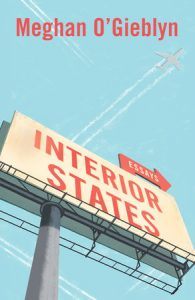 But it wasn’t as if, by leaving church, I could escape. In the Midwest, everything is haunted by Jesus: the Rust Belt towns, the long gray freeways; county fairs in the summer with headlining Christian bands; breweries full of wholesome Christian hipsters in warm sweaters, Iron and Wine or Sufjan Stevens on the sound system. After belief, I didn’t want to drive through the suburbs and come upon some postwar church with hymnals full of
 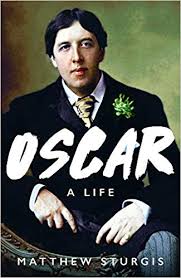 Each critic sees him- or herself in Oscar Wilde. Saint Oscar; Wilde the Irishman; Wilde the wit. The classicist; the socialist; the martyr for gay rights. “To be premature is to be perfect”, Wilde wrote; “History lives through its anachronisms.” It is in large part on this quality that the Wilde industry has been built. For an industry it certainly is. Books on Wilde are glamorous in a way that academic monographs seldom are. They come with beautiful artwork and endorsements by Stephen Fry. They lend themselves to the crossover market, eminently desirable to publishers as monograph sales dwindle. At their zenith, they beget publicity tours and a spot on a Waterstones table. In a world where most of us academics regularly spend weeks preparing a conference paper to deliver before an audience of a dozen, this is stardom.


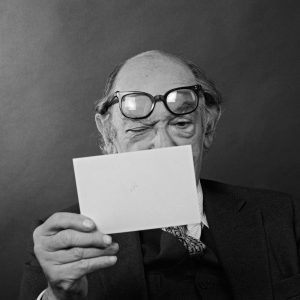
 Meena Alexander, a poet and scholar whose writings reflected the search for identity that came with a peripatetic life, including time in India, Africa, Europe and the United States, died on Wednesday in Manhattan. She was 67.
 Blurbs, the quoted testimonials of a book’s virtues by other authors, are now so ubiquitous, readers expect them, first-time authors stress about getting them, booksellers base orders on them. A blank back cover today would probably look like a production mistake. But while readers heft books in their hands and scrutinize the praise, it should be noted that blurbs are not ad copy written by some copywriter; they are ad copy written by a fellow author. “Ad copy” might be a bit harsh, but maybe not. The “flap copy,” the wordage on the inside flap of the cover of a hard cover, is written by the publishers, to tell potential readers what the book is about but also, of course, to spur a purchase. Blurbs are also there for promotional purposes only, their bias similarly implicit. “Why is this even a book?” I saw in a book review for a tepid memoir that I read in galleys and enthusiastically thought the same thing about. But such an honest negative assessment is not going to make it as a blurb, nor does an author’s effusive praise guarantee that the book has been read. Random people I interviewed for this piece didn’t know what blurbs were—when I asked about their persuasiveness/necessity, most said they thought they were necessary, but then I realized they were referring to the “flap copy” on the inside cover. Most readers I spoke to casually, including my niece, a college student who can’t leave a bookstore without at least 50 pounds of books, seemed pretty agnostic-to-meh about blurbs and mostly ignored them while browsing.