
Amber Dance in The Scientist:
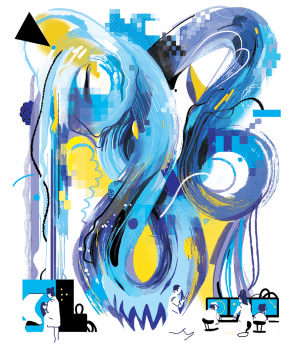 It’s the question on every cancer patient’s mind: How long have I got? Genomicist Michael Snyder wishes he had answers. For now, all physicians can do is lump patients with similar cancers into large groups and guess that they’ll have the same drug responses or prognoses as others in the group. But their methods of assigning people to these groups are coarse and imperfect, and often based on data collected by human eyeballs. “When pathologists read images, only sixty percent of the time do they agree,” says Snyder, director of the Center for Genomics and Personalized Medicine at Stanford University. In 2013, he and then–graduate student Kun-Hsing Yu wondered if artificial intelligence could provide more-accurate predictions. Yu fed histology images into a machine learning algorithm, along with pathologist-determined diagnoses, training it to distinguish lung cancer from normal tissue, and two different types of lung cancer from each other. Then he fed in survival data for those slides, letting the system learn how that information correlated with the images. Finally, he added in new slides that the model hadn’t seen before, and asked the all-important longevity question.
The computer could predict who would live for shorter or longer than average survival times for those particular cancers—something pathologists struggle to do.1 “It worked surprisingly well,” says Yu, now an instructor at Harvard Medical School. But Snyder and Yu thought they could do more. Snyder’s lab works on -omics, too, so they decided to offer the computer not just the slides, but also tumor transcriptomes. With these data combined, the model predicted patient survival even better than images or transcriptomes alone, with more than 80 percent accuracy.2
More here.
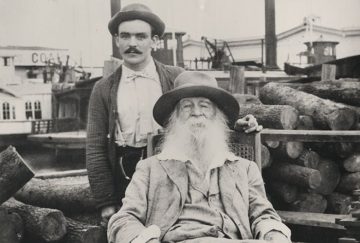 “Whitman demonstrates part of his Americanness by placing cocksucking at the center of Leaves of Grass.” Gay liberationist Charles Shively—not one to mince words—wrote this in Calamus Lovers: Walt Whitman’s Working Class Camerados (1987), his revelatory, if sometimes risible, account of the poet’s queer egalitarianism. Whether cocksucking is central to Whitman’s book, or even uniquely American, is debatable; more pertinent is the implied connection between Whitman’s homosexuality and his patriotic fervor.
 Commentators from across the political spectrum warn us that extreme partisan polarization is dissolving all bases for political cooperation, thereby undermining our democracy. The near total consensus on this point is suspicious. A recent Pew study finds that although citizens want politicians to compromise more, they tend to blame only their political opponents for the deadlock. In calling for conciliation, they seek capitulation from the other side. The warnings about polarization might themselves be displays of polarization.
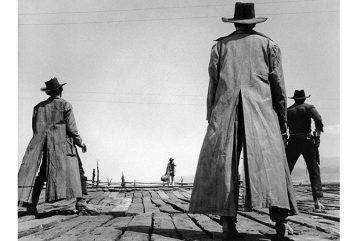 The movie that made me consider filmmaking, the movie that showed me how a director does what he does, how a director can control a movie through his camera, is Once Upon a Time in the West. It was almost like a film school in a movie. It really illustrated how to make an impact as a filmmaker. How to give your work a signature. I found myself completely fascinated, thinking: ‘That’s how you do it.’ It ended up creating an aesthetic in my mind.
 The press photographer’s task is to obtain a likeness of the person who is at the center of the news. This proves difficult when the subject, who is either accused of crimes or tied, however flimsily, to someone who is, wants to avoid being photographed at all costs. Hounded at every step, unable to escape, even in shackles, the subject resorts to makeshift concealments—hat, sleeve, lapel, handkerchief, newspaper—in order to prevent facial capture. The photographer can only pursue, shadow, perhaps verbally goad the subject, waiting for a slip or a stumble that will cause the mask to drop. When that fails to happen, the photographer’s sole option is to photograph the mask. The public, inflamed by press coverage of the case, wants a face it can charge with blame (and, often enough, spread the blame to faces that bear it a superficial resemblance), but is instead offered a metonym: hat, handkerchief, newspaper. The photographer, in quest of a portrait, has delivered in its place an event: the defeat of portraiture by the subject.
 There is intense debate as to what the outcome tells us about voter support for Brexit, with both Leavers and Remainers claiming vindication. The most striking feature of the results, however, is the polarisation they reveal. The result of a botched Brexit has been the Europeanisation of British politics, with the old centre ground falling away.
 As a literary scholar and authority on African American history, Henry Louis Gates Jr. has written or co-written 24 books and serves on the faculty of Harvard University. But he didn’t achieve broad public attention until he began hosting “Finding Your Roots,” a popular PBS series in which celebrities explore their ancestry, often with surprising results. During an episode of a related program, “African American Lives 2,” comedian Chris Rock discovers that his great-great-grandfather, Julius Caesar Tingman, had fought for the Union with the United States Colored Troops during the Civil War, then served in the South Carolina legislature under its Reconstruction government. The revelation brought the typically glib Rock to tears. “How in the world could I not know this?” Rock asked Gates.
 In the Netflix anime series Knights of Sidonia, humankind is marooned in a spaceship 500,000-strong, refugees constantly on the run from shapeshifting aliens who destroyed Earth over 1,000 years ago. Both the patriarchy and poverty have been smashed. Advances in genetic engineering have allowed androgynous individuals to proliferate and asexual reproduction to become commonplace. Everybody (except the protagonist, a clone of his grandfather) can photosynthesize, drastically reducing the need to eat. A plot twist near the end of the first season, released in 2014, revealed the existence of a shadow government called the Immortal Ship Committee which, in the last several centuries, had grown in number, from less than 10 members to just under 30, becoming more and more corrupt and self-serving. One of them, a 600-year-old woman named
  Trying to get a point across in public writing, whether established or clickbait media (a distinction of vanishing significance), with just the nuance, force, and connotations you intend, is like trying to perform a violin solo underwater. You can be as virtuosic as you like, but the medium you’re playing in is going to distort the signal to the point that your effort becomes a vain expenditure, and the result of it comes across as a dull, warped, and muted sound wave to which silence would have been preferable.
 Critics are often maligned.
  What year is it? It’s 2019, obviously. An easy question. Last year was 2018. Next year will be 2020. We are confident that a century ago it was 1919, and in 1,000 years it will be 3019, if there is anyone left to name it. All of us are fluent with these years; we, and most of the world, use them without thinking. They are ubiquitous. As a child I used to line up my pennies by year of minting, and now I carefully note dates of publication in my scholarly articles.
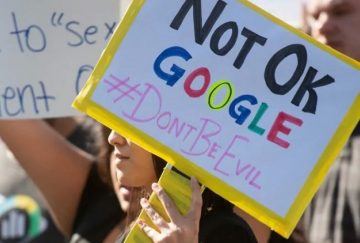 The tech giants are facing a moment of reckoning. Google, Facebook, Amazon, and Uber all grew explosively over the last decade, in part by delivering real convenience and benefits to consumers. For this we forgave their more venial sins, such as unfair competition, copyright infringement, data hoarding, and price discrimination. But recent years have brought one revelation after another around privacy issues—including Facebook’s sharing of data with the dark arts firm Cambridge Analytica—and ever-growing worries about the tech giants’ monopoly powers.
 The president of Ukraine sits in his office, a glum look on his face. He has just been trounced in the election by a political outsider, and isn’t taking it well. When his successor, Vasyl Holoborodko, tries to move into his office, the outgoing president shoots at him through the door with a shotgun, just missing his target. He’s refusing to leave until his demands are met, says an aide: he wants a litre of vodka, several packs of cigarettes and political asylum in Yugoslavia. “But Yugoslavia doesn’t even exist anymore,” says Holoborodko. “He knows, that’s why he asked for the vodka,” the aide replies.
 T
T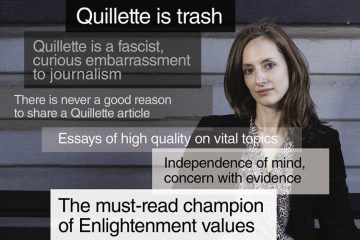 The portrait of university life offered by the online journal Quillette is not a flattering one. Free speech stifled at every turn. Scholars with divergent views relentlessly mobbed. Entire disciplines ruined by left-wing activism. A leafy dystopia populated by irrationally furious undergraduates, pathetically craven administrators, and professors who peddle mindless ideology at the expense of scientific inquiry. It’s enough to make anyone question the mental health of the academy, if not run screaming through the quad.