https://www.youtube.com/watch?v=yifBazD2xl4

https://www.youtube.com/watch?v=yifBazD2xl4
“…any man’s death diminishes me, because I am involved in mankind, and
therefore never send to know for whom the bell tolls; it tolls for thee.”
—John Donne
Now for the first time on the night of your death
your name is mentioned in convents, ne cadas in
obscurum.
Now with a true bell your story becomes final. Now
men in monasteries, men of requiems, familiar with
the dead, include you in their offices.
You stand anonymous among thousands, waiting in
the dark at great stations on the edge of countries
known to prayer alone, where fires are not merciless,
we hope, and not without end.
You pass briefly through our midst. Your books and
writing have not been consulted. Our prayers are
pro defuncto N.
Yet some look up, as though among a crowd of prisoners
or displaced persons, they recognized a friend
once known in a far country. For these the sun also
rose after a forgotten war upon an idiom you made
great. They have not forgotten you. In their silence
you are still famous, no ritual shade.
How slowly this bell tolls in a monastery tower for a
whole age, and for the quick death of an unready
dynasty, and for that brave illusion: the adventurous
self!
For with one shot the whole hunt is ended!
by Thomas Merton
from A Book of Luminous Things
Harcourt Publishing 1996
Nicole Karlis in Salon:
 Despite the common cold being so — well — common, researchers have never succeeded in the long dream of curing or immunizing against the array of rhinoviruses that generally cause it. Though the common cold generally does not kill those who are not infirm or immunocompromised, it costs billions in lost time and energy. Now, new research hints that science might be closing in on the cold. In a study to be published in Nature Microbiology, researchers at Stanford University and University of California, San Francisco say that the cure to the common cold could be the result of disabling one single host protein.
“Our grandmas have always been asking us, ‘If you’re so smart, why haven’t you come up with a cure for the common cold?’” Jan Carette, PhD, associate professor of microbiology and immunology at Stanford University at Stanford University, said in a media statement. “Now we have a new way to do that.” In the study, Carette and his colleagues found a way to stop a broad range of enteroviruses, the class of RNA viruses that includes cold viruses, after discovering that enteroviruses could not be replicated without one host protein, known as SETD3. After the discovery, the researchers bioengineered mice without this protein. To their surprise, they grew healthily into adulthood, and they were impermeable to infection by two enteroviruses that can cause paralytic and fatal encephalitis — even when the enteroviruses were injected into the mice’s brains. Rhinoviruses, a type of enterovirus, are the most common viral infectious agent in humans and the main cause of the common cold.
More here.
Fiona Sturges at The Guardian:
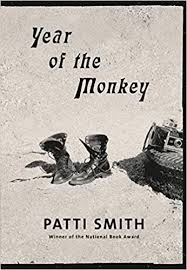 Typically for Smith, portents and symbols lurk in unexpected places, and everyday objects become freighted with meaning. Photographing them with her trusty Polaroid camera, she basks in the memories evoked by her father’s cup, a motel sign, a suit worn by the artist Joseph Beuys and a book of poems by Allen Ginsberg. She imagines her old chum Ginsberg fearlessly grappling with the current political turmoil. He “would have jumped right in, using his voice in its full capacity, encouraging all to be vigilant, to mobilise, to vote, and if need be, dragged into a paddy wagon, peacefully disobedient”.
Amit Chaudhuri at the LARB:
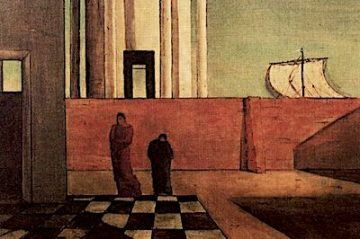 YEARS AGO, I began to run into the claim that we are all storytellers. Evidently, storytelling was a primal communal function for humanity. I was assured that we’ve been telling each other stories since the beginning of time. I felt a churlish resistance to these proclamations, possibly because one might well decide that being human doesn’t mean one should subscribe, without discomfiture, to everything the human race is collectively doing at any given point. Storytelling shouldn’t be guaranteed an aura simply because humans have been at it from the beginning of history.
Of course, part of my unease emanated from the fact that the “beginning of history” is even more of a wishful invention than the “end of history” is. It occurs to me that we probably began to first hear the utterance “we are all storytellers” around the late 1980s and early 1990s. From the moment we first heard this statement, it felt like we’d been hearing it from the beginning of time. As with various things that happened during the age of globalization, radical shifts in our understanding — of value, for instance — swiftly acquired an immemorial air.
more here.
Michael Dirda at The Washington Post:
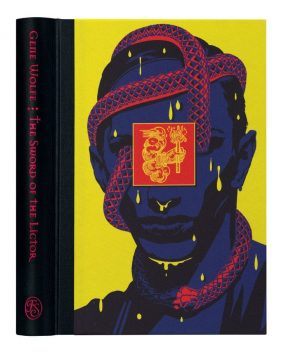 Devotees of the darker forms of fantastika know that much of the best work originates with small publishers, often in print runs of just a few hundred copies. So don’t delay in checking out Sarob Press’s Their Dark & Secret Alchemy: Stories by Richard Gavin, Colin Insole & Damian Murphy , with a cover illustration by the genre’s master artist Paul Lowe. In feel and elegance, the book closely resembles titles issued by Swan River Press, whose most recent offering is John Howard’s unsettling story collection, A Flowering Wound. More of Howard’s fiction, coupled with equally polished work by his friend Mark Valentine, appears in Inner Europe, a companion to Secret Europe. Both these handsome volumes — from Tartarus Press — are suffused with that air of mystery, transgression and foreboding one associates with continental literature and film during the 1920s and ’30s.
more here.
The startled blue heron erupts out of its long-legged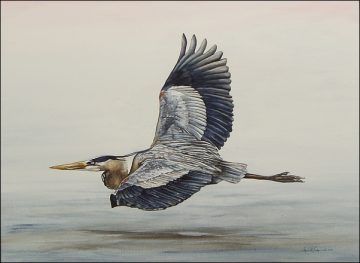
inwardness and flies low to the pond over its
shadow. My eye flickers between its great sweep
of wing and its blurred mirror motion almost white
in the pond’s sky-shine. At the end of each wingbeat,
the long body dips toward its rising shadow. Now
the heron settles back down onto itself as far away
from me as the pond allows and I finish my walk half gangly,
half graceful thinking if I were a bird, this is how I’d fly.
by Nils Peterson
from All the Marvelous Stuff
Caesura Editions, 2019
Susan Dominus in Smithsonian Magazine:
 In 1969, Margaret Rossiter, then 24 years old, was one of the few women enrolled in a graduate program at Yale devoted to the history of science. Every Friday, Rossiter made a point of attending a regular informal gathering of her department’s professors and fellow students. Usually, at those late afternoon meetings, there was beer-drinking, which Rossiter did not mind, but also pipe-smoking, which she did, and joke-making, which she might have enjoyed except that the brand of humor generally escaped her. Even so, she kept showing up, fighting to feel accepted in a mostly male enclave, fearful of being written off in absentia.
During a lull in the conversation at one of those sessions, Rossiter threw out a question to the gathered professors. “Were there ever women scientists?” she asked. The answer she received was absolute: No. Never. None. “It was delivered quite authoritatively,” said Rossiter, now a professor emerita at Cornell University. Someone did mention at least one well-known female scientist, Marie Curie, two-time winner of the Nobel Prize. But the professors dismissed even Curie as merely the helper to her husband, casting him as the real genius behind their breakthroughs. Instead of arguing, though, Rossiter said nothing: “I realized this was not an acceptable subject.” Acceptable or not, the history of women in science would become Rossiter’s lifework, a topic she almost single-handedly made relevant. Her study, Women Scientists in America, which reflected more than a decade of toil in the archives and thousands of miles of dogged travel, broke new ground and brought hundreds of buried and forgotten contributions to light. The subtitle—Struggles and Strategies to 1940—announced its deeper project: an investigation into the systematic way that the field of science deterred women, and a chronicling of the ingenious methods that enterprising women nonetheless found to pursue the knowledge of nature. She would go on to document the stunted, slow, but intrepid progress of women in science in two subsequent volumes, following the field into the 21st century.
More here.
Terry Hartle in The Christian Science Monitor:
 Kendi, like any good academic, is clear about his terms and definitions. He believes that a racist is someone who supports “a racist policy through their actions or inaction or expressing a racist idea,” while an antiracist is one who supports “an antiracist policy through their actions or expressing an antiracist idea.” Most of us, he concludes, hold both racist and antiracist views. But our beliefs are not necessarily fixed and immutable. “‘Racist’ and ‘antiracist’ are like peelable name tags that are placed and replaced based on what someone is doing … in each moment. These are not permanent tattoos.” In other words, our views and positions can change – as the evolution of his own thinking demonstrates. He calls policies that increase racial disparities “racist” while policies that reduce such disparities are “antiracist.” So affirmative action policies in college admissions designed to increase the enrollment of students of color are antiracist. (Presumably this means that legacy preferences in admissions, which do not reduce racial disparities and indeed may reinforce them, are racist.) Working to repeal the Affordable Care Act is racist because doing so would increase racial disparities in health care. “Do-nothing climate policy is racist policy, since the predominately non-White global south is being victimized by climate change more than the Whiter global north.”
Intriguingly, Kendi argues that the word “racist” should be seen as descriptive rather than pejorative. If we regard it that way, we might be able to talk far more candidly about racism in all its manifestations. But in 21st century America, the word is a pejorative slur and there is no easy way to make it less emotionally laden. One of the challenges is that addressing our deeply ingrained tendencies to default to racist ideas requires “persistent self-awareness, constant self-criticism, and regular self-examination.” This won’t be easy because many of us would rather avoid these often difficult discussions. Recently The Washington Post wrote that the efforts of tour guides at Monticello, Thomas Jefferson’s plantation, to introduce descriptions of slavery into their presentations have been dismissed by some visitors. One guide, after describing how slaves at Monticello had tended the garden, was reportedly told, “Why are you talking about that? You should be talking about the plants.” Not much self-examination there.
More here.
Fatima Bhutto in The Guardian:
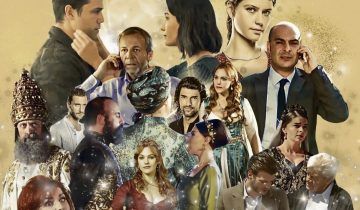 The first agreement we should make is: don’t call them soap operas,” Dr Arzu Ozturkmen, who teaches oral history at Boğaziçi University in Istanbul, scolds me. “We are very much against this.” What Turkey produces for television are not soap operas, or telenovelas, or period dramas: they are dizi. They are a “genre in progress”, declares Ozturkmen, with unique narratives, use of space and musical scores. And they are very, very popular.
Thanks to international sales and global viewership, Turkey is second only to the US in worldwide TV distribution – finding huge audiences in Russia, China, Korea and Latin America. At present, Chile is the largest consumer of dizi in terms of number of shows sold, while Mexico, then Argentina, pay the most to buy them.
Dizi are sweeping epics, with each episode usually running to two hours or longer. Advertising time is cheap in Turkey and the state broadcasting watchdog mandates that every 20 minutes of content be broken up by seven minutes of commercials. Every dizi has its own original soundtrack, and can have up to 50 major characters. They tend to be filmed on location in the heart of historic Istanbul, using studios only when they must.
More here.
Sean Carroll in Aeon:
 One of the most radical and important ideas in the history of physics came from an unknown graduate student who wrote only one paper, got into arguments with physicists across the Atlantic as well as his own advisor, and left academia after graduating without even applying for a job as a professor. Hugh Everett’s story is one of many fascinating tales that add up to the astonishing history of quantum mechanics, the most fundamental physical theory we know of.
Everett’s work happened at Princeton in the 1950s, under the mentorship of John Archibald Wheeler, who in turn had been mentored by Niels Bohr, the godfather of quantum mechanics. More than 20 years earlier, Bohr and his compatriots had established what came to be called the ‘Copenhagen Interpretation’ of quantum theory. It was never a satisfying set of ideas, but Bohr’s personal charisma and the desire on the part of scientists to get on with the fun of understanding atoms and particles quickly established Copenhagen as the only way for right-thinking physicists to understand quantum theory.
More here.
Richard Tafel in Quillette:
 Understanding American politics has become increasingly confusing as the old party labels have lost much of their meaning. A simplistic Left vs. Right worldview no longer captures the complexity of what’s going on. As the authors of the October 2017 “Pew Survey of American Political Typologies” write, “[I]n a political landscape increasingly fractured by partisanship, the divisions within the Republican and Democratic coalitions may be as important a factor in American politics as the divisions between them.”
To understand our politics, we need to understand the cultural values that drive it. The integral cultural map developed by philosopher Ken Wilber identifies nine global cultural value systems including the archaic (survival), tribal (shaman), warrior (warlords and gangs), traditional (fundamentalist faith in God), modern (democracy and capitalism), and postmodern (world-centric pluralism). When combined with Pew’s voter typologies, Wilber’s cultural levels offer a new map of America’s political landscape.
More here.
Sadiqa de Meijer at Poetry Magazine:
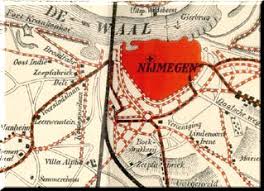 Afval is not offal, but garbage.
A blad is not a blade but a leaf, and also a sheet when referring to paper.
To huil is not to howl but to cry.
A geest is not so much a ghost as a spirit, and is also used for genie, which English has adapted instead from the Arabic jinni.
A fles is a bottle, which probably has something to do with a flask. A rozenbottel is a rose hip.
And in a very strange confluence, an eekhoorn, which is pronounced almost exactly like acorn, is a squirrel.
Boom, a tree. Tree, a step of the stairs. Stairs, a trap. Trap, a val, which also means fall, perhaps because of those archaic traps, holes dug on forest trails and covered with sticks and leaves. The season of fall, herfst.
more here.
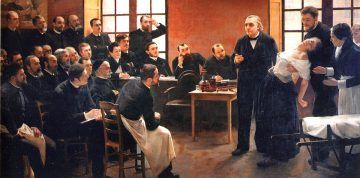
Not only was hysteria a disease of the body, but so was the susceptibility to hypnotic suggestion. In other words, according to Charcot, only true hysterics could attain the postures and maintain the poses of artificial hysteria. These could not be faked, so they had to be a pathological sign connected to real hysteria, even diagnostic of it. He called it le grand hypnotisme.
In 1882, Charcot presented this theory to the French Academy of Sciences as part of his bid for membership. The academy had already accepted his claim for the status of hysteria as a true disease on the strength of his reputation, although without much enthusiasm. They also signed off on his description of grand hypnotism, despite widespread skepticism. The idea had almost no support outside of Paris. According to Charcot’s critics, his four stages of hysteria and three-act demonstrations of hypnosis could be observed only at the Salpêtrière, or in patients who had lived there and had learned the choreography.
more here.
Sudip Bose at The American Scholar:
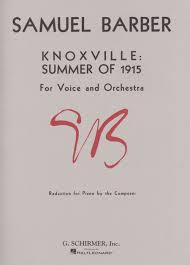 “That was exactly my childhood!” said Eleanor Steber of Barber’s work and Agee’s text, remembering her upbringing in Wheeling, West Virginia. Another superb interpreter of Knoxville: Summer of 1915, Leontyne Price, born in Laurel, Mississippi, had a similar response: “it expresses everything I know about my roots and about my mama and father … my home town. … You can smell the South in it.” Why has Barber’s piece appealed to so many people from such different backgrounds—irrespective of race, wealth, or region? The text, a poetic hymn to both nostalgia and existential insecurity, does address questions of universal appeal, but I suspect that the music’s subtle bluesy streaks increases its familiarity and allure. Barber may have been the consummate continental Romantic, but he never sounded so idiomatically American as he does in Knoxville: Summer of 1915. The work speaks to us all. In its journey from innocence to experience, it deals profoundly with our loneliness in the world, with how we reckon with growing up, a business made all the harder when the last thing we come to learn is exactly who we are.
more here.
The world begins at a kitchen table. No matter what, we must eat
….. to live.
The gifts of earth are brought and prepared, set on the table. So it
….. has been since creation, and it will go on.
We chase chickens or dogs away from it. Babies teethe at the corners.
….. They scrape their knees under it.
It is here that children are given instructions on what it means to
….. be human. We make men at it, we make women.
At this table we gossip, recall enemies and the ghosts of lovers.
Our dreams drink coffee with us as they put their arms around
….. our children. They laugh with us at our poor falling-down
….. selves and as we put ourselves back together once again at the
….. table.
This table has been a house in the rain, an umbrella in the sun.
Wars have begun and ended at this table. It is a place to hide in
….. the shadow of terror. A place to celebrate the terrible victory.
We have given birth on this table, and have prepared our parents
….. for burial here.
At this table we sing with joy, with sorrow. We pray of suffering
….. and remorse. We give thanks.
Perhaps the world will end at the kitchen table, while we are
….. laughing and crying, eating of the last sweet bite.
by Joy Harjo
from The Woman Who Fell From the Sky
© 1994
Michael Prodger in New Statesman:
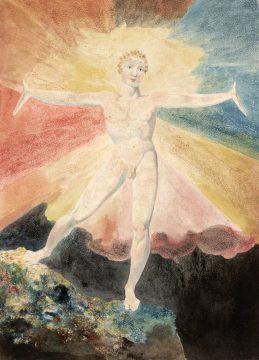 On February 1818, Samuel Taylor Cole-ridge was sent a copy of Songs of Innocence, William Blake’s first illustrated book of poems, which had been published some 30 years earlier. He was both impressed and discomfited by what he read. “You may smile at my calling another Poet a Mystic,” Coleridge, by then a fully fledged opium addict, wrote to a friend, “but verily I am in the very mire of commonplace common sense compared with Mr Blake.” Coleridge was not, of course, the first or last person to be mired.
Blake’s offbeat character – from his naturism and convoluted, self-invented cosmology to his visions of angels sitting in trees and his political and religious nonconformism – forms a carapace so tough as to be nigh-on impenetrable. The fact that his quirks were not so much elements of the man but the man himself means that he can be too daunting to comprehend properly. He once said of his illustrated poems that “My style of designing is a species by itself” and Blake too can perhaps be best characterised as a species in himself.
Whatever Blake was – poet, prophet and sage, or “Rebel, Radical, Revolutionary” as the poster to Tate Britain’s extraordinary new survey of his career somewhat sensationally puts it – he was primarily, and from first to last, a professional artist. For much of his life he spent his days as a highly regarded freelance commercial engraver; his evenings he gave over to his watercolours and relief etchings – intended as saleable products; and it was only late at night that he became a poet, composing in snatches when he had a few moments to spare.
More here.
Fitzpatrick and Marra in The New York Times:
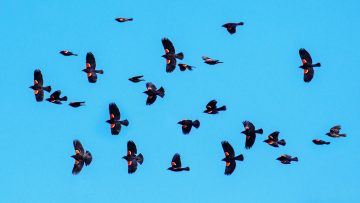 Nearly one-third of the wild birds in the United States and Canada have vanished since 1970, a staggering loss that suggests the very fabric of North America’s ecosystem is unraveling. The disappearance of 2.9 billion birds over the past nearly 50 years was reported today in the journal Science, a result of a comprehensive study by a team of scientists from seven research institutions in the United States and Canada.
As ornithologists and the directors of two major research institutes that directed this study, even we were shocked by the results. We knew of well-documented losses among shorebirds and songbirds. But the magnitude of losses among 300 bird species was much larger than we had expected and alarmingly widespread across the continent.
What makes this study particularly compelling is the trustworthiness of the data. Birds are the best-studied group of wildlife; their populations have been carefully monitored over decades by scientists and citizen scientists alike. And in recent years, scientists have been able to track the volume of nighttime bird migrations through a network of 143 high-resolution weather radars. This study pulls all of that data together, and the results signal an unfolding crisis. More than half our grassland birds have disappeared, 717 million in all. Forests have lost more than one billion birds.
More here.
Michael Chabon in the New York Review of Books:
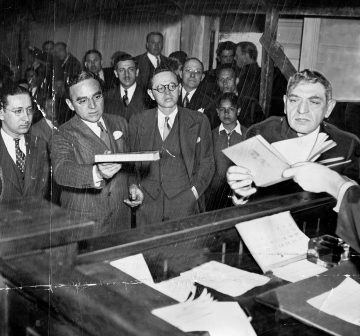
It was a setup: a stratagem worthy of wily Ulysses himself.
The conspirators were Bennett Cerf, publisher and cofounder of Random House, and Morris Ernst, general counsel of the ACLU. The target was United States anti-obscenity law. The bait was a single copy of an English-language novel, printed in Dijon by Frenchmen who could not understand a word of it, bound in bright blue boards, and sold mail-order by the celebrated Paris bookshop Shakespeare and Company. When Cerf and Ernst first began to conspire in 1931, the novel, James Joyce’s Ulysses, was the most notorious book in the world.
“It is,” the editor of the London Sunday Express had written nine years earlier, sounding like H.P. Lovecraft describing Necronomicon:
the most infamously obscene book in ancient or modern literature….All the secret sewers of vice are canalized in its flood of unimaginable thoughts, images and pornographic words. And its unclean lunacies are larded with appalling and revolting blasphemies directed against the Christian religion and against the name of Christ—blasphemies hitherto associated with the most degraded orgies of Satanism and the Black Mass.
Regarded as a masterpiece by contemporary writers such as T.S. Eliot and Ernest Hemingway, celebrated for being as difficult to read as to obtain, Ulysses had been shocking the sensibilities of critics, censors, and readers from the moment it began to see print between 1918 and 1920, when four chapters were abortively serialized in the pages of a New York quarterly called The Little Review.
More here.