Justin E. H. Smith
 I am writing from a motel room somewhere in Indiana. The obese teenage girl who checked me in asked me where I stand in respect of today’s competition between the ‘Bears’ and the ‘Colts’, which, as I know without ever having sought to know, are two nearby cities’ football teams. When I gave her a Canadian postal code in lieu of a zip, she quickly apologized, red in the face, for her attempt at familiar chatter. Damn it, I thought, there I go othering myself again.
Now I’m in my room, there is a corn field out the window, and Every Which Way But Loose is on the TV. Clyde the orangutan just gave a biker gang the finger. Clint Eastwood, as I know in advance, is about to nail Sondra Locke. I hope you’ll excuse me if I get distracted and the narrative flow tapers off.
I am in the American Midwest for a little over a week. Officially, my purpose here is the usual one that takes me wherever I go: academic conferences. Behind this, however, there is a more personal reason: I wanted to return to the place I lived for two and a half years at the very beginning of the present century, and to see if I could make some sense out of it. There is another region of the world –the American West– that will always form the deepest stratum of my psychogeographical sense. Yet the Midwest, too, managed to leave a thin but hard crust over some of the other layers, one that doesn't get in the way of deeper digging, necessarily, but still requires its own equipment and instruments of analysis.
My last trip through Indiana, in early Summer, 2003, was capped off by an ugly traffic accident on the Interstate, as I was travelling south-southeast from Chicago to Cincinnati. The police report is something I occasionally pull out and study when I want, for some perverse reason, to relive the trauma of it. I even brought it with me for my most recent Indiana road trip. One of the witnesses, Tricia Yoder, reports the event as follows: “I seen the black car [mine] driving in the left lane and the blue car [Travis Butler’s] driving in the right lane. The blue car tried to make a suden turn in front of the black car in order to turn around on the hi-way divider to go back the other direction, even thouh the sign said ‘no’ u-turn. The black car did’nt have time to stop and ran into the drivers side of the blue car. I seen it from behind the black car.”
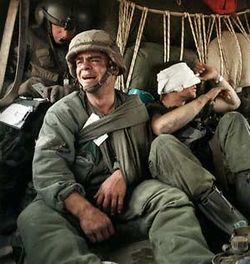
I hit Travis Butler, in other words, who, as I would later learn, was born in 1954 and was a resident of Pulaski County. As I inferred at the time –having, in the millisecond before impact, thoroughly studied and committed to memory the POW-MIA sticker in the rear window on the driver's side– Mr. Butler was a veteran of a certain bitter war. I hit the vet, and he got issued a moving violation on his way to the hospital. It still doesn't seem right. He was, I feel like saying, the legal cause of the collision, but I was the metaphysical cause. Like the ancient archer discussed by Bernard Williams in Shame and Necessity, it does not matter that he could not have known that a runner would be passing in the distance at the moment he let go the arrow. You can't hit someone who passes in front of you without shaking up the cosmos a bit. Our Christian, free-will-based legal system makes a distinction that our not yet fully de-Hellenized, fatalistic subconsciences can't quite accept. You can’t hit a guy without being tainted. You definitely can’t hit a Vietnam vet.
After the cars had come to their resting places on the grassy center divider, I slithered out, stunned, and walked like a zombie over to his car. Are you alright? I asked. ‘Yeah’, he said. Good, I said. I was sincerely relieved for a moment. Then I saw blood streaming from the crown of his head and dripping down, in big, fast drops, behind his left ear. He was not alright.
(Clint has just barged into the YWCA where Sondra is staying. The appearance of a man has put the young women, with their nightgowns and curlers and face creams, into a frenzy.)
The collision solved at least one problem for me: I had been looking for a way to free myself of my 1991 Acura Integra, for which I did not want to have to pay the exorbitant fee required to bring it with me on my impending move to Canada. I was in fact, at that very moment, in connection with the move, hauling nearly my entire library in the trunk, back seat, front seat, front passenger floor, glove compartment, and dashboard of my Acura. I have recently related how some of my most intense interaction with my books occur when I, on frequent occasions, have been obliged to lug them from one domicile to another, but never have my books had quite such an impact as they did that day, when, having rapidly decelerated upon hitting the Vietnam vet's car, my precious copy of volume III of Adam and Tannery's edition of the Oeuvres complètes of René Descartes, which had been resting atop of the pile on the backseat behind my head, quickly accelerated, by some law of mechanical physics that the great French philosopher himself probably discovered, and struck me in the back of the skull.
This as much as the accident itself was a cause of my utter stupefaction, so that when I forced the door open and slithered out to go check on Travis, in my state of curiously heightened alertness I was able to examine the covers of all the great works of philosophy that were spilling out onto the grassy division. There went Jan-Baptista van Helmont's De Ortu medicinae! And there's the single-volume edition of Spinoza's collected works! Why, he barely wrote anything! Any scholar who works on Spinoza should be required to memorize him by heart, I thought. And there's Shame and Necessity! What a book! What a hammer of a book!
Within a few moments the Indiana state troopers would arrive, and I recall them scratching their heads and laughing as they went around picking up the far-flung works of philosophy. I recall seeing one of them holding Hegel’s Phänomenologie des Geistes. “Do you understand this?,” he asked me. No, I said. Not really.
Read more »