
Category: Archives
The Moment Sylvia Plath Found Her Genius
Craig Morgan Teicher at Literary Hub:
 In Plath we have a unique example of rapid, surging development of a poet’s art. In only seven years—from 1956, when the first poems in her Collected Poems were written, to 1963, the year of her death—Plath went from being an obviously talented and excruciatingly ambitious (as her journals attest) apprentice poet with lots of technique and intensity but few real subjects on which to train those powers, to the author of unprecedented works of genius. In Plath’s first book, The Colossus and Other Poems, the only book of poetry she published in her lifetime, we have an unusual opportunity to pinpoint the moments when her art surges forward in particular poems—we can actually watch her grow as an artist, see a little bit how the magic trick was done, and perhaps learn from it. Plath’s earlier poems have a lot to teach about how poets expand their capacities, how they “find” a voice by listening closely to their own minds, and how genius can be, if not made, then at least willfully courted.
more here.
Talking about Populism
Philip Manow at Eurozine:
 Disregarding the substance of populism and focusing exclusively on its exclusionary rhetoric may succeed in protecting the definition of populism from everyday polemic, however it also allows one to ignore the political issues, in other words what populists are actually saying and why. This, at least, is compatible with the prevailing view that populist positions are so obviously irrational that there is no point in bothering to discuss them anyway. However, this is nothing but the abjuration of the pluralist claim bandied about to characterise populism in the first place. In particular, it enables avoidance of basic questions of redistribution and scarcity, such as that of the losers of cosmopolitan humanitarianism: a question that the (German) middle class no longer likes to talk about, because it hardly comes into contact with them.
more here.
Tales of Sleep and Sleeplessness
Marina Benjamin at the TLS:
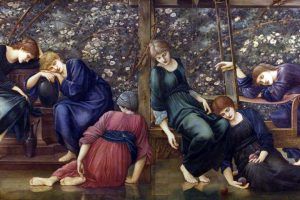 When Burne-Jones painted his Briar Rose cycle, grown women who had too much to say and to do were being forcibly put to bed. They were diagnosed as hysterics, depressives and neurasthenics, whose delicate nerves were no match for their mental gymnastics, and given a prescription of hardcore rest. Many of these women were insomniac. Some had eating disorders; others were suicidal. To a woman (almost) they balked at the societal restrictions that corralled them into being mothers and homemakers and disallowed anything else. Nervous conditions, sleeplessness, self-starvation (that is, disappearing before you are made to disappear), this was their protest.
The writer Charlotte Perkins Gilman described how at Silas Weir Mitchell’s Philadelphia clinic, in the spring of 1887, she was “put to bed and kept there”. Mitchell was the physician who devised the infamous rest cure, after working with soldiers who had emerged from the Civil War afflicted with “wounded nerves”.
more here.
How biologists are creating life-like cells from scratch
Kendall Powell in Nature:
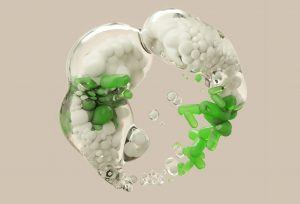 There were just eight ingredients: two proteins, three buffering agents, two types of fat molecule and some chemical energy. But that was enough to create a flotilla of bouncing, pulsating blobs — rudimentary cell-like structures with some of the machinery necessary to divide on their own. To biophysicist Petra Schwille, the dancing creations in her lab represent an important step towards building a synthetic cell from the bottom up, something she has been working towards for the past ten years, most recently at the Max Planck Institute of Biochemistry in Martinsried, Germany. “I have always been fascinated by this question, ‘What distinguishes life from non-living matter?’” she says. The challenge, according to Schwille, is to determine which components are needed to make a living system. In her perfect synthetic cell, she’d know every single factor that makes it tick.
Researchers have been trying to create artificial cells for more than 20 years — piecing together biomolecules in just the right context to approximate different aspects of life. Although there are many such aspects, they generally fall into three categories: compartmentalization, or the separation of biomolecules in space; metabolism, the biochemistry that sustains life; and informational control, the storage and management of cellular instructions. The pace of work has been accelerating, thanks in part to recent advances in microfluidic technologies, which allow scientists to coordinate the movements of minuscule cellular components. Research groups have already determined ways of sculpting cell-like blobs into desired shapes; of creating rudimentary versions of cellular metabolism; and of transplanting hand-crafted genomes into living cells. But bringing all these elements together remains a challenge.
More here.
Wednesday Poem
— “A friend of mine found this photograph in a shoe box in his Grandmother’s attic.
I wonder if those quotation marks imply what I think they do[;]
by the look on their faces, I would say they do.” — The Gaily Grind
Aunty Mary and Her “Friend” Ruth, 1910.
You wear the faded muslin—
did it begin yours or mine?
Everything we have is both.
Everything we are is both,
our faces shaped like sisters,
bodies like lovers. Our eyes
away from the camera as one.
This morning I brushed our hair in bed,
yours then mine, twisted the usual
Psyche knots onto our heads.
My mouth full of pins, you kissed
just the corner. For years
I turned my cheek, held your hands
to keep them from me but no more.
On the chair by the window,
room for only one, so I hold you
round your shoulders to balance us both.
The only difference between us:
yours is a smile that knows the sin
but not the penance and mine,
secret, hardly there.
Your fingers dust my chin,
the flashbulb goes.
by Sarah Sansolo
from Split This Rock
Wednesday, November 7, 2018
Thinking Clearly About Immigration
Kay Hymowitz in the New York Times:
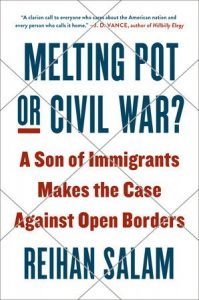 Global migration is triggering the sort of existential questions advanced nations haven’t had to bother with very much. Aside from lines on a map and a shared language, what makes Denmark Denmark, or Canada Canada? When does citizen-feeling for national culture and identity — not to mention budget concerns — veer into xenophobia? How much should a modern, secular nation tolerate the illiberal customs of newcomers from traditional cultures? As a “nation of immigrants,” one with a relatively modest welfare state, the United States should be safe from these prickly questions. After all, we have long been a hyphenated citizenry; our children are tutored — or are supposed to be — in E pluribus unum.
Yet here we are in the throes of a bitter war over immigration. Everyone knows who the enemy is, or thinks he does: One side points at ethnonationalist racists who cheer budget-busting walls, Muslim bans, caged children and deportations of hard-working parents whose only crime is wanting a better life. The other side sees self-deluded elitist hypocrites who condone criminal border-crossing and extravagant social spending as a way of supplying cheap labor to look after their children and clean their homes — while telling an ailing, law-abiding white working class that its time is up.
More here.
America Is No Longer Attracting The Top Minds In Physics
Ethan Siegel in Forbes:
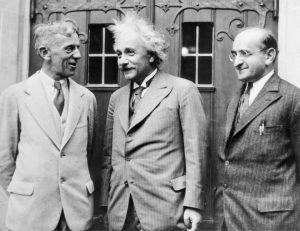 Throughout the 20th century and into the 21st, America emerged at the pre-eminent place to be for physics research in the world. Of the 209 people to ever win the Nobel Prize in Physics, a whopping 93 of them claimed United States citizenship: triple that of Germany, the next-closest country. This was reflected not only at the highest levels of prestige and accomplishment in research, but also in education.
The United States of America became the most desired place in the world to study physics at the highest levels. From fewer than 20 PhDs a year in 1900 to around 500 per year in the 1950s, we now award nearly 2,000 PhDs in physics every year. Moreover, since the 1990s, international students, representing some of the best and brightest talent the world has to offer, represent almost half of those degrees.
Yet, according to the American Physical Society, the past year has seen an alarming, unprecedented drop in the number of international applications to physics PhD programs in the United States. In an extremely large survey of 49 of the largest physics departments in the country, representing 41% of all enrolled physics graduate students in the United States, an overall decrease of almost 12% in the number of international applicants was observed from 2017 to 2018.
More here.
Yuval Noah Harari on Why Technology Favors Tyranny
Yuval Noah Harari in The Atlantic:
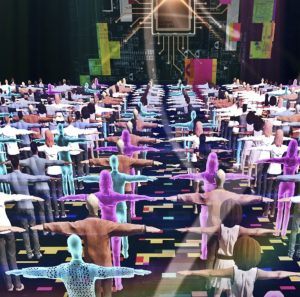 There is nothing inevitable about democracy. For all the success that democracies have had over the past century or more, they are blips in history. Monarchies, oligarchies, and other forms of authoritarian rule have been far more common modes of human governance.
The emergence of liberal democracies is associated with ideals of liberty and equality that may seem self-evident and irreversible. But these ideals are far more fragile than we believe. Their success in the 20th century depended on unique technological conditions that may prove ephemeral.
In the second decade of the 21st century, liberalism has begun to lose credibility. Questions about the ability of liberal democracy to provide for the middle class have grown louder; politics have grown more tribal; and in more and more countries, leaders are showing a penchant for demagoguery and autocracy. The causes of this political shift are complex, but they appear to be intertwined with current technological developments. The technology that favored democracy is changing, and as artificial intelligence develops, it might change further.
More here.
Line Riders: Beethoven’s 5th
Ypres, a Century On
Jay Copp at Commonweal:
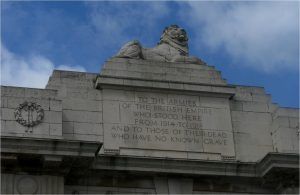 Ypres swarms with somber British tourists, who disembark from buses to walk its cobblestone paths, view its seemingly centuries-old shops, homes, and churches, and wander its 175 cemeteries, located outside town amid the famous poppy fields. The ancient architecture and ambience are an illusion. The entire town was destroyed in World War I. Not a single home or tree survived. Churchill argued that Ypres should not be rebuilt: “A more sacred place for the British race does not exist in the world,” he thundered. But the residents of Ypres who survived the war insisted on rebuilding.
Still, the Belgians have shown their gratitude. Every day is Veterans Day in Ypres. Every night since November 11, 1929 (except for the four years of German occupation during World War II) an elaborate ritual is repeated at eight o’clock: volunteer buglers sound out the Last Post at the Menin Gate, where Allied soldiers marched off to the front. The British endured the most casualties; some quarter million fell in or near Ypres.
more here.
The Odyssey of The Ballpoint Pen
B. Alexandra Szerlip at The Believer:
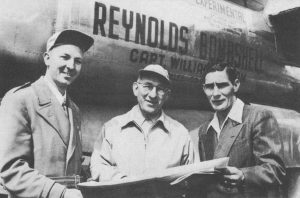 The odyssey, at times hilarious, of the ballpoint pen is a window into entrepreneurship and America’s consumer mentality at the start of the postwar (post WWII) period.
The first “ball tip” pen patent was filed back in 1888, the invention of Massachusetts leather tanner John Loud, who needed to mark hides, but it was never commercially exploited. Fifty years later, Hungarian journalist László Jozsef Biro—frustrated at always having to fill up fountain pens and clean up smudges—noticed that newspaper ink dried almost immediately, leaving the paper relatively smudge-free. But newsprint ink was too thick to flow through regular pen nibs (which often tore up the newsprint); he and his chemist brother, Georg, set to work making models. Their eureka moment came, the story goes, while watching boys playing street marbles; one marble, having rolled through a puddle, left a line behind it. The brothers devised a point fitted with a tiny ball bearing that, fed by a fine-coiled tube in the barrel, rolled (rather than poured) ink onto the page.
more here.
The Life of Saul Bellow
David Mikics at Literary Review:
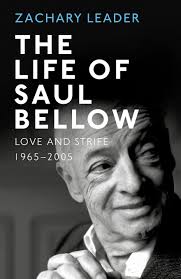 Saul Bellow had what one of his characters in Ravelstein calls ‘a gift for reading reality – the impulse to put your loving face to it and press your hands against it’. Bellow seems to outstrip other novelists in his unembarrassed wish to get as close as possible to the reality of people – their faces, clothes, bodies, speech, gestures. If Bellow’s love for his characters was often contentious and double-edged, well what is love if not the highest form of contention?
Bellow was a personality worthy of his own fictions, a lively, inspired troublemaker, as Zachary Leader shows in the second volume of his magisterial biography. He was ‘a great chain-yanker’ during arguments, his son Daniel said, adding, ‘He liked to dig a pit and cover it with branches so you’d come walking along, whistling away, and fall right in it. Then he would stand at the edge and watch you as you sort of thrashed around. He liked that.’
more here.
The Lies That Bind Us
Kwame Anthony Appiah in IAI:
“And now what will become of us without barbarians? / Those people were a kind of solution.”
—C. P. Cavafy, “Waiting for the Barbarians” (1898)
 Perhaps you know this poem? Constantine Cavafy was a writer whose every identity came with an asterisk, a quality he shared with Italo Svevo. Born two years after Svevo, he died only a few years after him. Cavafy was a Greek who never lived in Greece. A government clerk of Eastern Orthodox Christian upbringing in a tributary state of a Muslim empire that was under British occupation for most of his life, he spent his evenings on foot, looking for pagan gods in their incarnate, carnal versions. He was a poet who resisted publication, save for broadsheets he circulated among close friends; a man whose homeland was a neighborhood, and a dream. Much of his poetry is a map of Alexandria overlaid with a map of the classical world— modern Alexandria and ancient Athens— in the way that Leopold Bloom’s Dublin neighborhood underlies Odysseus’s Ithaca. No single sentence captures this Alexandrian genius better than E. M. Forster’s evocation of him as “a Greek gentleman in a straw hat, standing absolutely motionless at a slight angle to the universe.” 1 And I conjure Cavafy, here, at journey’s end, because I want to persuade you that he is representative precisely in all his seeming anomalousness.
Poems, like identities, never have just one interpretation. But in Cavafy’s “Waiting for the Barbarians” I see a reflection on the promise and the peril of identity. All day the anticipation and the anxiety build as the locals wait for the barbarians, who are coming to take over the city. The emperor in his crown, the consuls in their scarlet togas, the silent senate and the voiceless orators wait with the assembled masses to accept their arrival. And then, as evening falls, and they do not appear, what is left is only disappointment. We never see the barbarians. We never learn what they are actually like. But we do see the power of our imagination of the stranger. And, Cavafy hints, it’s possible that the mere prospect of their arrival could have saved us from ourselves.
More here.
The de-civilising process
Adrian Wooldridge in 1843:
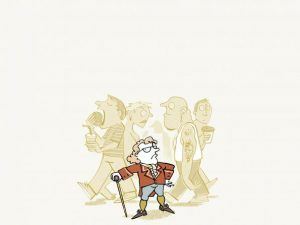 In his new book, “In Pursuit of Civility”, British historian Keith Thomas tells the story of the most benign developments of the past 500 years: the spread of civilised manners. In the 16th and 17th centuries many people behaved like barbarians. They delighted in public hangings and torture. They stank to high heaven. Samuel Pepys defecated in a chimney. Josiah Pullen, vice-principal of Magdalen Hall, Oxford, urinated while showing a lady around his college, “still holding the lady fast by the hand”. It took centuries of painstaking effort – sermons, etiquette manuals and stern lectures – to convert them into civilised human beings.
Reading Thomas’s book on a train recently I was gripped by a terrible realisation: everything our forebears worked so hard to achieve is now reversing. A process that took centuries has been undone in just a few decades. There is no better place to observe the collapse of manners than on mass transport. The most basic move in the civilising process was to make a distinction between the public and the private: persuading people to defecate in lavatories rather than chimneys and eat at regular times in designated places, not whenever or wherever the mood took them. Yet today city streets reek of urine and trains smell of fast food. I recently had the misfortune to sit next to a quivering man-mountain on a train who proceeded to slurp a Coke, demolish a Big Mac, munch fries and spill ketchup onto his beard while giggling at a film on his super-sized iPad. His only concession to the fact that he wasn’t in his own sitting room was to wear headphones.
More here.
Tuesday, November 6, 2018
Can the Republic Strike Back?
Andrew Sullivan in New York Magazine:
 Whatever else it will be, Tuesday will be a relief. We will finally find out where we are in the surreal dystopia of the last two years. We will see, in a tangible way, what America now is.
These years have been overwhelmed and saturated by a single figure with no political experience, who won almost 3 million fewer votes than his opponent, has had consistently lower approval numbers than any of his recent predecessors, and speaks and acts in ways no previous president ever has. He has cast a staggering spell over a hefty segment of the population, and he has earned the intense loathing of the rest. And for these very reasons, it has been tortuously hard to see what is in front of our noses.
Is this the new normal? Or has this been a detour into the freak zone, with a president accidentally elected, a major party temporarily hypnotized, but with a population still aware of something called reality? We’ve tried and tried these past two years to figure that out, and there are many layers of meaning here, but we haven’t had a clear test of anything. Polls are not elections. Only elections are elections. We are entering the human phase of the trials.
More here.
Dear young people, “Don’t Vote”
Please share with the young people you know!
Climate Change Is Already Damaging American Democracy
Vann R. Newkirk II in The Atlantic:

The damage from hurricane michael is still being cataloged. After the Category 4 storm made landfall in the Florida Panhandle two weeks ago, it ripped through parts of Florida and Georgia, killing dozens and destroying homes and vital infrastructure in rural communities. Residents don’t yet have a full account of the lives and property erased in the calamity, and even when they do, that accounting will only provide a rough estimate of what was lost. More difficult still will be dealing with the intangibles: the exhaustion and mental-health consequences, the frayed sense of security and safety, the missed school days, and the deepening vulnerability among people who faced the storm.
As the country deals with an onslaught of powerful hurricanes and other weather-related events, those intangibles have become more evident, and more and more important. Michael is—according to experts I spoke with—both a harbinger of a future climate and a representative of a class of disasters that in the past few years have exposed the vulnerabilities of local and national institutions. Those disasters have highlighted the role of inequality, civic instability, and poor planning in amplifying the effects of both extreme and mundane weather. The evidence seems to be mounting that not only will the developing climate regime, if sustained, expose the cracks in the American democratic project, but it will also widen them.
More here.
The Trump Legions: Despite their sudden rise, they didn’t come out of nowhere
Thomas B. Edsall in the New York Times:
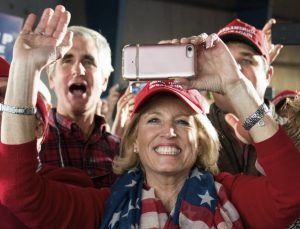 How could this man have been elected to the highest office in the land? And how can Trump not only remain in office but, for the moment at least, appear to stand a reasonable chance of being renominated and even re-elected?
To get some answers to these questions, I turned to a 2018 paper by Ronald Inglehart and two fellow political scientists at the University of Michigan, as well as to a new book by Marc Hetherington and Jonathan Weiler, who are political scientists at the University of North Carolina-Chapel Hill.
In “The Silent Revolution in Reverse: Trump and the Xenophobic Authoritarian Populist Parties,” Inglehart, Jon Miller and Logan Woods provide fresh insight on a subject to which Inglehart, at times writing withPippa Norris of Harvard, has devoted much of his career: the ongoing tension between materialist and post-materialist values and the political consequences of that tension.
More here.