Monday Poem

Teach the Children About the Cycles

.
……
—on a poem by Gary Snyder in which Snyder is
……… visited by Lew Welsh

Dead Lew comes to Gary in a poem
and tells the thing that must be taught,
he says,
……….. Teach the children about the cycles.
The life cycles.
He may as well have said
the universe is a breathing spinning top,
the children should know this,
a cliché is its essence,
what goes around comes around believe it or not;
and
……….. All other cycles, he says,
so as to bring the truth of all turbulence
out and set it on a table turning
to make the why of their dizziness understandable
and clear. Because, Lew goes on to say,
It’s what it’s all about but it’s been forgot,
which keeps us in our fears and burnings
and our fables while at the center,
at its hub, everything is still. This is
what they should be learning

Jim Culleny
3/6/18
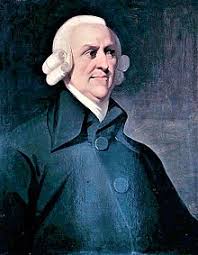
On Adam Smith’s The Wealth of Nations

by Emrys Westacott

I just read Adam Smith’s The Wealth of Nations for the first time. Not every word. It’s over a thousand pages, and there are long “Digressions” (Smith’s term) on matters such as the history of the value of silver, or banking in Amsterdam, which I simply passed over. I was mainly interested in what Smith has to say about work, so I also  merely skimmed some other sections that seemed to have little relevance to my research. Time and again, though, I found myself getting sucked into chapters unrelated to my concerns simply because the topics discussed are so interesting, and what Smith has to say is so thought-provoking. Reading the book is also made easier both by Smith’s admirably lucid writing and by the brief summaries of the main claims being made that he inserts throughout at the left-hand margin.



By any measure The Wealth of Nations is one of the most influential books ever written and represents a monumental intellectual achievement, initiating a paradigm shift in political economy. Before its publication in 1776, the dominant view in Britain and many other countries was some form of mercantilism. According to this theory, the path to prosperity and power for a nation lay in its having a positive balance of trade, exporting more than it imported, thereby accumulating wealth at the expense of its rivals. Government policy thus sought to promote the production of goods while ignoring or even suppressing domestic consumption. Against this, Smith argues that the wealth of a nation does not reside in a store of goods or gold, but consists, rather, in the totality of the economic activity that its people and institutions are engaged in. Read more »

Fifty Shades of Pakistani Feminism

by Samia Altaf

After an anxious and grey winter, the gloom of an unraveling economy, topped by the ominous beating of war drums, spring arrived in Punjab and Lahore’s academies and activists put aside their concerns to celebrate Women’s International Day on March 8. Amidst the blooming of flowers and the heady fragrance of newly sprouting jasmine—feminism and feminist concerns and the doings of women suffused the air.

There were reviews of achievements by Pakistani womenMalala, Sharmeen Chinoy, Mukhtaran Mai, Fehmida Riaz, Hina Khar were lauded. There was the woman’s march of sisterhood and solidarity. The Prime Minister wants to ‘create an environment in which women can play their rightful role.’ Lively discussions were held on university campuses and in exclusive clubs. Television channels and talk shows competed to give more upbeat views of the whole  ‘woman question’ that included duties of women, responsibilities of women, rights of women, clothes of women as well as the pro-women actions undertaken and being planned. A female student of an elite university dared to attempt to wear shorts. Thankfully that is where it remained, a dare. We spoke of the hijab, the veil, its ‘badness’ and ‘goodness,’ and so on. All discussions ended with exhortations for ‘women’s empowerment.’

Ah, that word. What does it even mean? Read more »

Jesus with the Light Brown Hair

by Shawn Crawford

Sallman’s Head of Christ

In 1987, Anderson University, an Evangelical school in Indiana, acquired 140 works by the artist Warner Sallman, including Head of Christ. You may have never heard of Sallman, but in terms of sheer sales and presence, his Head of Christ makes him the most popular 20th Century artist in America. Exponentially more popular than Warhol or Wyeth. If you are a Boomer or Gen X Evangelical, Head of Christ provided the definitive image of Jesus, in a way that you can never shake.

At my house, this was the only “art” hanging on the wall. Many of my friends could say the same. One of the wealthier families in our church also had a copy of Sallman’s Christ at Heart’s Doorwith a heavy gilt frame and one of those fancy lights attached at the top to better illuminate Jesus trying to get in. The painting has obvious echoes to William Holman Hunt’s The Light of the World without thePre-Raphaelite theatrics. Our Jesus did not wear a cape. And that beard needs a trim. As a freshman in college I learned Hunt had also painted The Awakening Conscience, a painting so erotic to my sheltered sensibilities I could not reconcile the two. I also stared at the reproduction in my British literature anthology for hours on end.

If you are wondering just how ubiquitous Sallman’s picture is, over 500 million copies have been sold since he painted it in 1940. That’s enough for every man, woman, and child in the U.S. with plenty left for Justin Trudeau to pass out to his disillusioned base. Oh pretty, pretty Justin. Read more »

Sunday, March 10, 2019

The Oppression of the Supermajority: The defining political fact of our time is not polarization, It’s the thwarting of a largely unified public

Tim Wu in the New York Times:

About 75 percent of Americans favor higher taxes for the ultrawealthy. The idea of a federal law that would guarantee paid maternity leaveattracts 67 percent support. Eighty-three percent favor strong net neutrality rules for broadband, and more than 60 percent want stronger privacy laws. Seventy-one percent think we should be able to buy drugs imported from Canada, and 92 percent want Medicare to negotiate for lower drug prices. The list goes on.

The defining political fact of our time is not polarization. It’s the inability of even large bipartisan majorities to get what they want on issues like these. Call it the oppression of the supermajority. Ignoring what most of the country wants — as much as demagogy and political divisiveness — is what is making the public so angry.

Some might counter that the thwarting of the popular will is not necessarily worrisome. For Congress to enact a proposal just because it is supported by a large majority, the argument goes, would amount to populism. The public, according to this way of thinking, is generally too ill informed to have its economic policy preferences taken seriously.

More here.

Why Do People Love to Hate Steven Pinker?

Tom Bartlett in the Chronicle of Higher Education:

Pinker does get a lot of press, though most-covered doesn’t always mean most-loved. While Enlightenment Now received ecstatic blurbs — Bill Gates called it his “favorite book of all time” — other assessments were less kind. A New York Times reviewer panned it as “disdainful and condescending — sympathetic to humanity in the abstract but impervious to the suffering of actual human beings.” The dismissive term “Pinkering” has been coined to describe applying a too-sunny gloss to world events. A cartoon strip published in Current Affairs shows a crazed-looking Pinker staring into a mirror: “Remember,” cartoon Pinker says to himself, “no matter what people say it’s statistically impossible for you to be the worst person on the planet.” In addition, a surprising number of detractors have referred to Harvard’s Johnstone family professor of psychology as “Peven Stinker,” which, while not exactly an argument, does capture a certain disdain.

More here.

Why Does Congress Care More About Jewish Feelings Than Palestinian Rights?

Peter Beinart in Forward:

Late last month, in between the firestorm over Congresswoman Ilhan Omar’s comments about AIPAC’s influence being “all about the Benjamins” and the firestorm over her comments about “allegiance to a foreign country,” the United Nations issued a report into Israel’s killing of 189 Palestinians — some of whom were journalists and health workers, and 35 of whom were children — and injuring of more than 9,000 during protests last year in the Gaza Strip.
The report, which was based on 325 interviews and over 8,000 documents, alleged that, “Israeli security forces killed and maimed Palestinian demonstrators who did not pose an imminent threat of death or serious injury to others when they were shot.”

It suggested that the killings may constitute a crime against humanity.

The United States is not a bystander in this. For many years, Israel has used American weaponry in Gaza: Apache helicopters, F16s, bunker busting bombs. Amnesty International has questioned whether Israel’s use of such weapons violates the Arms Export Act of 1976, which requires that American-made weapons not be used for “violations of internationally recognized human rights.”

None of this means Congress should take the UN report as gospel. The UN is a flawed institution populated by many regimes that don’t like Israel, and its evidence should be thoroughly interrogated.

But Congress didn’t debate the report. It didn’t investigate its claims. It pretended that it did not exist.

More here.

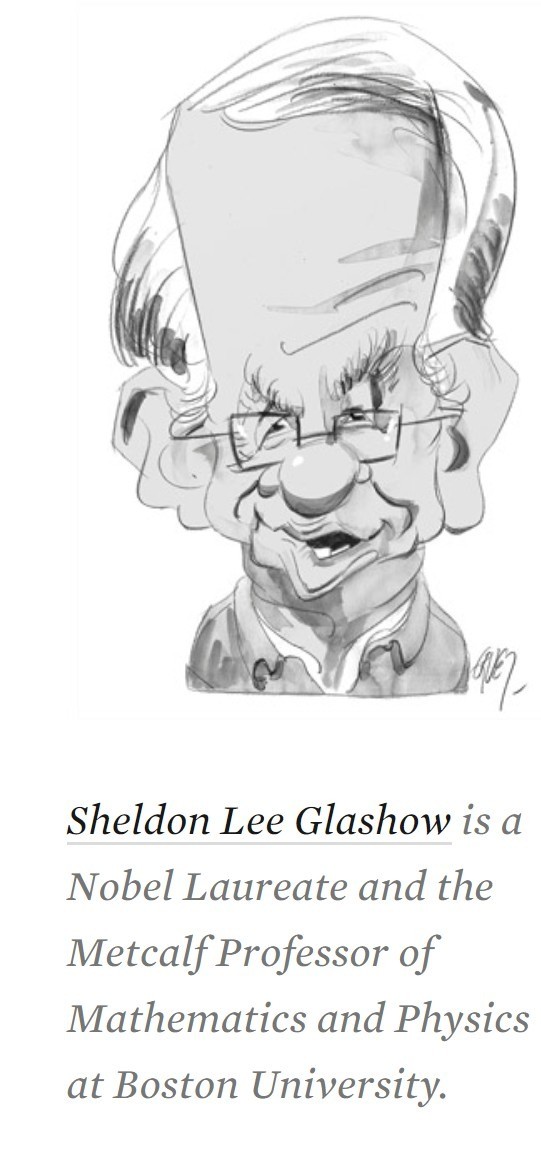
Sheldon Lee Glashow reviews “Lost in Math: How Beauty Leads Physics Astray” by Sabine Hossenfelder

Sheldon Lee Glashow in Inference Review:

I approached Lost in Math with trepidation. Its subtitle, “How Beauty Leads Physics Astray,” annoyed me because, like Albert Einstein, Paul Dirac, and many others, I have always regarded elegance, simplicity, and beauty as essential criteria for physical laws. The preface begins even more disturbingly:

They were so sure, they bet billions on it. For decades physicists told us they knew where the next discoveries were waiting. They built accelerators, shot satellites into space, and planted detectors in underground mines. … But where physicists expected a breakthrough, the ground wouldn’t give. The experiments didn’t reveal anything new.1

These imprudent words demand rebuttal, but they do not characterize the remainder of the book. Sabine Hossenfelder shows even less understanding of her forsaken discipline in a recent essay for The New York Times. “Is a new $10 billion particle collider worth the money?” she asks. “If particle physicists have only guesses, maybe we should wait until they have better reasons for why a larger collider might find something new.”2 The purpose of costly particle colliders is not just to test theorists’ sometimes idle speculations. It is to look where no one has looked before, to explore as best we can the workings of the world we are born into. CERN’s Large Hadron Collider (LHC) has done just this. It has discovered that our Standard Model correctly describes the microverse at the highest energies yet available. Our European and Chinese colleagues now recognize—as proponents of the abandoned American Superconducting Super Collider (SSC) did twenty-five years ago—that a far more powerful instrument is needed, should we choose to learn nature’s secrets.

More here.

Sunday Poem

Be Bored

For the sake of cleansing seconds
stare at something still.
Free from feeling filled
hum the sound of the sun descending
sitting in its final ribbons.
Watch what leaves shake
in the unseen breeze.
Feel your own fingers.

Let time be soil for time.
Let hunger set in

by Sean Kearny
from Press 1 
Summer 2013

What I’m reading, from Flann O’Brien to The Odyssey

Clive James in Prospect Magazine:

Thrumming discreetly in the deep regions of Addenbrooke’s Hospital here in Cambridge, the X-ray projectors continue to chase a dodgy little cancer from one of my facial cavities to the next, so I am still catching up with Christmas. One of my presents was The Collected Letters of Flann O’Brien, edited by Maebh Long, who must have wondered, towards the end of her task, what kind of nut-bag she had taken on. Justifiably regarded as an adornment to Irish literature, O’Brien was a funny novelist who was even funnier as a columnist, but there is nothing funny about hearing a grown mind fooling around with the word “nigger.” In his later years O’Brien, in his correspondence, did so habitually, although we perhaps need to see his bad habit in the oblique light cast by the further fact that he never gave up on the idea that St Augustine might have been black.

O’Brien knew a lot about St Augustine, whom he read in the original Latin and admired greatly, just as Philip Larkin, supposedly prejudiced against all blacks, greatly admired Sidney Bechet. Doesn’t O’Brien’s admiration temper the apparent disparagement of saddling St Augustine with the “n” word? One would like to think so, but only because one prefers a sane O’Brien to a festering racist, however talented. Not that he ever went public with his quirk. Like HL Mencken, who was anti-semitic but never said so in print, O’Brien had the sense to realise that his prejudice, if revealed, would poison the water supply. Or that, anyway, is what I prefer to think, while leaving room to be told that At Swim-Two-Birds is really a coded hosanna to Jim Crow.

More here.

Michael Jackson’s hollow crown

Yo Zushi in New Statesman:

Diamond Joe Esposito was once plain Joseph Carmine Esposito, an Italian-American mechanic’s son growing up in Chicago during the Second World War. In the paranoid 1950s, he was drafted into service and sent to West Germany, where he met and befriended Elvis Presley. After their discharge, the singer employed him as his road manager and they remained close until the end – at least, the premature, undignified end of Presley’s life on 16 August 1977. Esposito was among the first to see his still-young body sprawled on the floor of his bathroom, beside some vomit and a book about the Turin shroud. Ten years later, Esposito was in the service of another king – this time the king of pop, Michael Jackson, for whom he was overseeing the logistics of the Bad tour. Jackson was another kind of pop star altogether, and big on a scale that would surely have been unimaginable even for Presley. But his confounding descent from great American icon to lonely, seedy, delusional butt of lazy comedians’ jokes would follow – with considerably more darkness – the template established by the first rock ’n’ roll icon. Neverland substituted for Graceland, the powerful sedative propofol for sundry uppers and downers, yet the grand narratives rhymed. When Esposito encountered Jackson at the peak of his powers, did he think, “Here we go again”?

After Elvis’s drug-related death at the age of 42, his cash-money manager Tom Parker said, “This changes nothing.” In a way, he was right. Presley’s music has continued to sell; a couple of years ago an Elvis album debuted at number one in the British charts. And since Jackson’s drug-related death at the age of 50, on 25 June 2009, his work has earned his estate more than $2bn. Yet death is the moment when a star loses control of his image once and for all, if he ever truly had control of it in the first place. And where the afterlife has been relatively kind to Elvis, who remains loved despite the fat jokes, I’m not so sure that Jackson the superstar will survive his.

More here.

Saturday, March 9, 2019

A belief in meritocracy is not only false: it’s bad for you

Clifton Mark in Aeon:

Although widely held, the belief that merit rather than luck determines success or failure in the world is demonstrably false. This is not least because merit itself is, in large part, the result of luck. Talent and the capacity for determined effort, sometimes called ‘grit’, depend a great deal on one’s genetic endowments and upbringing.

This is to say nothing of the fortuitous circumstances that figure into every success story. In his book Success and Luck (2016), the US economist Robert Frank recounts the long-shots and coincidences that led to Bill Gates’s stellar rise as Microsoft’s founder, as well as to Frank’s own success as an academic. Luck intervenes by granting people merit, and again by furnishing circumstances in which merit can translate into success. This is not to deny the industry and talent of successful people. However, it does demonstrate that the link between merit and outcome is tenuous and indirect at best.

More here.

In her short life, mathematician Emmy Noether changed the face of physics

Emily Conover in Science News:

On a warm summer evening, a visitor to 1920s Göttingen, Germany, might have heard the hubbub of a party from an apartment on Friedländer Way. A glimpse through the window would reveal a gathering of scholars. The wine would be flowing and the air buzzing with conversations centered on mathematical problems of the day. The eavesdropper might eventually pick up a woman’s laugh cutting through the din: the hostess, Emmy Noether, a creative genius of mathematics.

At a time when women were considered intellectually inferior to men, Noether (pronounced NUR-ter) won the admiration of her male colleagues. She resolved a nagging puzzle in Albert Einstein’s newfound theory of gravity, the general theory of relativity. And in the process, she proved a revolutionary mathematical theorem that changed the way physicists study the universe.

It’s been a century since the July 23, 1918, unveiling of Noether’s famous theorem. Yet its importance persists today. “That theorem has been a guiding star to 20th and 21st century physics,” says theoretical physicist Frank Wilczek of MIT.

Noether was a leading mathematician of her day. In addition to her theorem, now simply called “Noether’s theorem,” she kick-started an entire discipline of mathematics called abstract algebra.

More here.

Scott Aaronson disagrees with Sabine Hossenfelder on whether to build a collider to succeed the LHC

Scott Aaronson in Shtetl-Optimized:

I’ve of course been following the recent public debate about whether to build a circular collider to succeed the LHC—notably including Sabine Hossenfelder’s New York Times column arguing that we shouldn’t.  (See also the responses by Jeremy Bernstein and Lisa Randall, and the discussion on Peter Woit’s blog, and Daniel Harlow’s Facebook thread, and this Vox piece by Kelsey Piper.)  Let me blog about this as a way of cracking my knuckles or tuning my violin, just getting back into blog-shape after a long hiatus for travel and family and the beginning of the semester.

Regardless of whether this opinion is widely shared among my colleagues, I like Sabine.  I’ve often found her blogging funny and insightful, and I wish more non-Lubos physicists would articulate their thoughts for the public the way she does, rather than just standing on the sidelines and criticizing the ones who do. I find it unfortunate that some of the replies to Sabine’s arguments dwelled on her competence and “standing” in physics (even if we set aside—as we should—Lubos’s misogynistic rants, whose predictability could be used to calibrate atomic clocks). It’s like this: if high-energy physics had reached a pathological state of building bigger and bigger colliders for no good reason, then we’d expect that it would take a semi-outsider to say so in public, so then it wouldn’t be a further surprise to find precisely such a person doing it.

Not for the first time, though, I find myself coming down on the opposite side as Sabine. Basically, if civilization could get its act together and find the money, I think it would be pretty awesome to build a new collider to push forward the energy frontier in our understanding of the universe.

More here.

The Once and Future Bolaño

Sean Alan Cleary at Public Books:

It was a December 17, 2012, review in the New Republic that called it. In the course of largely panning Roberto Bolaño’s Woes of the True Policemanas an incomplete work that “showed [its] seams,” the reviewer, Sam Carter, declared that the immortal Bolaño was—finally—dead. It’d been nine years and 10 novels translated since the author’s death from liver failure, and now his illustrious second life in the American literary public’s eye had ended.1 “We have enough,” the review concluded.

The posthumous wave of translations and publications that had kept Bolaño alive for American audiences had crashed—or, at least the “Bolaño Bubble,” as Carter called it, had burst. A New York Times review declared that Woes has an appeal that “is to completists only,” and, if it were an album, that it would be akin to “a collection of outtakes, alternate versions, and demos.” The book’s publisher, Farrar, Straus & Giroux, had described Woes as Bolaño’s “last, unfinished novel” and added an explanatory note that laid out the rummaging done among his papers to put the thing together.

more here.