
Category: Archives
‘Love Your Enemies’ urges readers to meet vitriol with decency
Terry W. Hartle in The Christian Science Monitor:
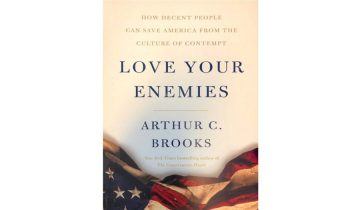 Arthur Brooks is one of the limitless number of policy analysts who toil in Washington. He stands out both because he is prolific and his work has had an impact. He has already written 10 books on a wide range of subjects, served as president of the influential center-right American Enterprise Institute, and writes a column for the Washington Post. His background sets him apart. An accomplished classical musician, he spent 12 years playing in a symphony orchestra. He worked his way through college and attended Thomas Edison State University in New Jersey – not exactly a “big name” school in the corridors of power (though he did earn a Ph.D. in public policy from the Rand Institute). On a personal level, he is deeply religious (Roman Catholic) and calls the Dalai Lama a friend and mentor.
In his latest book, Love Your Enemies: How Decent People Can Save America From the Culture of Contempt, Brooks takes aim at the hypertoxic climate that affects our civic culture. His description of the current situation is essentially that “hyperbolic” public discourse driven by an “outrage industrial complex” has produced a culture of contempt that is tearing America apart.
He uses the word “contempt” deliberately because it is more than mere anger. A culture of contempt reflects a desire to “mock, shame, and permanently exclude [the other side] from relationships by belittling, humiliating, and ignoring” those with whom we disagree. “Contempt” says to others: “You disgust me. You are beneath caring about.” Brooks marshals an impressive amount of evidence to make his point. Not only is such behavior damaging to the public discourse, he writes, but it undermines the health of not only its practitioners but also of those on the receiving end. He cites research to suggest that humans are likely hard-wired to be decent and kind and to seek common ground. To him, the toxic political culture undermines our democracy and health and is contrary to human nature.
More here.
Darwinian existentialism: The history — and evolution — of the meaning of life
Michael Ruse in Alternet:
 As the French novelist Albert Camus said, life is “absurd,” without meaning. This was not the opinion of folk in the Middle Ages. A very nice young Christian and I have recently edited a history of atheism. We had a devil of a job – to use a phrase – finding people to write on that period. In the West, Christianity filled the gaps and gave life full meaning. The claims about our Creator God and his son Jesus Christ, combined with the rituals and extended beliefs, especially about the Virgin Mary, meant that everyone’s life, to use a cliché from prince to pauper, made good sense. The promises of happiness in the eternal hereafter were cherished and appreciated by everyone and the expectations put on a godly person made for a functioning society.
Then, thanks to the three Rs, it all started to crumble. First the Renaissance, introducing people to the non-believers of the past. Even the great Plato and Aristotle had little place for a Creator God. Then the Reformation tore into established beliefs such as the importance of the Virgin Mary. Worse, the religious schism suggested there was no one settled answer. Finally, the (Scientific) Revolution, showed that this plant of ours, Earth, is not the center of the universe but a mere speck in the whole infinite system. This system works according to unbreakable laws – no miracles – and God became, in the words of a distinguished historian, a “retired engineer.” There was still the problem of organisms, whose intricate design surely had to mean something. Blind law just leads to rust and decay. And yet, organisms defy this. If a clever technician set out to make an instrument for spotting things at great distances, the eye of the hawk is built exactly as one would predict. There had to be a reason. As the telescope had a telescope designer, so the eye surely pointed to The Great Optician in the Sky. Along came Charles Darwin with his theory of evolution. He showed, through his mechanism of natural selection – the survival of the fittest – how blind law could indeed explain the eye. Thanks to population pressures, there is an ongoing struggle for existence, or more importantly struggle for reproduction. Simply, those organisms with better proto-eyes did better in this struggle, and over time there was general improvement. The hawks with keener sighthad more babies! They were “naturally selected.”
…That is the secret, the recipe, for a meaningful life in this Darwinian world. First, family and the love and security that that brings. Then society, whether it be going to school, shopping at the supermarket, or simply having a few drinks with friends, and sometimes strangers. Third, the life of the mind. Shakespeare’s creative works are about people and their relationships – happy (Twelfth Night), sad (Romeo and Juliet), complex (Hamlet), doomed (Macbeth), triumphant (Henry V). This is the life of meaning. Take life for what it is. Enjoy it to the full, realizing that the secret of true happiness is being fully human, taking from and giving to others. And stop worrying about the future. There may be one. There may not. There is a now.
More here.
Saturday, April 27, 2019
How to Fuck Your Neighbor
Maryse Meijer at the LARB:
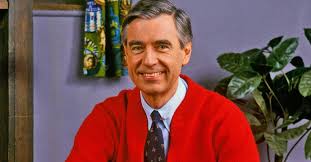 For me — and, I suspect, for many others — my crush on Rogers has something to do with seeing a man play, and make-believe, and talk openly about his feelings; it’s about what it means to see a man not acting like “a man” at all. And the excitement of that — political, ethical, and, yes, sexual. What would it be like, I wonder as I watch Rogers, to fuck a man who rejects masculinity? How does Rogers, embodying this alternative, make us think about sex, about who it is safe to do it with, and how, and why, and who we become when we fuck, and what hurts when we do, and what might feel good, and what never did, and why our sex is so often marked by violence, physical or mental or emotional. The Rogers phenomenon is about what masculinity might look like if one rejects its patriarchal construction; it’s about the fear of — and intense desire for — a radical alternative.
more here.
How the Suicide Bomber Shaped the Modern Age
Peter Beaumont at The Guardian:
 What Overton proposes is a sort of grand unified theory of suicide bombing, tracing a thread of bloody utopian thinking through a century or so of self-destructive murder, where the act prefigured either an idea of self-sacrifice for a greater good or reflected the religious conviction that the self continues.
“Such influences,” he writes in his prologue, “inspired the title of this book… It refers to the acceptance of death as the price of a bombing; how a suicide attack is perceived as the best way – even the only way – to defeat the enemy and usher in a new, peaceful age on earth; how a suicide attack is seen to offer the martyr access to paradise in their next life as reward for their actions”.
more here.
Sex, Art, and Misogyny
Coco Fusco at the NYRB:
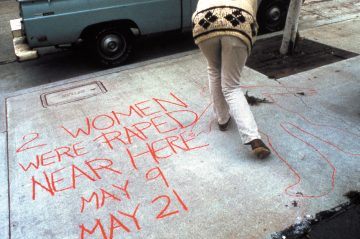
Vivien Green Fryd’s new book, Against Our Will: Sexual Trauma in American Art Since 1970, arrives at this historical moment to offer an overview of American feminist artists’ treatment of rape. Fryd takes the first part of her title from Susan Brownmiller’s best-selling Against Our Will: Men, Women and Rape (1975), which called for a redefinition of rape as a political crime against women. Although some readers criticized the book for its comparisons of rape with lynching, Brownmiller’s argument that rape was an instrument of oppression against all women and that Freudian psychoanalysis had unjustly discredited women’s accounts of rape (by presuming them to be fantasies) helped to change laws relating to sex crimes. Rape shield laws were adopted in the late 1970s to prohibit the admission of evidence of or the questioning of rape complainants about their past sexual behavior.
Similarly, Fryd concentrates on feminist art that foregrounds the pervasiveness of rape, proposing that such art should be valued for its capacity to empower survivors and enhance public awareness. She focuses on how the experience of the survivor rather than the action of the perpetrator is represented in art and how it affects viewers.
more here.
The Gray Race for the White House
Edward-Isaac Dovere in The Atlantic:
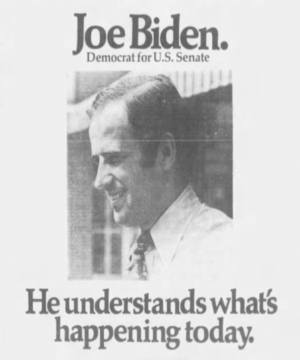 “Joe Biden. He understands what’s happening today.”
The newspaper ad ran a few weeks before the 1972 Senate election in Delaware, when the upstart 29-year-old was challenging a 63-year-old incumbent. The ad, which appeared in the News Journal, Delaware’s major newspaper, happened to run under a column that described Biden’s newly combative strategy in the closing days of the race. Biden’s approach then, according to the columnist, was “in effect, ‘Dear old dad may have been right for his time—and I love him—but things are different now.’” The world was changing in the 1970s. It’s changing even more now. But the early months (at least) of the 2020 race are going to be dominated by three white men in their 70s arguing about how to make America great again: Donald Trump is turning 73 in June, Biden is 76, Bernie Sanders is 77.
Trump wants age to be an issue—he thinks it helps him. “I look at Joe, I don’t know about him. … They’re all making me look very young, both in terms of age, and in terms of energy,” he said on Friday, getting onto a helicopter on the White House lawn. “I am a young, vibrant man.”
More here.
Saturday Poem
Baseball Canto
Watching baseball, sitting in the sun, eating popcorn,
reading Ezra Pound,
and wishing that Juan Marichal would hit a hole right through the
Anglo-Saxon tradition in the first Canto
and demolish the barbarian invaders.
When the San Francisco Giants take the field
and everybody stands up for the National Anthem,
with some Irish tenor’s voice piped over the loudspeakers,
with all the players struck dead in their places
and the white umpires like Irish cops in their black suits and little
black caps pressed over their hearts,
Standing straight and still like at some funeral of a blarney bartender,
and all facing east,
as if expecting some Great White Hope or the Founding Fathers to
appear on the horizon like 1066 or 1776.
But Willie Mays appears instead,
in the bottom of the first,
and a roar goes up as he clouts the first one into the sun and takes
off, like a footrunner from Thebes.
The ball is lost in the sun and maidens wail after him
as he keeps running through the Anglo-Saxon epic.
And Tito Fuentes comes up looking like a bullfighter
in his tight pants and small pointy shoes.
And the right field bleechers go mad with Chicanos and blacks
and Brooklyn beer-drinkers,
“Tito! Sock it to him, sweet Tito!”
And sweet Tito puts his foot in the bucket
and smacks one that don’t come back at all,
and flees around the bases
like he’s escaping from the United Fruit Company.
As the gringo dollar beats out the pound.
And sweet Tito beats it out like he’s beating out usury,
not to mention fascism and anti-semitism.
And Juan Marichal comes up,
and the Chicano bleechers go loco again,
as Juan belts the first ball out of sight,
and rounds first and keeps going
and rounds second and rounds third,
and keeps going and hits paydirt
to the roars of the grungy populace.
As some nut presses the backstage panic button
for the tape-recorded National Anthem again,
to save the situation.
But it don’t stop nobody this time,
in their revolution round the loaded white bases,
in this last of the great Anglo-Saxon epics,
in the territorio libre of Baseball.
That Man From Stratford
Dominic Dromgoole in The New York Times:
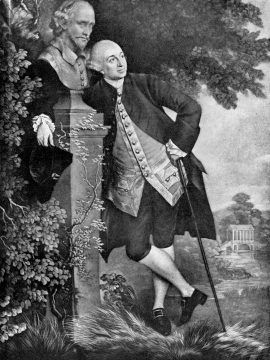 Shakespeare’s power to endure has been ensured by twin track modes of survival: his life on the page and on the stage. His texts are pored over scrupulously by academics, read dreamily by kids and scanned with soft remembrance by the sere. At any given moment, his dramatic verse is sung, shouted, muttered and sometimes spoken with the warm assurance it needs, from hundreds of stages to thousands of eager spectators.
Two new books — “Shakespeare’s Library,” by Stuart Kells, and “What Blest Genius?,” by Andrew McConnell Stott — offer insights from each strand. Stott’s book delivers a vivacious portrait of the Stratford-upon-Avon Jubilee of 1769, organized by the actor and manager David Garrick, whose goal was to make a lot of noise for himself and in the process marmorealize Shakespeare. Kells goes on a quest through the oddly perverse world of booksellers and bibliographers, in search of Shakespeare’s own tomes. Coming from a performance rather than an academic background, I have a greater propensity for the Garrick story, but whatever your background, it’s easy to distinguish between a book to be cherished and one to be thrown across the room.
More here.
Friday, April 26, 2019
Board Games and the Meaning of History
Alex Andriesse in The Public Domain Review:
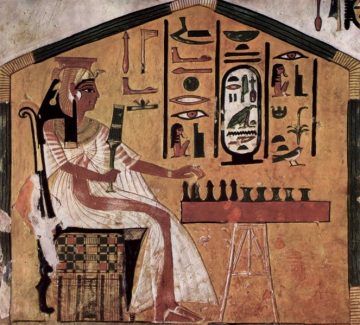 Ten thousand years ago, in the Neolithic period, before human beings began making pottery, we were playing games on flat stone boards drilled with two or more rows of holes.1 By the Early Dynastic Period in Ancient Egypt, three millennia later, board games were already represented in hieroglyphs. And on the wall of Nefertari’s tomb, built in the twelfth or thirteenth century BCE, someone painted the queen playing Senet, one of three Ancient Egyptian board games whose pieces have come down to us, along with Mehen and Hounds and Jackals.
The ancient Greeks, for their part, had Tabula, an ancestor of backgammon; the Romans added Latrones, an ancestor of chess. All across the ancient Near East, people played the Game of Twenty Squares, while in ancient China they played Liubo and in ancient India Moksha Patam, which was rechristened Snakes and Ladders when colonials imported it to Britain in the Victorian era. Wherever there has been civilization, strange to say, there have been games played on boards.
Until about the seventeenth century, these games tended to be traditional folk inventions that could not be traced back to a maker. Their boards were also relatively abstract, consisting of squares, triangles, spirals, or holes.2 With the advent of the Enlightenment and the rise of capitalism, however, the board games of Europe — like so much else on the continent — began to change.
More here.
A marine parasite’s mitochondria lack DNA but still churn out energy
Tina Hesman Saey in Science News:
 One parasite that feeds on algae is so voracious that it even stole its own mitochondria’s DNA.
Mitochondria — the energy-generating parts of cells — of the parasitic plankton Amoebophyra ceratii seem to have transferred all of their DNA to the cell’s nucleus, researchers report April 24 in Science Advances. The discovery is the first time that scientists have found an oxygen-using organism with fully functional mitochondria that don’t have any mitochondrial DNA. (Some anaerobic organisms, which don’t need oxygen, and thus mitochondria, to survive, have also lost mitochondrial DNA.)
Mitochondria are thought to be bacteria that were captured by other cells and eventually became standard parts of eukaryotic cells — cells that encase their DNA and other parts in membranes. Mitochondria reside outside of the nucleus in a cell’s jellylike guts, the cytoplasm. Part of the settling-in process involved relocating some genes needed for mitochondria’s function to the nucleus of host cells. But most mitochondria kept at least a few genes. (Human mitochondria held on to 37 genes.)
Not so for A. ceratii, Uwe John of the Alfred Wegener Institute in Bremerhaven, Germany, and colleagues discovered.
More here.
Why the U.N. chief’s silence on human rights is deeply troubling
Ken Roth in the Washington Post:
 Halfway through his first five-year term, U.N. Secretary General António Guterres is becoming defined by his silence on human rights — even as serious rights abuses proliferate.
U.N. secretaries general have all struggled with when to speak out, trying to balance their role as quiet mediators of disputes with the need to represent core U.N. values. Outspoken support for rights can close some diplomatic doors but keeping quiet leaves the perception that the United Nations is indifferent to atrocities, abandoning the victims while often undermining prospects for peace. Guterres has firmly sided with quiet diplomacy.
He set the tone early in his tenure, which corresponded with President Trump’s inauguration. Guterres criticized Trump’s “Muslim ban” only after many other governments had condemned it — and then without mentioning Trump.
Guterres perhaps didn’t want to risk giving Trump an excuse to stop sending checks to the United Nations. But that reluctance to speak out has also characterized his approach to other powerful governments such as Saudi Arabia, China and Russia.
More here.
Bohemian Rhapsody by 40 Fingers
Edward Gorey’s Life as Art
Jillian Steinhauer at The Nation:
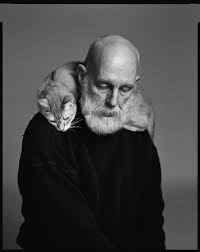 Published 18 years after his death, Born to Be Posthumous is the first full-length biography of Gorey. (His friend Alexander Theroux released a shorter, more intimate portrait, which he later expanded, in 2000.) Coming in at just over 500 pages, the book meticulously tells the story of the unconventional author and artist, who amassed an ardent following yet remains unknown to many readers. The fact that Gorey’s work is either fiercely beloved or completely unfamiliar has to do with the type of work it is: His primary output was small volumes that are reminiscent of children’s books in form but tell mostly adult tales of melancholy, mystery, and often sudden death—especially the deaths of children. “Tales” may be too strong a word in some cases, even when the contents cohere; sometimes they’re just collections of limericks or rhyming couplets of assorted words. As an adherent of literary nonsense and surrealism, Gorey was less interested in plot than tone, which he created in part through black-and-white drawings that look like prints.
more here.
Remembering Alex Brown
Rachel Kushner at Artforum:
 “I’ll be wearing a blue anorak,” he said to me on the phone, so I could identify him when we met. We were more like immediate siblings than date possibilities for each other, and I repeated this line about a blue anorak to him for twenty years. He claims there was no blue anorak and what the fuck is an anorak, anyhow? But that’s what I remember. We went to see a Gerhard Richter show at Marian Goodman. I was aware that Alex’s grandfather Alexander Lippisch was a famous Luftwaffe aeronautical engineer who was recruited to White Sands Missile Range after the war. Looking at Richter’s paintings together, I immediately associated Richter’s blend of formal precision and German trauma with Alex’s. From the gallery, we walked into Central Park. We sat on a rock and Alex told me that one day, on a very similar rock, he’d been on acid with his friend the painter Alexander Ross. As they sat on this rock, tripping, they watched Alex Katz approach a Sabrett cart and buy a hot dog. Three painters named Alex: two on acid, one eating a hot dog. They left and went to Alex Brown’s place on Forsyth Street and, still tripping, walked into the scene of a dramatic drug bust.
more here.
Delacroix’s Lion Hunt at the 1855 Exposition Universelle
Jennifer Olmsted at nonsite:
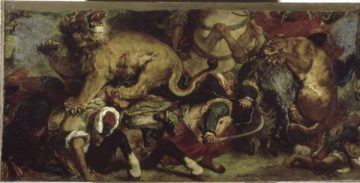
Delacroix Eugène (1798-1863)
Bordeaux, musée des Beaux-Arts
The sheer oddness of Delacroix’s subject choice and the venue for which his painting was produced suggest that there was more at stake here than the simple reenactment of a cherished theme. Barthélémy Jobert has stressed the Exposition’s significance for the artist, calling it “the final turning point in Delacroix’s career—and one of the most important stages, when he was finally acknowledged by every authority.”10 In Jobert’s estimation, Delacroix’s participation in the Exposition resulted in his election, after seven previous rejections, to the Institut de France. The Exposition was unquestionably a moment of high visibility for Delacroix, both as an artist and as an administrator (the latter thanks to his appointment to the organizing committee). While he cannot have known what impact the Exposition would have on his career, Delacroix understood its importance as a showcase for contemporary art, and he persuaded the committee that the Exposition should focus on the work of living artists rather than serving as a retrospective of nineteenth-century art.11Given this context, it seems likely that the decision to depict a lion hunt was made carefully. Delacroix received his official appointment to the organizing committee on 24 December 1853, and the commission for the painting followed on 24 March 1854.
more here.
Friday Poem
I Am Not a Literary Wife
—for Sumra
I spill seeds
watch them
sprout
my trinket children
pull lobes
breasts choose
to be pendulous
after years
pinched metaphors
in closets and on sheets
of orgasmic upheaval
when afterwards you scribble
under an obsessive shade
of a yellow lamp
fingering hairs
I tuck pillows’ case
a part-time muse
substantiate a make-shift smile
a line or a word
fixes me
while a lonely dog cracks
the silence of night providing you
the major inspiration deviating
from my arms
odd embraces
vicarious extensions
stains on pages
you call poems
for God’s sake
I am not over.
by Rizwan Akhtar
from Lahore, I Am Coming
Punjab University Press, 2017
Nurture Alone Can’t Explain Male Aggression
Steve Stewart-Williams in Nautilus:
 A young bank teller is shot dead during a robbery. The robber flees in a stolen van and is chased down the motorway by a convoy of police cars. Careening through traffic, the robber runs several cars off the road and clips several more. Eventually, the robber pulls off the motorway and attempts to escape into the hills on foot, the police in hot pursuit. After several tense minutes, the robber pulls a gun on the cops and is promptly killed in a hail of gunfire. It is later revealed the robber is a career criminal with a history of violent crime stretching all the way back to high school.
Now tell me: Are you picturing a male or a female robber? If you look back at the last paragraph, you’ll notice that I didn’t actually specify the robber’s sex. Nonetheless, I’d be willing to bet that you were picturing a man. Don’t worry—you weren’t being sexist; you were simply playing the odds. Most men are not especially violent, but most people who are especially violent are men. And rare though they might be, men such as our fictitious robber are the extreme of a more general trend, namely that men are more violent than women, more in-your-face aggressive, and more prone to taking risks.
Why? Where do these all-too-familiar sex differences come from? A recent New York Times opinion piece weighed in on this difficult question, and came to a fairly common conclusion. The headline captured the gist: “It’s Dangerous to Be a Boy: They smoke more, fight more and are far more likely to die young than girls. But their tendency to violence isn’t innate.” (Emphasis added.) In other words, sex differences in aggression come entirely from the environment: from culture rather than biology, nurture rather than nature. Let’s call this the Nurture Only position.
More here.
The personal trauma that lies behind Edvard Munch’s unnerving art
James Waddell in MIL:
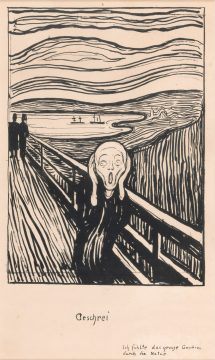 At the start of the 20th century Sigmund Freud observed the psychological phenomenon of “repetition compulsion”, the pathological desire to repeat a pattern of behaviour over and over again. He no doubt would have diagnosed the painter Edvard Munch with such an affliction. As the British Museum’s new exhibition of his work demonstrates, Munch returned obsessively to certain visual motifs: uncanny sunsets, zombie-like faces, threateningly sexualised female bodies.
Freud might have looked to Munch’s biography for the roots of his mental anguish. There is much to unpick. His mother died from tuberculosis in 1868 when he was five. Nine years later, his sister died of the same disease. At a time of rapid industrialisation and grinding urban poverty, tuberculosis was tragically common. Munch had to watch as his father, a doctor, desperately tried to save the lives of consumptive patients, often resorting to prayer when all else had failed. This, and the Lutheran strictures of Munch’s adolescence in conservative Kristiana (now Oslo), did little to encourage the healthy processing of Munch’s trauma. By the time he reached adulthood he longed to escape, and managed to do so by falling in with a bohemian set of radical artists and writers, including Henrik Ibsen and August Strindberg. He soon developed a visual style that cast aside the Scandinavian traditions of formal portraiture and stately landscapes, resulting in vivid and unnerving prints.
Printmaking is by its very nature a process of repetition. There is also something almost violent about its technical vocabulary of acid bites, drypoint scratches and woodcut gouges. Possibly this appealed to Munch, as he printed, scraped, clawed and re-printed, the resulting image darkening with each new impression.
More here.
Thursday, April 25, 2019
50 lost words from the OED
Stan Carey in Sentence first:
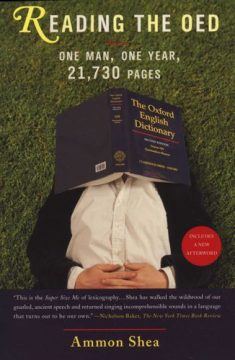 Ammon Shea loves dictionaries – especially the OED. He loves the OED so much, he read it – the whole thing, in its second edition: 21,730 pages with around 59 million words. It took him a year, full-time, and he wrote a book about it, titled Reading the OED (2008).
This is not a review, but it is a recommendation. Reading the OED will charm anyone who’s into dictionaries and words, especially unusual ones, or anyone curious about unusual hobbies and passions-slash-afflictions. (I did review Shea’s 2014 book Bad English, an entertaining historical snapshot of the English usage wars.)
When I said Shea loves dictionaries, I meant he really, really loves them. (This repetition of really is an example of epizeuxis, which is defined below.) Before the book came out, he moved house and brought 45 boxes: dictionaries filled 41 of them. As well as the 20-volume second edition of the OED, he owns the 13-volume 1933 edition, the four-volume supplement, the two- and ten-volume Shorter OEDs, the condensed-type edition, and ‘a random single-volume edition’. ‘Each has its own usefulness,’ he assures us. Certainly these things are relative, but I don’t doubt him for an instant.
So what was it like to read the biggest, most celebrated dictionary ever compiled – ‘the most coveted and desirable book in the world’, as Oliver Sacks wrote? ‘It is resolutely, obstinately, and unapologetically exhaustive,’ writes Shea. ‘These qualities make it both a tremendous joy to read at some times and unbearably boring at others.’
More here.