
Gary Kemp at the TLS:
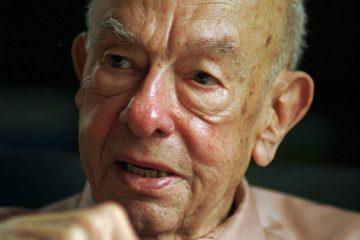 Willard Van Orman Quine is well known to the average analytic philosopher. True, he disdained much of the Pandora’s box of conceptual playthings often thought necessary for serious work in analytic philosophy nowadays, and his doctrines are thought to have been largely superseded. But he is treated by many – along with the earlier thinkers Gottlob Frege and Bertrand Russell – as an important intellectual ancestor, who developed many of the puzzles, paradoxes and paradigms that have dominated hardcore analytic philosophy for decades from the 1950s and 1960s.
Certain Quinean doctrines do continue to come up frequently: the untenability of the traditional “Analytic–Synthetic” distinction (a distinction between statements the truth or falsity of which depends only on its words, as in “No bachelor is married”, and those that depend also on particular facts, as in “the cat is hungry” – a distinction that was thought by many to be the key to various problems in the theory of knowledge); the “web of belief” metaphor (non-metaphorically: that no statement, not even apparent certainties such as 2+2=4, is in principle immune to revision); the unavoidability of the assumption that in addition to tables and trees there really are abstract objects such as numbers (on pain of hamstringing science); the Indeterminacy of Translation (that in principle one correct translation of a sentence – any sentence, say one of Czech – might conflict with another correct translation of that same sentence, and they might even say the opposite of the other); that there is “no entity without identity” (that a scientific use of a term for a kind of thing requires a means of settling whether one of them is the same as another); that science has no serious need of modal logic (the logic of necessity and possibility); that “to be is to be the value of a bound variable” (which is rather too complicated to go into here).
More here.
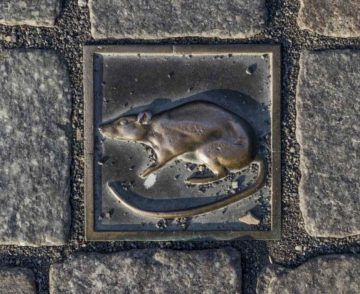 It took only a few seconds to spot one. Then another. As I walked into the small park around noon, dozens of rats could be seen scurrying in every direction. They dashed in and out of burrows scattered around the planting beds. They scampered between the safety of shrub cover and the trash bins containing a smorgasbord for them to feed on. They leaped on and off the unoccupied benches encircling the park. The rats of Churchill Square had returned.
 There are people who believe that the political polarization now afflicting the United States might finally start to subside if Americans of both parties could somehow become more empathetic. If you’re one of these people, the American Political Science Review has sobering news for you.
 IT IS A TRUTH

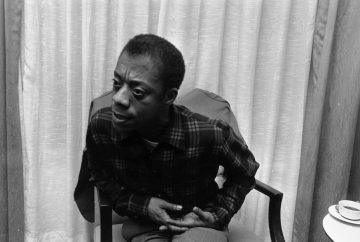 Laura Tanenbaum in Jacobin:
 Rohit De and Surabhi Ranganathan in NYT:
 One night in 1953, the Reverend Billy Graham awoke at two in the morning, went to his study, and started writing down ideas for the creation of a new religious journal. Graham, then in his mid-thirties, was an internationally renowned evangelist who held revival meetings that were attended by tens of thousands, in stadiums around the world. He had also become the leader of a cohort of pastors, theologians, and other Protestant luminaries who aspired to create a new Christian movement in the United States that avoided the cultural separatism of fundamentalism and the theological liberalism of mainline Protestantism. Harold Ockenga, a prominent minister and another key figure in the movement, called this more culturally engaged vision of conservative Christianity “new evangelicalism.” Graham believed a serious periodical could serve as the flagship for the movement. The idea for the publication, as he later wrote, was to “plant the Evangelical flag in the middle of the road, taking a conservative theological position but a definite liberal approach to social problems.” The magazine would be called Christianity Today.
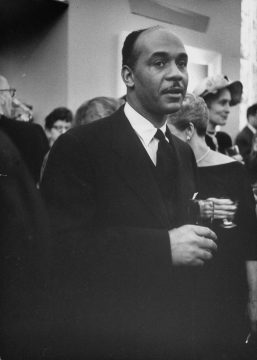 “Complexity” was the term that Ralph Ellison deployed most often to describe black life and culture. And it is the term best suited to convey the character of this brilliant, often disapproving and unsparing man. Decades before Toni Morrison’s “Beloved” and “Song of Solomon,” “Invisible Man” (1952) singularly defined the meaning of literary achievement. As a critic, Ellison was no less significant a thinker and stylist. Always, he was a philosopher of black expressive form and an astute cultural analyst.
 Dear imagined future self,
 False words, phony videos, doctored photos, and violent content are regular features on the online ecosystem worldwide. India is no exception, where such content, which often attracts millions of views, has led to
  Accusations of antisemitism
  I often think that my obsession with