
Category: Archives
Why Modi’s Thugs Attacked My University
Jayati Ghosh in Project Syndicate:
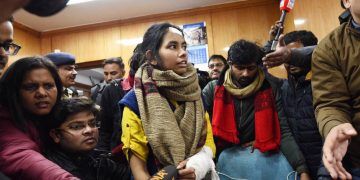
NEW DELHI – On January 5, masked men and women stormed the New Delhi campus of Jawaharlal Nehru University (JNU), where I am a professor, and attacked the students and faculty they found there with sticks, iron rods, and scythes. The university administration, security guards, and local police not only failed to protect the innocent victims of this rampage, which included vandalism and trespassing, in addition to the violence; they watched and were complicit in the assault. This is Prime Minister Narendra Modi’s India.
JNU is a highly respected institution. But with India’s leadership promoting an aggressive form of Hindu nationalism – including by enacting the blatantly unconstitutional Citizenship Amendment Act (CAA), which has rendered millions of Muslim Indians stateless – the university has come to represent the enemy: the liberalism and tolerance that is supposed to underpin Indian democracy.
This is not an accident, the result of some small group of zealots misinterpreting the Modi government’s message. On the contrary, Modi’s Bharatiya Janata Party has been actively cultivating this narrative for a long time, and, since coming to power in 2014, the BJP’s government has been using pliant media to vilify universities, especially those like JNU whose faculty and students have criticized the ruling dispensation.
More here.
The Code of Capital (Katharina Pistor)
William Barr: The Carl Schmitt of Our Time
Tamsin Shaw in The New York Review of Books:
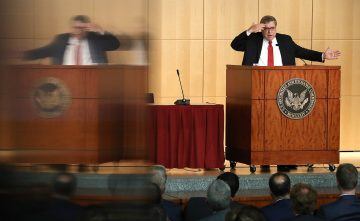
US Attorney General William Barr’s defense of unchecked executive authority in his recent speech to the Federalist Society had an unpleasant familiarity for me. It took me back to a time in my life—during the late 1990s, as a graduate student in England, and the early 2000s, teaching political theory in the politics department at Princeton University—when I seemed to spend altogether too much time arguing over the ideas of a Nazi legal theorist notorious as the “crown jurist” of the Third Reich.
Carl Schmitt’s work had then become popular in universities, and particularly in law schools, on both sides of the Atlantic. The frequent references to his “brilliance” made it evident that in the eyes of his admirers he was a bracing change from the dull liberal consensus that had taken hold in the wake of the cold war. Schmitt’s ideas thrived in an air of electrifyingly willed dangerousness. Their revival wasn’t intended to turn people into Nazis but to rattle the shutters of the liberal establishment.
Schmitt was supposed to be a realist. For him, laws and constitutions didn’t arise from moral principles. At their basis, there was always a sovereign authority, a decision-maker. Schmitt stipulated that the essential decision was not a moral choice between good and evil but the primally political distinction between friend and enemy.
More here.
‘Dead Astronauts’ by Jeff VanderMeer
Nina Allen at The Guardian:
 A genuinely innovative artwork requires time to fulfil its effect. Jeff VanderMeer’s Dead Astronauts is one such work – bewildering, perplexing, original – and I would recommend that readers allow it the concentration it demands. The opening third poses as a quest narrative, a fantastical variant of the classic western: three battle-scarred gunslingers set out across an ecologically ravaged landscape in pursuit of an enemy. Our heroes are Grayson, a black woman and sole survivor of a disastrously failed mission to explore deep space; Chen, an indentured worker bound in perpetuity to an invasive corporation known only as the Company; and Moss, whose name was once Sarah, now a complex, composite organism who has been partially absorbed into the structure of the worlds they move through. The enemy they seek to defeat is the Company itself, and more specifically its agent, a deranged Dr Moreau-type biologist named Charlie X. The three are helped along their journey by Charlie’s failed experiments: the blue fox, the duck with the broken wing, the leviathan called Botch, a hive-mind of salamanders.
more here.
‘Serious Noticing’ by James Wood
Parul Sehgal at The New York Times:
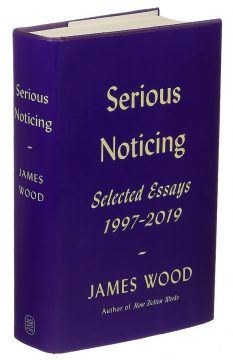 In the introduction, Wood mentions that he was taught how to read by a deconstructionist who would badger the class with the same question: “What are the stakes here?” The two voices mingling in this collection give a beautiful, moving sense of the stakes of criticism as Wood has practiced it, vigorously, without interruption for 30 years: What does it mean to do this work well, and what does it add to the world? What has it added to his life? Wood’s latest novel, “Upstate,” which follows a deeply depressed philosopher, dramatizes these questions about the relationships between analysis and fulfillment. He writes in that book: “If intelligent people could think themselves into happiness, intellectuals would be the happiest people on earth.”
Wood had his deconstructionist, and many of us have had James Wood. No modern critic has exerted comparable influence in how we read.
more here.
More Zora Neale Hurston
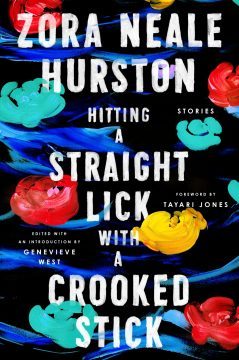 Sixty years after Zora Neale Hurston’s death in relative obscurity, a new collection of short fiction by the legendary African American author and anthropologist has arrived. For readers who are more familiar with Hurston’s novels, the collection “
One of the leading voices of the Harlem Renaissance, Hurston received a renaissance of her own in the late 20th century due to black women writers and scholars who brought her work to prominence by writing about it, teaching it in university courses, getting her books back into print circulation and the like.
more here.
Progressives Warn of a Great Deflation
Elaine Godfrey in The Atlantic:
 “Please don’t make me vote for Joe Biden!” a flock of teenagers pleaded in a series of videos posted to the social-media app Tik-Tok earlier this month. But as the Iowa caucuses draw closer, a Biden nomination is looking more likely by the day. Lefty groups are worried—and warning that a Biden win could crush the activist enthusiasm they’re counting on to win in November.
The thousands of Americans who wait for hours in line to snap a photo with Senator Elizabeth Warren of Massachusetts and who fill arenas for Senator Bernie Sanders of Vermont simply will not be as enthusiastic about the former vice president, leaders at nine progressive organizations, all of which are involved with organizing and get-out-the-vote efforts, told me in interviews this month. “I can’t imagine having Biden on the ticket is going to be the thing that energizes these folks to get out and do the door-knocking and have the conversations we need them to have,” said Natalia Salgado, who runs civic engagement at the Center for Popular Democracy, a left-wing advocacy group. “It’s incredibly concerning to me.”
Despite the conventional wisdom that Biden, with his nearly ubiquitous name recognition and decades of experience, is the safest candidate to put up against President Donald Trump in November, some progressives fear that he might actually be the riskiest.
More here.
The Fog of Rudy: Did he change — or did America?
Jonathan Mahler in The New York Times:
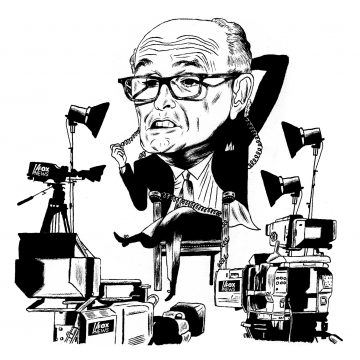 In the middle of September, shortly before the House of Representatives opened its impeachment inquiry against President Trump, I started texting with his personal lawyer, Rudolph Giuliani, to try to arrange a time to get together. I stressed that I wasn’t looking for sound bites; I wanted to talk, in depth, about the whole arc of his career, with the goal of explaining how he wound up at the center of this historic moment. There were several weeks of inconclusive, if at times amusing, exchanges — when I reminded him of the numerous Giuliani profiles this magazine has published over the course of the last four decades, he ‘‘loved’’ my text — before I decided to call him on his cellphone. It was a Friday evening, a few days after his business associates Lev Parnas and Igor Fruman were arraigned on charges of conspiring to funnel foreign money into American elections. To my surprise, Giuliani answered. I could hear that he was in a crowded bar or restaurant; he sounded as if he was in good spirits. ‘‘I really want to talk to you,’’ he said. ‘‘The thing is, I’m a little busy right now. Give me another week, and I should have all of this behind me.’’
Since then, things seem to have gotten a lot worse for Giuliani. The House has impeached the president largely on the basis of Giuliani’s work, and Giuliani himself has come under investigation for possibly serving as an unregistered agent of a foreign government. And yet he has continued to go on cable television and Twitter, making reckless statements, all the while pressing a bizarre and baseless corruption case against Joe Biden. All of this has left a lot of people puzzled. How did a man who was once — pick your former Rudy: priestly prosecutor, avenging crime-buster, America’s mayor — become this guy, ranting on TV, unapologetically pursuing debunked conspiracy theories, butt-dialing reporters, sharing photos of himself scheming in actual smoke-filled rooms? What happened?
More here.
Saturday Poem
A Youth Mowing
There are four men mowing down by the Isar;
I can hear the swish of the scythe-strokes, four
Sharp breaths taken: yea, and I
Am sorry for what’s in store.
The first man out of the four that’s mowing
Is mine, I claim him once and for all;
Though it’s sorry I am, on his young feet, knowing
None of the trouble he’s led to stall.
As he sees me bringing the dinner, he lifts
His head as proud as a deer that looks
Shoulder-deep out of the corn; and wipes
His scythe-blade bright, unhooks
The scythe-stone and over the stubble to me.
Lad, thou hast gotten a child in me,
Laddie, a man thou’lt ha’e to be,
Yea, though I’m sorry for thee
by D.H. Lawrence
from The Norton Anthology
Friday, January 17, 2020
Cowardly Provincial Assholes
Jeremy Klemin in Agni:
 During schoolyard spats between young boys, conflicts rarely end in punches. There is, instead, a perpetual appeal to those higher up in the food chain—all grade-school boys magically have a big brother who is ready, apparently, to fight someone half their age, or, if necessary, beat up the rival’s hypothetical older brother. Because of an eight-year-old boy’s inability to really hurt anybody, harkening to brothers capable of real violence is a means of confirming one’s own capacity to provoke fear in others.
In Ottilie Mulzet’s beautiful translation of László Krasznahorkai’s Baron Wenckheim’s Homecoming, which won the 2019 National Book Award for Translated Literature, Big Brother is no mechanism of the state but instead the omnipresent Big Brother that eight-year-old boys constantly reference. Brute force is the only higher power in this book, and everyone constantly attempts to either exploit or gain the favor of the richer and more powerful.
More here.
Designer Spends a Year Creating Logos That Subtly Reveal the Meaning of Words

More here.
Time for the Human Screenome Project
Reeves et al in Nature:
 There has never been more anxiety about the effects of our love of screens — which now bombard us with social-media updates, news (real and fake), advertising and blue-spectrum light that could disrupt our sleep. Concerns are growing about impacts on mental and physical health, education, relationships, even on politics and democracy. Just last year, the World Health Organization issued new guidelines about limiting children’s screen time; the US Congress investigated the influence of social media on political bias and voting; and California introduced a law (Assembly Bill 272) that allows schools to restrict pupils’ use of smartphones.
All the concerns expressed and actions taken, including by scientists, legislators, medical and public-health professionals and advocacy groups, are based on the assumption that digital media — in particular, social media — have powerful and invariably negative effects on human behaviour. Yet so far, it has been a challenge for researchers to demonstrate empirically what seems obvious experientially. Conversely, it has also been hard for them to demonstrate that such concerns are misplaced.
…According to a 2019 systematic review and meta-analysis3, over the past 12 years, 226 studies have examined how media use is related to psychological well-being. These studies consider mental-health problems such as anxiety, depression and thoughts of suicide, as well as degrees of loneliness, life satisfaction and social integration. The meta-analysis found almost no systematic relationship between people’s levels of exposure to digital media and their well-being. But almost all of these 226 studies used responses to interviews or questionnaires about how long people had spent on social media, say, the previous day.
More here.
Robert Reich: Why I’m Still Hopeful About America
Robert Reich in The American Prospect:
 If climate change, nuclear standoffs, assault weapons, hate crimes, mass killings, Russian trolls, near-record inequality, kids locked in cages at our border, and Donald Trump in the White House don’t occasionally cause you feelings of impending doom, you’re not human.
But I want you to remember this: As bad as it looks—as despairing as you can sometimes feel —the great strength of this country is our resilience. We bounce back. We will again. We already are.
Not convinced?
First, come back in time with me to when I graduated college in 1968. That year, Martin Luther King Jr. was assassinated. Robert F. Kennedy was assassinated. Our cities were burning. Tens of thousands of young Americans were being ordered to Vietnam to fight an unwinnable and unjust war, which ultimately claimed over 58,000 American lives and the lives of over 3 million Vietnamese. The nation was deeply divided. And then in November of that year, Richard Nixon was elected president.
I recall thinking this nation would never recover. But somehow we bounced back.
More here.
Greta Thunberg and George Monbiot have made a short film on the climate crisis
Forming Humanity: Redeeming the German Bildung Tradition
Timothy Stoll at Notre Dame Philosophical Reviews:
 The German word Bildung is notoriously difficult to render in English. Its most common meaning is perhaps ‘education,’ though in a more capacious sense than what happens exclusively in schools and universities. It is related to the German for ‘image’ (Bild) and the verb meaning ‘to form, shape, construct’ (bilden), and so suggests, when applied to a human being, a kind of quasi-aesthetic formation of one’s character. The complexities and ambiguities of the term provide a considerable obstacle to those interested in late eighteenth and early nineteenth-century German ethical thought, in which the ideal of Bildung plays a crucial role. In this splendid book, Jennifer Herdt has thus provided a valuable service in tracing the ways in which the concept of Bildung figures in the work of some of the most prominent thinkers of the period. With verve and impressive erudition, Herdt details how the notion of Bildung originated in the German pietist movement in the seventeenth century, and blossomed into a more (though perhaps not entirely) humanistic ideal in the subsequent work of Herder, Wilhelm von Humboldt, Schiller, Goethe, and Hegel. Though these figures differ in many crucial respects, they are united by the idea that human beings are “oriented toward a telos conceived as the harmonious development of all their various capacities . . . into a balanced, unified whole” (p. 82).
more here.
The Great American Novel?
Tyler Malone at The Hedgehog Review:
 Perhaps it’s no surprise that the Great American Novel was born in 1868, only a few years after the end of the Civil War. Writing in The Nation, John William DeForest formulated the notion, defining it not just as the best novel by an American author but as “the picture of the ordinary emotions and manners of American existence.” DeForest argued that Hawthorne, whom he lauded as having “the greatest of American imaginations,” fell short of achieving the accolade. Although books such as The Scarlet Letter were “full of acute spiritual analysis,” the characters belonged to “the wide realm of art rather than to our nationality.” Indeed, DeForest found them to be “as probably natives of the furthest mountains of Cathay or of the moon as of the United State of America.” The Great American Novel, he determined, must take up the “task of painting the American soul within the framework of a novel.”
That the formulation of the Great American Novel came in the wake of a bloody conflict that split the country in two reveals much: Americans yearned for myths that would renew their sense of common purpose, that would encourage them to reexamine their foundational values and guiding principles, their darkest sins and loftiest aspirations.
more here.
A Restless History of Washington Heights
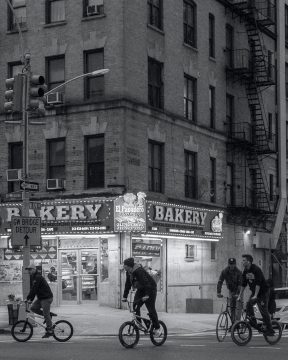
In his treatise The Poetics of Space, the French philosopher Gaston Bachelard claims “a house in a big city lacks cosmicity.” Only the rambling, breezy chateaus of the countryside provided the space necessary for his daydreaming to develop into something more substantial, like thought, where quiet corners the boy never had to clean became chapels consecrated to his own heroic becoming. In the urban apartment, “Home has become mere horizontality. The different rooms that compose living quarters jammed into one floor all lack” some essential humanizing feature from which literature might emerge. My mother shares his skepticism regarding the literary potential of our apartment. She suggests I consider the illustrious history of the neighborhood instead, a world Bachelard might have recognized as worthy if he’d ever been uptown.
Washington Heights became Washington Heights in the middle of the nineteenth century, when rich New Yorkers began to build estates on the dramatic high points of Manhattan far from the tumult of downtown docks and slums, the slave market on Wall Street.
more here.
Out of the Maze
Sandy Allen in Guernica:
 I have read before with fascination about the neurology of London cab drivers. Prospective London cabbies must memorize a preposterous amount of geographic information in order to pass the rigorous cab driver exam. Researchers have put drivers in brain scanners, wondering, is there something inherently different about their brains that allows them to memorize so much? Or does the memorization change their brains? They’ve found that in London cabbies’ brains, the area associated with memory is larger. This raises an enormous question, one that medicine still hasn’t figured out: when it comes to what happens inside our skulls, what makes an individual fall into or out of some standard called “normal?”
I thought about this on a Friday morning in early 2016, after my red-eye landed at Heathrow and I walked to find a cab. There was a particular museum just south of London that I desperately wanted to go to. For some months, I’d been visiting its website over and over. More recently, I’d been trying to convince my boyfriend that we needed to go to London for a weekend. He had some days off coming up and the means to go, I reasoned. It’d be romantic. “Plus,” I said, as if it were an afterthought, “I can go to that museum I’ve wanted to go to!”
The day we were to fly was also the day I was supposed to file a draft of my first book to my publisher. In the days leading up to the deadline, I hardly slept. I woke early and worked continuously, eventually closing my eyes past midnight but rising again in the dark, making another pot of coffee and continuing on. I paced the apartment. I read aloud to myself. I printed pages and wrote profanity in the margins. I muttered and cursed. I looked out the windows and wept. I handed in the draft just hours before we left for the airport.
I felt good! I felt great! The book was done! I told anyone who asked, and some who didn’t. Some weeks later, my editors would summon me and make clear, as gently as they could, that the work wasn’t finished, not at all. As they explained this to me in a small conference room over the course of an hour and a half, I tried not to cry. I managed to hold back tears until I was on the train home, and then kept at it for many days after. Eventually I’d tear the draft apart and rewrite the book entirely. Some months later, I’d do it again. The actual “the book is finished!” feeling wouldn’t arrive for another year and a half.
More here.
Friday Poem
Racists
Vas en Afrique! Back to Africa! The butcher we used to patronize in the
………. Rue Cadet market
beside himself, shrieked at a black man in an argument the rest of the
………. import of which I missed
but that made me anyway for three years walk an extra street to a shop
………. of definitely lower quality
until I convinced myself that probably I’d misunderstood that other thing
………. and could come back.
Today another black man stopped, asking something again that I didn’t
………. catch, and the butcher,
who at the moment was unloading his rotisserie, slipping the chickens
………. off their heavy spit,
as he answered—how get this right?—casually but accurately brandished
………. the still-hot metal,
so the other, whatever he was there for, had suddenly to lean away a little,
………. so as not to flinch.
by C.K. Williams
from Collected Poems
Noonday Press, 1994