
Category: Archives
Garden of Painterly Delights
Jenny Uglow at the NYRB:
 During World War I, when soldiers thought longingly of home, their minds often turned to the garden. Indeed, they made small gardens in the trenches, planting bulbs in empty brass shell-casings. In a catalog essay, the Garden Museum’s director, Christopher Woodward, quotes Ford Madox-Ford’s No Enemy: A Tale of Reconstruction (1929), on the soldier’s dream of return, not to a landscape but “a nook rather,” at the end of a valley “with a little stream, just a trickle level with the grass of the bottom. You understand the idea—a sanctuary.” So the focus of the show is not on great estates but on domestic landscapes and individual plants, and implicitly on the garden’s allegorical power: the myths of Eden.
more here.
Robert Stone, Chronicler of America’s Decline
Madison Smartt Bell at The Paris Review:
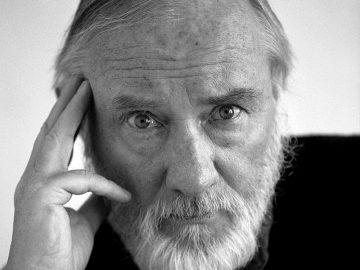 When Stone mustered out of the navy in the late fifties, the United States had perhaps reached its zenith in terms of economic success and dominance, political hegemony worldwide, and a vibrant and vigorous culture, ripe for exportation in multiple embodiments: from serious literature and high art to B movies, pop music, and Coca-Cola. It seemed a national moment free of self-doubt—although a considerable dysphoria would soon begin to express itself, as the social upheavals of the sixties began. Stone, who did not begin the world from a position of privilege, was quicker than most to see the shadows cast by the rising American star. In his work, he would repeatedly portray those bright aspirations set off by a surrounding darkness that was likely in the end to devour them.
more here.
Why Birds Are the World’s Best Engineers
Siobhan Roberts in The New York Times:
 The term “bird’s nest” has come to describe a messy hairdo, tangled fishing line and other unspeakably knotty conundrums. But that does birds an injustice. Their tiny brains, dense with neurons, produce marvels that have long captured scientific interest as naturally selected engineering solutions — yet nests are still not well understood. One effort to disentangle the structural dynamics of the nest is underway in the sunny yellow lab — the Mechanical Biomimetics and Open Design Lab — of Hunter King, an experimental soft-matter physicist at the University of Akron in Ohio. “We hypothesize that a bird nest might effectively be a disordered stick bomb, with just enough stored energy to keep it rigid,” Dr. King said. He is the principal investigator of an ongoing study, with a preliminary review paper, “Mechanics of randomly packed filaments — The ‘bird nest’ as meta-material,” recently published in the Journal of Applied Physics. (He added that, obviously, the bird-nest stick bomb never explodes.) Dr. King and his colleagues seek to answer simple questions: What is the underlying mechanical principle behind the bird nest’s construction strategy? What are the statistically robust characteristics of “the nest state”? That is to say, what separates a nest from the same sticks and twigs collected into a tight bundle or scattered helter-skelter?
“Birds perform what I’ve been calling ‘mechanical synthesis,’” Dr. King said. “Whereas, on a molecular scale, a chemist will synthesize polymers of varying length or stiffness in anticipation of bulk mechanical properties, the bird chooses skinny elements from its environment, with some selection criteria in expectation of nest performance.” A nest has a certain chemistry — an alchemy, almost. From humble parts, a greater sum emerges and coheres. And, presumably, its generic principle would not be exclusive to nests. Rather, it would be widely applicable to structures in architecture, packaging, shock-absorption and more.
More here.
Social distancing prevents infections, but it can have unintended consequences
Greg Miller in Science:
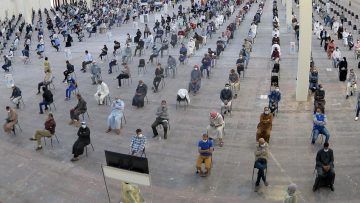
In response to the coronavirus pandemic, public health officials are asking us to do something that does not come naturally to our very social species: Stay away from each other. Such social distancing—avoiding large gatherings and close contact with others—is crucial for slowing the spread of the virus and preventing our health care system from getting overwhelmed. But it won’t be easy. “The coronavirus spreading around the world is calling on us to suppress our profoundly human and evolutionarily hard-wired impulses for connection: seeing our friends, getting together in groups, or touching each other,” says Nicholas Christakis, a social scientist and physician at Yale University.
And social distancing also tests the human capacity for cooperation, he adds. “Pandemics are an especially demanding test … because we are not just trying to protect people we know, but also people we do not know or even, possibly, care about.” The effects of short-term social distancing haven’t been well studied, but several researchers—most of them scrambling to deal with disruptions to their own lives because of the coronavirus—recently took time to share some thoughts with ScienceInsider on the potential social and psychological impacts, and how to mitigate them. Here’s what they said:
What’s known about the effects of social interaction on mental and physical health?
Over long periods of time, social isolation can increase the risk of a variety of health problems, including heart disease, depression, dementia, and even death. A 2015 meta-analysis of the scientific literature by Julianne Holt-Lunstad, a research psychologist at Brigham Young University, and colleagues determined that chronic social isolation increases the risk of mortality by 29%.
More here.
Tuesday Poem
The River Merchant’s Answer to His Wife
—(For A. L.)
The lights of Cho-fu-Sa fade in the distance,
and this will arrive when I do.
Travel has unraveled all my senses; each night
I curl my body around a small piece of silence
waiting in the dark for its sound.
Now my boat rounds the point, the sky lightens,
and at last I begin to hear the monkeys
serenade beneath our window.
I will watch for the silk flag of your sleeve
fluttering on the shore, calling me
to the slim ivory of your wrist.
I promise you we shall grow old together
feeding lychees to the monkeys
each night before we sleep.
by Tim Mayo
from Narrative Magazine
Sunday, March 15, 2020
On Pandemic and Literature
Ed Simon in The Millions:
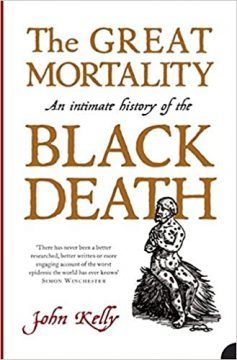 Less than a century after the Black Death descended into Europe and killed 75 million people—as much as 60 percent of the population (90% in some places) dead in the five years after 1347—an anonymous Alsatian engraver with the fantastic appellation of “Master of the Playing Cards” saw fit to depict St. Sebastian: the patron saint of plague victims. Making his name, literally, from the series of playing cards he produced at the moment when the pastime first became popular in Germany, the engraver decorated his suits with bears and wolves, lions and birds, flowers and woodwoses. The Master of Playing Cards’s largest engraving, however, was the aforementioned depiction of the unfortunate third-century martyr who suffered by order of the Emperor Diocletian. A violent image, but even several generations after the worst of the Black Death, and Sebastian still resonated with the populace, who remembered that “To many Europeans, the pestilence seemed to be the punishment of a wrathful Creator,” as John Kelly notes in The Great Mortality: An Intimate History of the Black Death, the Most Devastating Plague of all Time.
The cult of Sebastian had grown in the years between the Black Death and the engraving, and during that interim the ancient martyr had become associated with plague victims.
More here.
Microbiological Class War in China
From Chuang:
 Wuhan is known colloquially as one of the “four furnaces” (四大火炉) of China for its oppressively hot humid summer, shared with Chongqing, Nanjing and alternately Nanchang or Changsha, all bustling cities with long histories along or near the Yangtze river valley. Of the four, Wuhan, however, is also sprinkled with literal furnaces: the massive urban complex acts as a sort of nucleus for the steel, concrete and other construction-related industries of China, its landscape dotted with the slowly-cooling blast furnaces of the remnant state-owned iron and steel foundries, now plagued by overproduction and forced into a contentious new round of downsizing, privatization and general restructuring—itself resulting in several large strikes and protests in the last five years. The city is essentially the construction capital of China, which means it has played a particularly important role in the period after the global economic crisis, since these were the years in which Chinese growth was buoyed by the funneling of investment funds into infrastructure and real estate projects. Wuhan not only fed this bubble with its oversupply of building materials and civil engineers but also, in so doing, became a real estate boomtown of its own. According to our own calculations, in 2018-2019 the total area dedicated to construction sites in Wuhan was equivalent to the size of Hong Kong island as a whole.
But now this furnace driving the post-crisis Chinese economy seems, much like those found in its iron and steel foundries, to be cooling. Though this process was already well underway, the metaphor is now no longer simply economic, either, as the once-bustling city has been sealed off for over a month, its streets emptied by government mandate: “The greatest contribution you can make is: don’t gather together, don’t cause chaos,” read a headline in the Guangming Daily, run by the Chinese Communist Party’s propaganda department. Today the Wuhan’s broad new avenues and the glittering steel and glass buildings that crown them are all cold and hollow, as winter dwindles through the Lunar New Year and the city stagnates under the constriction of the wide-ranging quarantine.
More here.
A Smoothie Recipe Written By A Cop In A Small Town That Just Had Its First Murder In 50 Years
Maeve Dunigan in McSweeney’s:
Step One: Set up your blender in a clear space on the counter. Clean out the inside of the blender with a wet paper towel, being careful to avoid the sharp blades. Try not to think about the little Wilson girl. Remove berries from freezer.
More here.
This 18 seconds is good advice about the coronavirus
The Logic of the Rebel: On Simone Weil and Albert Camus
Robert Zaretsky in LA Review of Books:
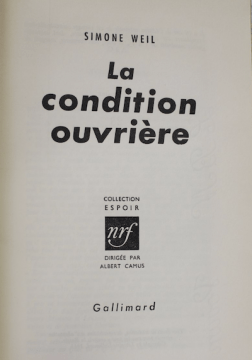 IN THE SUMMER or fall of 1943, La France libre, the London-based provisional government led by General Charles de Gaulle, received a letter from across the Channel. In three closely typed pages, the writer, identifying himself as “un résistant intellectuel,” described the “anguish” he felt as he surveyed the political and moral landscape of Nazi-occupied France. We are teetering, he declared, between renaissance and ruin. Moreover, those struggling on behalf of the former were driven by two often competing ideals: “The clear desire for justice and profound demand for liberty.” Yet, he warned, if we can one day create a doctrine based on these two imperatives, they would lead to the “complete overhaul” of the nation’s constitutional and financial institutions. One way or another, in short, France would never again be the same.
De Gaulle most probably never read this letter. He was, for the most part, too busy making life wretched for Franklin Roosevelt and Winston Churchill to find the time to read or reflect on the clandestine missives sent by the internal resistance movements. Besides, while de Gaulle cast himself as the embodiment of a free France, he had a cast of hundreds to attend to the details of achieving this freedom. This cast included analysts who read these letters from France, recapped the contents, and reported them to their immediate superiors.
This particular letter, I think, would have caught the attention of one of the analysts. Like the writer, the analyst was thinking hard how to balance the often-competing imperatives of liberty and justice. Equally important, she wanted to be sent to France in order to fight, like the writer, in the Resistance. As she told a friend, the suffering of those in France “obsesses and overwhelms me to the point of annihilating my faculties and the only way I can revive them and release myself from the obsession is by getting for myself a large share of danger and hardship.” Her efforts to persuade her superiors, however, were repeatedly rebuffed. Indeed, when de Gaulle himself read one of the analyst’s proposals — namely, to lead a group of nurses as poorly trained as herself to be parachuted onto a battlefield — he dismissed her as “crazy.”
More here.
Genesis Breyer P-Orridge (1950 – 2020)
Eric Taylor (1949 – 2020)
Max von Sydow (1929 – 2020)
Between the spreadsheets
Alice Hines in More intelligent Life:
 Once upon a time, there was a man who thought love was a maths problem.
“Love is a capricious spark, a miraculous whirlwind,” one of his blog posts began, sarcastically. “It is found by following ancient prophecies, embarking on dangerous quests…Something like that, who knows. Anyway, it sounds like finding a girlfriend was crazy hard before computers!” The man’s name was Jacob. He is currently 32 and works in finance, creating software that helps banks comply with regulations. He has dark curly hair and a beard, a left eyebrow that’s often raised and, in his own words, a “dad bod”. His self-deprecating streak is tempered by optimism. “Growth mindset” is one of his favourite phrases. As in “I’m still not bisexual, but, you know, growth mindset.” For most of his life Jacob dated only when he’d received clear signs of encouragement from one of the many women he found beautiful or fascinating. In 2013 he moved to New York from North Carolina. Thanks to the volume of people using dating apps, it was suddenly possible to spend each night of the week with a different woman who was already intrigued by his online persona. There was the cheesemaker. The fashion designer. Three different med-school students. Jacob liked them all. On each date, he holidayed in another person’s world and learned something new.
But cumulatively, the experience was overwhelming. Jacob knew he wanted to get serious with someone, but he found it hard to weigh the merits of each of these potential partners against each other. So he did what he knew best: he made a spreadsheet. He called it “How to Choose a Goddess”. When he described this to me, some of the calculations lay beyond my comprehension. But my more quantitatively minded friends seemed impressed when I rattled them off.
More here.
Sunday Poem
We’re Together Now
I longed for five years, and then
I got her, my tailfeathers more resplendent
then the other guy’s. Or I have bigger antlers.
So she’s mine. I can circle her
for hours, and she won’t chase me away.
We’ll make a home somewhere
with detritus from both our lairs, I love
the intimacy we share, the body sounds,
though sometimes sort of miss the longing,
which was always there, a scar.
It was like the Red Sox fans
felt the eighty-six years their team
didn’t win the World Series. Then they did,
and what kept those fans on edge
for decades was gone. Sure, winning
was great. But so was all that hope,
so close you could almost touch
the skittish thing, if only, if only.
When if only came true, they had
to learn to live without it.
………………………..It was not the same
after winning. I was better;
it was just not the same.
Michael Chrisman
from Little Stories
Dyslexia Books, NY, NY;
Antigua Guatemala, 2013
Saturday, March 14, 2020
The Party Cannot Hold
 Michael Tomasky in the NYRB:
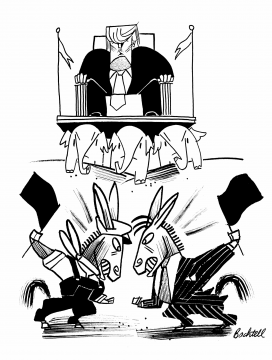
At the moment, as the Democrats struggle over their future, one can legitimately wonder whether the poles of the Democratic tent are strong enough to hold. The divisions are stark. This historical moment is often compared to 1972, when a youth movement similar to the one Sanders leads today took over the party and nominated George McGovern. But if anything, today’s divisions run far deeper. Then, the party was split chiefly over the Vietnam War. There were other issues, to be sure, and the New Left—the 1960s movement of student radicals that spread from Madison to Berkeley to everywhere—pressed a broader critique of American society; but McGovern’s was fundamentally an antiwar candidacy. And while the Vietnam debate was shattering to the party for a few years, wars eventually end, as indeed that one did, not long after the 1972 election.
Once it ended, and once the Watergate scandal mushroomed, the party was able to stitch itself back together with surprising ease. In the 1974 midterms, both liberals and moderates were able to run aggressively against Richard Nixon, and the Democrats made historic gains that year. Then, with the country still agitated over Nixon and Gerald Ford’s pardon of him, and with a sunny southern moderate vaulting over several better-known and more liberal senators, they recaptured the White House in 1976.
The current divide is not about one war. It is about capitalism—whether it can be reformed and remade to create the kind of broad prosperity the country once knew, but without the sexism and racism of the postwar period, as liberals hope; or whether corporate power is now so great that we are simply beyond that, as the younger socialists would argue, and more radical surgery is called for.
More here.
Trump’s Culture Wars Come to Architecture
 Anthony Paletta in The Boston Review:
Nearly everything is exasperating about the debate surrounding the Trump administration’s draft executive order, “Making Federal Buildings Beautiful Again.”
The foremost problem is the order itself. An intemperate jeremiad against modernist architecture, it proposes that “the classical architectural style shall be the preferred and default style” for government buildings in Washington and for federal courthouses; the subsequent fine print is designed to ensure that exceptions would be difficult and unlikely. The order first nails its list of grievances to the door of Marcel Breuer’s Brutalist Hubert Humphrey building. It then proceeds to derogate federal architecture over the last fifty-eight years in support of its argument that the government has “stopped building beautiful buildings that the American people want to look at or work in.”
The draft has provoked well-warranted opposition from a chorus of critics: every conceivable architectural professional organization, historic preservationists, architectural historians, and a wide range of others. Most of this response has been sound and reasonable; some has been intemperate and outlandish. The order’s exaggerated contempt for modernism as a willful and deliberate assault on beauty has provoked similarly overheated charges identifying neoclassicism as a vessel for fascism, white supremacy, and genocide. In this, the Trump administration has displayed its typical incendiary skill at pouring accelerants onto any squabble, inflaming ground that has largely managed, until now, to escape the pitched battles of the ever-widening culture wars.
More here.
Coronavirus: can herd immunity really protect us?
 Jeremy Rossman in The Conversation:
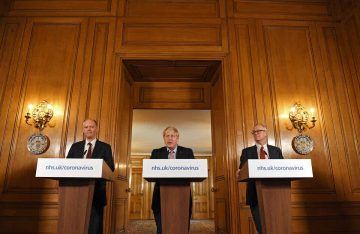
Our bodies fight infectious diseases through the actions of our immune systems. When we recover, we often retain an immunological memory of the disease that enables us to fight off that same disease in the future. This is how vaccines work, creating this immune memory without requiring getting sick with the disease.
If you have a new disease, such as COVID-19, that we don’t have a vaccine for and no one in the country has ever been infected with, the disease will spread through the population. But if enough people develop an immune memory, then the disease will stop spreading, even if some of the population is not immune. This is herd immunity, and it is a very effective way to protect the whole of a population against infectious disease.
But herd immunity is typically only viewed as a preventive strategy in vaccination programmes. If we don’t have a vaccine – as we don’t for COVID-19 – achieving herd immunity would require a significant proportion of the population to be infected and recover from COVID-19. So what would this mean for the spread of the disease in the UK?
More here.
The Collapse of the Trump Administration
 Greg Valliere of AGF Investments over at the firms’ website:
THE MARKETS HAVE COLLAPSED, the sports world has collapsed, and the Trump Administration has collapsed — abdicating to the steely Nancy Pelosi on policy, abdicating to health experts like Dr. Anthony Fauci, and potentially abdicating to Joe Biden in November.
WHEN THE HISTORY OF THIS SHOCKING COLLAPSE is written, its defining chapter may focus on Donald Trump’s appalling speech on Wednesday night — poorly delivered, filled with errors, insulting to European allies, and a disaster for the financial markets.
WE TALKED WITH INSIDERS YESTERDAY who are stunned by the speech and Trump’s improvised happy talk. One source said that within the White House, there’s dismay that policy is being crafted by Jared Kushner, who has no expertise on health issues.
THERE’S BEEN NO DIRECTION from the White House on policy responses, so Pelosi has filled the void, winning concession after concession, prevailing with 14 days of paid sick leave, more generous unemployment benefits, free virus testing, etc. Many of the concessions could be permanent.
More here.