
Emily Tamkin in New Statesman:
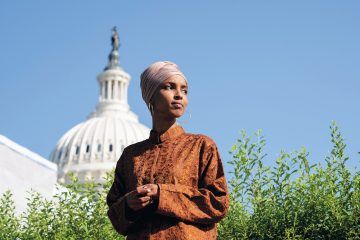 This is not the usual bland political memoir offering yet another story of finding the American dream. In part, this is because Ilhan Omar is not another dull politician. That much is obvious from the waves she has made in Washington, DC since becoming a member of Congress in 2019. Omar, from Minnesota, and Rashida Tlaib, from Michigan, are the first two Muslim women elected to Congress. Along with two other women of colour, who are also in their first term, Alexandria Ocasio-Cortez and Ayanna Pressley, they are known as “the squad”. The 181-year-old ban on wearing religious head-wear in the House chamber was changed in 2019, allowing Omar to wear her hijab on the floor of Congress. While running for Congress, Omar admits, she was worried that this rule would keep her from being able to serve.
Omar quickly gained attention for her progressive stances, aggressive questioning of foreign policy hawks, and contentious statements on Israel (she apologised for one of these comments, a 2019 tweet that suggested Republican support for Israel was “all about the Benjamins, baby” – ie, financially motivated). And she has been relentlessly attacked from all sides, from the far right to the centre left. Donald Trump ranted about Omar in a rally in 2019, prompting the crowd to start chanting, “Send her back.” Omar was born in Mogadishu, Somalia, in 1982. She was the baby of the family; “a particularly tiny child” and a tomboy. She lost her mother at a very young age, but even so her family lived what sounds like a happy, chaotic but colourful life – until war came and they left for the US. Omar’s book gives an insight into one of the likely future leaders of Democratic politics. Some of the details are unexpected: I didn’t think the person, living or dead, she would choose to meet would be Margaret Thatcher: “Time and time again,” Omar writes, “she showed up in rooms filled with men and didn’t have to do much to lead them to decide that she should be in charge.”
More here.
 Helen Fisher first appeared in Nautilus in 2015 with her article, “
 Andrew Gelman over at his website:
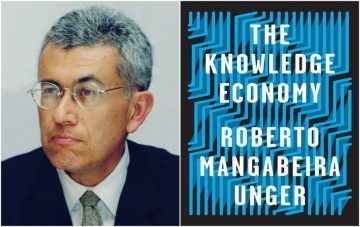 Daniel Steinmetz-Jenkins interviews Roberto Unger in The Nation:
 Sam Moyn over at the Quincy Institute:
 Sarah Stoller in Aeon:
 Hassina Mechaï over at the Verso blog:
 When I think that it won’t hurt too much, I imagine the children I will not have. Would they be more like me or my partner? Would they have inherited my thatch of hair, our terrible eyesight? Mostly, a child is so abstract to me, living with high rent, student debt, no property and no room, that the absence barely registers. But sometimes I suddenly want a daughter with the same staggering intensity my father felt when he first cradled my tiny body in his big hands. I want to feel that reassuring weight, a reminder of the persistence of life.
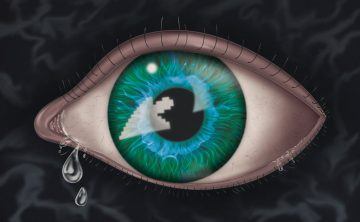 In early April, at the height of the pandemic lockdown, Gianpiero Petriglieri, an Italian business professor, suggested on Twitter that being forced to conduct much of our lives online was making us sick. The constant video calls and Zoom meetings were draining us because they go against our brain’s need for boundaries: here versus not here. “It’s easier being in each other’s presence, or in each other’s absence,” he wrote, “than in the constant presence of each other’s absence.”
 I must admit
 GIVEN THAT SHE
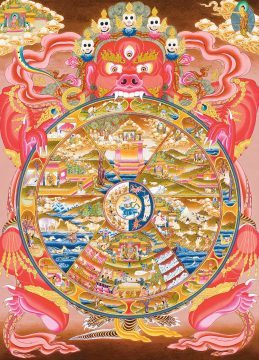 In any case, for me—like many Buddhists, past and present—the most frightening part of karma isn’t a vision of torments in the next life, but the idea that my suffering in this life isn’t altogether random or circumstantial; it carries the trace of some previous action along with it. There’s something unbearable about causality when we think about it in the strictest terms: A virus, for example, can be transmitted through the simplest unconscious act, like scratching your nose with the same finger that was just wrapped around a subway pole. In contemporary physics, the limits of causality are explored in the field known as “quantum entanglement,” or what Einstein called “spooky action at a distance”: that is, the ability of distant entities to influence one another with no apparent force (like gravity) connecting them. Physicists know quantum entanglement happens, but how it works, and what power it exerts over everyday objects, is a subject of much debate.
 Of course, I had seen, next to the Gentleman’s Relish, the box of finely dusted Turkish delight, the halva, the packets of rosti; I had been with him to his birthplace in Romania and seen the places of his childhood, not once but twice; together with Alexander, I had been in the ancient forests with him, had picked wild raspberries and cracked open hazelnuts with a stone. I had helped him fill the box of Christmas gifts for our cousins stuck behind the Iron Curtain: chocolate, vitamins, medicine, Marmite, jam, tinned sardines, winter gloves and hats, stockings. But these things had featured only in the margin of my map of my father. At least, until that day when my friend asked: ‘Where’s your father from?’ More than thirty years have passed, and still I hover in the same state of postponed understanding, like the delayed response after the turning of a ship’s wheel or the pulling of a bell rope. Where was he from? Why do I need to know? Will I feel better if I do?
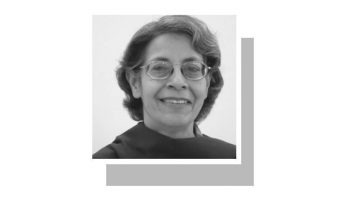 In 2019, 62 worshippers performing Friday prayers were killed by a bomb blast in Nangarhar. Back in 2002, a fire broke out at a girl’s school in Makkah. Fifteen young girls died and 50 injured, allegedly because they were beaten back to go inside: they had not covered their heads. In 1987, more than 400 unarmed pilgrims, mostly Iranians, were killed in Makkah during a protest. The list goes on. One fact stands out: most of the outpouring of anger, sympathy and concern came from non-Muslim organisations, people and countries. Muslims were, by and large, silent. Even as the world seems to have come closer, with a more formalised structure of human rights, it has regressed into increasing hatred and acts of violence against the ‘other’, whoever it might be. It took the Christians six centuries of religiously supported wars and torture against Muslims and Jews to decide that they could safely replace religion with science. They colonised, ridiculed Muslims, spread false rumours, destroyed traditions of Muslim scholarship and weakened Muslim societies through carefully orchestrated propaganda. Islamophobia has increased since 9/11 with Muslims being held in Guantanamo Bay prison and tortured. Very few Muslim governments stood up to help them.
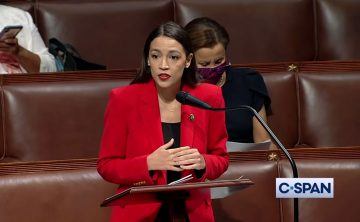 The story began earlier this week, when Yoho reportedly approached Ocasio-Cortez on the Capitol steps to inform her that she was, among other things, “disgusting” and “out of your freaking mind.” His analysis was directed at her (hardly novel) public statements that poverty and unemployment are root causes of the recent spike in crime rates in New York. On matters of criminal-justice reform, Yoho is of a decidedly conservative bent. Not long ago, he voted against making lynching a federal hate crime, saying that such a law would be a regrettable instance of federal “overreach.” According to a reporter for
  Melanie Rutkowski, PhD, of UVA’s Department of Microbiology, Immunology and Cancer Biology, found that