
Tom Roston in OneZero:
 Wikipedia was launched as the ugly stepsibling of a whole other online encyclopedia, Nupedia. That site, launched in 1999, included a rigorous seven-step process for publishing articles written by volunteers. Experts would check the information before it was published online — a kind of peer-review process — which would theoretically mean every post was credible. And painstaking. And slow to publish.
“It was too hard and too intimidating,” says Jimmy Wales, Nupedia’s founder who is now, of course, better known as the founder of Wikipedia. “We realized… we need to make it easier for people.”
Now 20 years later — Wikipedia’s birthday is this Friday — nearly 300,000 editors (or “Wikipedians”) now volunteer their time to write, edit, block, squabble over, and scrub every corner of the sprawling encyclopedia. They call it “the project,” and they are dedicated to what they call its five pillars: Wikipedia is an encyclopedia; Wikipedia is written from a neutral point of view; Wikipedia is free content that anyone can use, edit, and distribute; Wikipedia’s editors should treat each other with respect and civility; and Wikipedia has no firm rules.
More here.
 I don’t mean to slight the brilliant, insanely brave writer
  On World Hijab Day, 1 February, the Council of Ex-Muslims of Britain (CEMB) will premiere
  A
A  In the essay, Didion describes a particular “shimmer” that would form around images in her mind, creating a frame of sorts that pulled her in, impelled her to set down words as a means of telling the scene into being. She compares this shimmer to the way a schizophrenic or someone under the influence of psychedelic drugs is purported to perceive his surroundings — ”molecular structure breaking down,” foreground and background “interacting, exchanging ions.”
 AS A PROFESSOR OF MINE
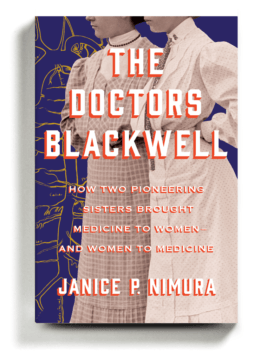 It’s tempting to presume a clear line between intention and accomplishment, but Janice P. Nimura, in her enthralling new book, “The Doctors Blackwell,” tells the story of two sisters who became feminist figures almost in spite of themselves. Elizabeth Blackwell was the first woman to receive a medical degree in the United States, in 1849, and she later enlisted her younger sister Emily to join her. Together they ran the New York Infirmary for Indigent Women and Children and founded a women’s medical college — even though, as Nimura puts it, opening a separate school for women was just about the last thing they had planned to do.
 I want to write about a certain kind of prose. It is the kind of prose that gets lost in itself. The kind of writing that tumbles head over heels and threatens to drown in its own wake. But not quite. The kind of prose that drowns completely is not so interesting. And the prose that never gets lost is not so interesting either. In my opinion. You’ve got to teeter around and stumble just at the edge there. In my opinion.
 Imagine spilling a plate of food into your lap in front of a crowd. Afterwards, you might fix your gaze on your cell phone to avoid acknowledging the bumble to onlookers. Similarly, after disappointing your family or colleagues, it can be hard to look them in the eye. Why do people avoid acknowledging faux pas or transgressions that they know an audience already knows about?
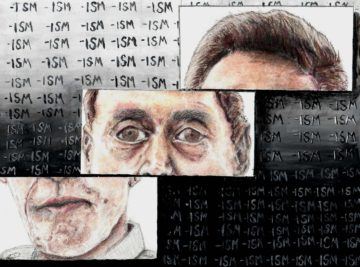 It was February 20, 1939, two days before George Washington’s birthday. Fritz Kuhn, leader of the prominent pro-Nazi German American Bund, took the stage at Madison Square Garden. Behind him stood a towering 30-foot portrait of the first US president between giant swastikas, and around him twenty thousand rally-goers. Posters at this infamous Pro-America Rally promised a “mass-demonstration for true Americanism,” bringing National Socialist ideals to the American people. Participants waved American flags, marched to loud drum rolls, and heard pro-fascist speeches. Speakers urged the audience to embrace National Socialism, not merely to show support for Germany, but above all because it was fundamentally American.
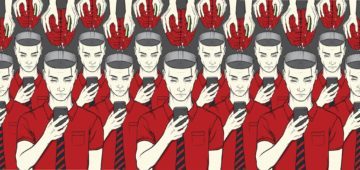 The United States of America was founded on a conspiracy theory. In the lead-up to the War of Independence, revolutionaries argued that a tax on tea or stamps is not just a tax, but the opening gambit in a sinister plot of oppression. The signers of the Declaration of Independence were convinced — based on “a long train of abuses and usurpations” — that the king of Great Britain was conspiring to establish “an absolute Tyranny” over the colonies.
 My daughter, a Pakistani American mother of two young children, married to an African American man of Jamaican parentage, is understandably excited about our new Veep-to-be, Kamala Harris. She keeps sending me articles by “desi” women like herself in relationships with Black men, who are excited about this new chapter dawning in American history.