
A TIME OUTSIDE THIS TIME (2021) from Amitava Kumar on Vimeo.
Category: Archives
Politicians love “road maps”. I miss the real thing
Ann Wroe in 1843 Magazine:
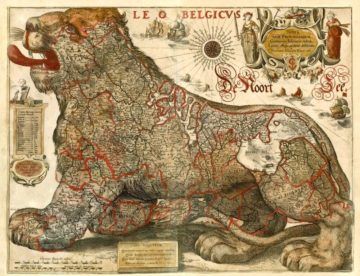 In spring thoughts traditionally turn to travelling, and so to maps. This was always something of a ritual in our house. Out of the bottom desk-drawer they’d come: the shiny Ordnance Surveys, the dog-eared city guides, the family treasures backed with canvas or patched with tape. Into the glove-compartment some would go, among the pens and receipts and whitening chocolate bars. We were halfway there already. Last year’s road map, already in a tattered state, would be thrown on the back seat. We had much less affection for that. Like the pale, flat Google Maps now on our phones, or the relentless black curve of the SatNav, this was a dull thing.
…Old maps assume that travel will be difficult, but they give it interest. The roads that meander through 17th-century county maps pass small pyramidal hills, copses, settlements and steeples, which look worth a visit. On medieval maps what seem to be roads may actually be rivers, snaking to alarming dead ends – you’ll be well-mired and stranded whichever way you go. Yet here is a building with turrets and vanes, there a train of laden camels, over there a Great Khan with turban and beard sitting, in a welcoming way, under a striped pavilion. And out in the sea great whales are surfacing and blowing.
Modern 1:25,000 maps have much the same allure.
More here.
Heroines of Self-Hate
Lucinda Rosenfeld in The New York Times:
 For generations, Anna Karenina and Emma Bovary have loomed as the nonpareils of self-loathing literary heroines. For Anna, guilt over having abandoned her husband and child, paired with a jealous nature, compels her to destroy the love she shares with Count Vronsky — and head for the train tracks. For Emma, dumped by a conscience-free bachelor with whom she has an extramarital affair — and unable to repay the debts she accrues on account of her shopping addiction — a spoonful of arsenic ultimately beckons. Lately, however, Tolstoy and Flaubert have had stiff competition on the self-harm front, thanks to women novelists intent on exploring their female characters’ propensity to act out their unhappiness on their bodies.
The 20-something protagonists of Sally Rooney’s two novels ask their lovers to hit them in bed. Frances, of “Conversations With Friends” (2017), a college student and aspiring poet, also scratches, pinches and gouges her skin. “I felt that I was a damaged person who deserved nothing,” she muses, describing her body as “garbage.” Marianne, in “Normal People” (2019), sabotages the love she shares with a sensitive classmate in favor of, first, a rich guy who mistreats her and, later, a creepy artist who takes nude pictures of her in degrading positions and does “gruesome” things to her during sex. This is all apparently because Marianne regards herself as “a bad person, corrupted, wrong,” and “all her efforts to be right, to have the right opinions, to say the right things … only disguise what is buried inside her, the evil part of herself.” Similarly, Edie, the self-described “office slut” in Raven Leilani’s debut, “Luster” (2020), encourages her married lover to shove and punch her, and sticks a samurai sword into her hand.
More here.
Saturday Poem
Frog Spring
Surprised by my tasting the spring, a golden frog
leaps to the bank. He flies froggy places,
his ankle-joints stretch the moment.
A puddock from his pop-eyes to his paddle-toes,
he darts out of the vital pool. Immortal frog,
to see him so healthy is a sure sign
the spring will be the same for me.
He hops past my shoulder to the paddy-pipes,
the reed-bed pockets frog. He vanished though,
each spear of rush keeps its own drop of dew.
by Valerie Gillies
from The Cream of the Well: New and Selected Poems
Luath Press, 2014
Friday, March 12, 2021
Searching for the Language of Home in “An I-Novel”
Leanne Ogasawara in the Chicago Review of Books:
 An I-Novel by Minae Mizumura is an immigrant story turned on its head. In traditional tales, a foreign-born young person arrives on American shores unable to speak the language but grows up to become a great success. An I-Novel, instead, is about two Japanese sisters in America who long to go “home.” But what does “home” even mean? Arriving in Long Island when they are in middle school, they are too old to become native speakers but too young to clearly remember the home they left behind. Without their memory, the word “home” is a stand-in for something else.
The older sister, Nanae, navigates this new world by trying to blend in. While most girls in Japan in the late 1960s preferred skin-whitening cosmetics and dressed demurely, Nanae enjoys tanning her skin and wearing miniskirts. But she still hopes to satisfy her parents by marrying a “real” Japanese man. Years later, when she meets her fiancé’s traditional parents in Tokyo for the first time, she wears heavy eye makeup and a flashy outfit, and proceeds to pull out a cigarette. That trip “home” ends in a suicide attempt when she is rejected by the boy and his family.
More here.
Isadore Singer Transcended Mathematical Boundaries
Daniel S. Freed in Quanta:
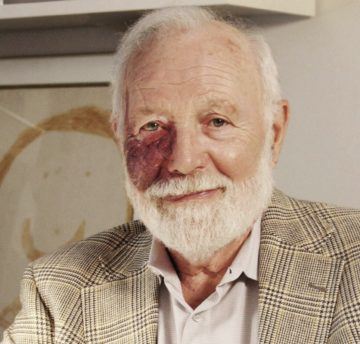 The mathematics community lost a titan with the passing last month of Isadore “Is” Singer. Born in Detroit in 1924, Is was a visionary, transcending divisions between fields of mathematics as well as those between mathematics and quantum physics. He pursued deep questions and inspired others in his original research, wide-ranging lectures, mentoring of young researchers and advocacy in the public sphere.
Mathematical discussions with Is were freewheeling. He wanted to get to the essence of the matter at hand, to understand and present new ideas in his own way. He constantly asked questions and provoked others to look deeper and more broadly. He knew no boundaries, which led him to forge deep connections between fields. Above all, he valued his freedom — the freedom to explore, the freedom to err, the freedom to create. A social mathematician by nature, he sought out and nurtured friendships with like-spirited collaborators.
More here.
A Tyranny without Tyrants?
Patrick J. Deneen in American Affairs:
 A distinguishing mark of classical political philosophy is its focus on the ruling claims of regimes. Classical philosophers sifted and evaluated the distinctive qualities invoked to legitimate governance by some number of people—one, few, or many. Not only the number of rulers but the stated ruling principles could vary widely across places and times, reflecting profound variety and disagreement over the nature and aims of government. Some regimes based political rule on virtue (aristocracy), others on wealth (oligarchy), others on the interests of a majority of citizens (democracy). Plato argued that philosophic wisdom should form the basis of good rule, while Confucius described the benefits of rule by those of greatest age and experience. Prophets, soldiers, and elders have all been rulers in various eras. Classical political philosophy sought to discern noble claims to rule, and how to achieve the best, or at least better, forms of governance.
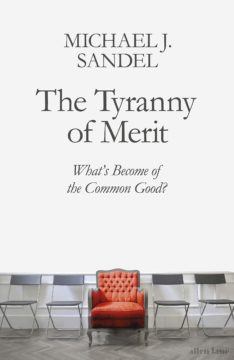
In his latest book, political theorist Michael Sandel subjects our present form of governance—“meritocracy”—to the same analysis. While our meritocracy has no exact equivalent in classical philosophy’s catalogue of regimes, Sandel finds it increasingly tyrannical. For the most part, however, Sandel’s prescriptions seem inadequate to this bracing indictment.
More here.
Debate on Israel-Palestine with Noam Chomsky & Rudy Rochman
Eight of Literature’s Most Powerful Inventions—and the Neuroscience Behind How They Work
Angus Fletcher in Smithsonian:
 Shortly after 335 B.C., within a newly built library tucked just east of Athens’ limestone city walls, a free-thinking Greek polymath by the name of Aristotle gathered up an armful of old theater scripts. As he pored over their delicate papyrus in the amber flicker of a sesame lamp, he was struck by a revolutionary idea: What if literature was an invention for making us happier and healthier? The idea made intuitive sense; when people felt bored, or unhappy, or at a loss for meaning, they frequently turned to plays or poetry. And afterwards, they often reported feeling better. But what could be the secret to literature’s feel-better power? What hidden nuts-and-bolts conveyed its psychological benefits?
After carefully investigating the matter, Aristotle inked a short treatise that became known as the Poetics. In it, he proposed that literature was more than a single invention; it was many inventions, each constructed from an innovative use of story. Story includes the countless varieties of plot and character—and it also includes the equally various narrators that give each literary work its distinct style or voice. Those story elements, Aristotle hypothesized, could plug into our imagination, our emotions, and other parts of our psyche, troubleshooting and even improving our mental function.
These literary inventions can alleviate grief, improve your problem-solving skills, dispense the anti-depressant effects of LSD, boost your creativity, provide therapy for trauma (including both kinds of PTSD), spark joy, dole out a better energy kick than caffeine, lower your odds of dying alone, and (as impossible as it sounds) increase the chance that your dreams will come true. They can even make you a more loving spouse and generous friend. You can find detailed blueprints for 25 literary inventions, including step-by-step instructions on how to use them all, in my new book, Wonderworks: The 25 Most Powerful Inventions in the History of Literature. And to give you a taste of the wonders they can work, here are eight basic literary inventions explained, starting with two that Aristotle unearthed.
More here.
Friday Poem
Amethyst Beads
And when I take them out of
the cherrywood box these beads are
the colour of dog-violets in shadow. Then
at the well of the throat where
tears start
they darken. Now I wear at my neck an old stress
of crystal: an impression of earthly housekeeping.
A mysterious brightness
made underground where there is no sun
only stories of a strayed child and her mother bargaining
with a sullen king. Promising and arguing:
what she can keep, what she can let him have. Shadows
and the season violets start up in are part of
the settlement. Stolen from such a place
these beads cannot be anything
but wise to the healing arts of compromise,
of survival. And when I wear them it is almost
as if my skin was taking into itself
a medicine of light. Something like the old simples.
Rosemary, say, or tansy.
Or camomile which they kept
to cool fever. Which they once used to soothe a child
tossing from side to side, beads of sweat catching
and holding a gleam from the vigil lamp.
A child crying out in her sleep
Wait for me. Don’t leave me here.
Who will never remember this.
Who will never remember this.
by Eavan Boland
from Poets.org
Anne Lamott on coping with “existential exhaustion,” from the healing power of Target to forgiveness
Mary Elizabeth William in Salon:
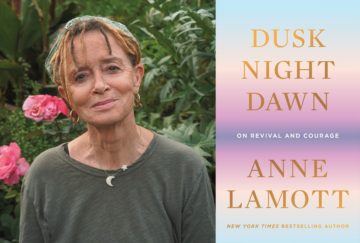 “That’s really all I write about, is hope and despair,” says Anne Lamott. Clearly, she was born into the era she was meant for. The bestselling author of durable classics like “Bird by Bird” and “Operating Instructions” is back once more with a new book, a new(ish) marriage and very much the same curiosity, humanity and sense of humor that been her brand for nearly 30 years. “Dusk, Night, Dawn: On Revival and Courage” considers friendship, forgiveness, aging and the collective “existential exhaustion” that haunts us. Salon spoke to Lamott recently about what’s changed since she wrote prophetically about “stockpiling for the apocalypse,” and finding grace in a big box store run.
…Now it is coming out into the world when we are one year into this very strange and deeply sad time. How do you approach this book in particular now?
…I’ve just been enraged since February of 2020, when the first cases surfaced and it was clearly not going to be addressed, even recognized, like the U.S. recognizes nations. We weren’t going to recognize it as a reality and there was going to be no real help. There was only going to be propaganda. I’ve been so angry for so long. But I’ll tell you I’m less angry this year. I am a lot less angry.
What’s that great line of Martin Luther King’s? Don’t let them get you to hate them. Even though I did hate them and kept going into that rabbit hole all through 2020, I kept remembering that line, and how it really destroys your center of gravity. It destroys yourself. I do have an inner Donald Trump, this petty, narcissistic blowhard, but to hate him took away my mostly “me” self, which is really decent and loving and caring, and mostly compassionate and mostly tenderhearted.
When I go into the hate, it’s like this cold sheet metal heart that I operate from and then I’m of no good to anyone. Probably every book I’ve written has had a great sorrow in it. My dad, and then my friend Pammy in “Operating Instructions,” I’ve just been a person who’s had a lot of death in her life and also I’m a person who doesn’t run from people when they are experiencing death. My best friend’s child just died. He was 23. She’s who said she had to keep changing the goalposts on “okay.” All of the books have been about that mixed grill, and that it’s devastating to be here on earth and to have had children and to not be able to save them from really much of anything.
More here.
In Our Time: Paul Dirac
https://www.youtube.com/watch?v=HybIXye8cV0
Is a Long-Dismissed Forgery Actually the Oldest Known Biblical Manuscript?
Jennifer Schuessler at The New York Times:
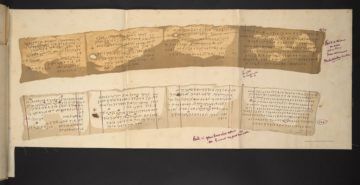 In 1883, a Jerusalem antiquities dealer named Moses Wilhelm Shapira announced the discovery of a remarkable artifact: 15 manuscript fragments, supposedly discovered in a cave near the Dead Sea. Blackened with a pitchlike substance, their paleo-Hebrew script nearly illegible, they contained what Shapira claimed was the “original” Book of Deuteronomy, perhaps even Moses’ own copy.
The discovery drew newspaper headlines around the world, and Shapira offered the treasure to the British Museum for a million pounds. While the museum’s expert evaluated it, two fragments were put on display, attracting throngs of visitors, including Prime Minister William Gladstone.
Then disaster struck.
more here.
The “Princess Daredevil” of the Belle Époque
Susanna Forrest at The Paris Review:
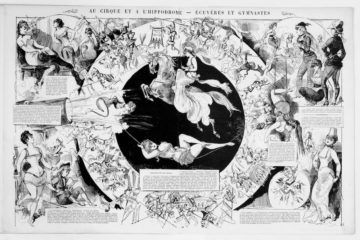 There is a dual quality to Émilie’s life at this time: her bravado in the ring and her celebrity are ranged against repeated accounts of a modest, single-minded loner. After her mother’s death in 1880 and Clotilde’s retirement from the circus, she traveled only with a maid and a huge, white shaggy dog called Turc who followed her everywhere and slept at the foot of her bed. She would live alone in a small apartment near the circus at which she was engaged, and was said to enjoy books, music, and art, and receive few guests. She would only permit admirers to give her flowers—she had no interest in jewelry or more lucrative tokens. When her followers crammed into the circus stables to see her, she offered them only “banal” smiles calculated to be polite but not enticing. Not that that mattered. The circus managers issued invitations to every aristocrat in town as soon as her first performance was scheduled, feeding on Clotilde’s notoriety. Some of the writing about her is feverish: “Our little queen!” “The most beautiful will-o-the-wisp anyone could imagine!” “A female centaur!” “The diva of equitation, the Patti of haute école, the most intrepid amazone, the most charming, the most dizzying experience since the advent of the Amazons!”
more here.
Thursday, March 11, 2021
The dead end of dividing the world on identity lines
Kenan Malik in The Guardian:
 In 1768, the German philosopher Johann Gottfried Herder paid a visit to the French city of Nantes. “I am getting to know the French language and ways of thinking,” he wrote to fellow-philosopher Johann Georg Hamann. But, “the closer my acquaintance with them is, the greater my sense of alienation becomes”.
It was not just because Herder despised the French. It was also that he did not think it possible truly to engage with another culture. Every people was bound by its Volksgeist or inner spirit. In each language dwells “the entire world of tradition, history, principles of existence: its whole heart and soul”. That was why he could “only stammer with intense effort in the words of a foreign language; its spirit will evade me”. Cultural divides were unbridgeable.
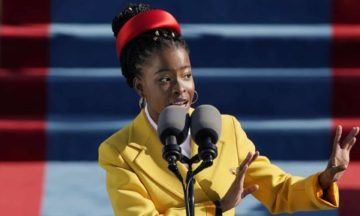
I was reminded of Herder’s letter by the controversy last week over the translation of Amanda Gorman’s poems into Dutch. Gorman is the African-American poet who stole the show at Joe Biden’s inauguration ceremony.
More here.
Scott Aaronson’s Zen Anti-Interpretation of Quantum Mechanics
Scott Aaronson in Shtetl-Optimized:
 …although I’ve written tens of thousands of words, on this blog and elsewhere, about interpretations of quantum mechanics, again and again I’ve dodged the question of which interpretation (if any) I really believe myself. Today, at last, I’ll emerge from the shadows and tell you precisely where I stand.
I hold that all interpretations of QM are just crutches that are better or worse at helping you along to the Zen realization that QM is what it is and doesn’t need an interpretation. As Sidney Coleman famously argued, what needs reinterpretation is not QM itself, but all our pre-quantum philosophical baggage—the baggage that leads us to demand, for example, that a wavefunction |ψ⟩ either be “real” like a stubbed toe or else “unreal” like a dream. Crucially, because this philosophical baggage differs somewhat from person to person, the “best” interpretation—meaning, the one that leads most quickly to the desired Zen state—can also differ from person to person. Meanwhile, though, thousands of physicists (and chemists, mathematicians, quantum computer scientists, etc.) have approached the Zen state merely by spending decades working with QM, never worrying much about interpretations at all. This is probably the truest path; it’s just that most people lack the inclination, ability, or time.
More here.
The Prophet Of The Trump Era
Matt Taibbi in his Substack Newsletter:
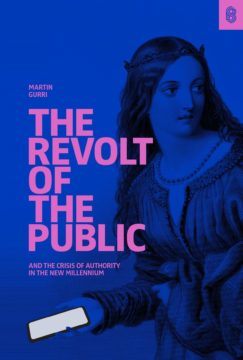 I entered Martin Gurri’s world on August 1, 2015. Though I hadn’t read The Revolt of the Public, at the time a little-known book by the former CIA analyst of open news sources, I hit a disorienting moment of a type he’d described in his opening chapter. There are times, he wrote, “when tomorrow no longer resembles yesterday… the compass cracks, by which we navigate existence. We are lost at sea.”
Gurri’s book is about how popular uprisings are triggered by collapses of faith in traditional hierarchies of power. I felt such a collapse that day in Waterloo, Iowa, covering the Republican presidential primary. The first debate was five days away and the man expected to occupy center stage, Donald Trump, held a seemingly inexplicable six-point lead.
More here.
How Animals Reclaimed Chernobyl
The Famed Painting The Scream Holds a Hidden Message
Jan Donges in Scientific American:
 “Kan kun være malet af en gal Mand!” (“Can only have been painted by a madman!”) appears on Norwegian artist Edvard Munch’s most famous painting The Scream. Infrared images at Norway’s National Museum in Oslo recently confirmed that Munch himself wrote this note.
The inscription has always been visible to the naked eye, but the infrared images helped to more clearly distinguish the writing from its background. Comparing it with the artist’s handwriting then clearly proved Munch’s authorship. “The finding closes the question about who the author of the inscription was,” says Mai Britt Guleng, a curator at the National Museum. “The [infrared] photo gave a clear image of the sentence, and this made it possible to systematically compare the handwriting, which is identical to Munch’s. The size of the letters are also too small for anyone to have written them as an act of vandalism.”
The inscription was first noticed in 1904, 11 years after its creation. At that time, the artwork was exhibited in Copenhagen. Critics assumed that an outraged viewer had defaced the painting. The Expressionist work provoked discussion from the outset, with Munch’s state of mind being openly broached even in his presence. Art critic and museum director Henrik Grosch wrote at the beginning of the 20th century that this painting indicated that Munch “could no longer be considered “a serious man with a normal brain”—an opinion that was shared by others besides Grosch.
More here.
What Is Happening to the Republicans?
Jelani Cobb in The New Yorker:
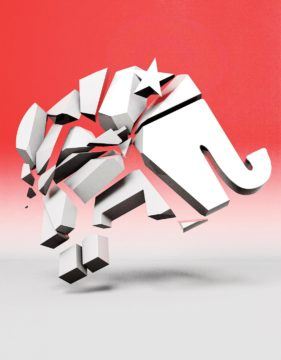 One of the oldest imperatives of American electoral politics is to define your opponents before they can define themselves. So it was not surprising when, in the summer of 1963, Nelson Rockefeller, a centrist Republican governor from New York, launched a preëmptive attack against Barry Goldwater, a right-wing Arizona senator, as both men were preparing to run for the Presidential nomination of the Republican Party. But the nature of Rockefeller’s attack was noteworthy. If the G.O.P. embraced Goldwater, an opponent of civil-rights legislation, Rockefeller suggested that it would be pursuing a “program based on racism and sectionalism.” Such a turn toward the elements that Rockefeller saw as “fantastically short-sighted” would be potentially destructive to a party that had held the White House for eight years, owing to the popularity of Dwight Eisenhower, but had been languishing in the minority in Congress for the better part of three decades. Some moderates in the Republican Party thought that Rockefeller was overstating the threat, but he was hardly alone in his concern. Richard Nixon, the former Vice-President, who had received substantial Black support in his 1960 Presidential bid, against John F. Kennedy, told a reporter for Ebony that “if Goldwater wins his fight, our party would eventually become the first major all-white political party.” The Chicago Defender, the premier Black newspaper of the era, concurred, stating bluntly that the G.O.P. was en route to becoming a “white man’s party.”
But, for all the anxiety among Republican leaders, Goldwater prevailed, securing the nomination at the Party’s convention, in San Francisco. In his speech to the delegates, he made no pretense of his ideological intent. “Extremism in the defense of liberty is no vice,” he said. “Moderation in the pursuit of justice is no virtue.” (He delivered that famous line shortly after the delegates had defeated a platform plank on civil rights.) Goldwater’s crusade failed in November of 1964, when the incumbent, Lyndon Johnson, who had become President a year earlier, after Kennedy’s assassination, won in a landslide: four hundred and eighty-six to fifty-two votes in the Electoral College. Nevertheless, Goldwater’s ascent was a harbinger of the future shape of the Republican Party. He represented an emerging nexus between white conservatives in the West and in the South, where five states voted for him over Johnson.
More here.