Sunday Poem

Amor Negro

In our wagon oysters are treasured
Their hard shells clacking against each other
Words that crash into out ears
We cushion them
Cup them gently in our hands
We kiss and suck the delicate juice
And sculpture flowers from the stone skin
We wash them in the river by moonlight
With offerings of songs
And after the meal we wear them in our hair
And in our eyes

by Sandra Maria Esteves
from
El Coro
University of Massachusetts Press, 1997

The Shabbiness of Beauty

Joanna Cresswell in Lens Culture:

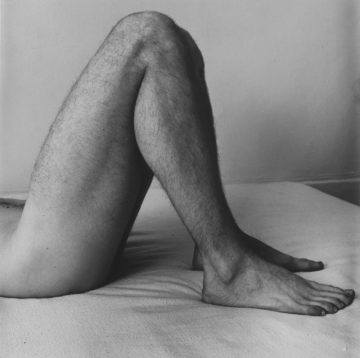
“How to describe the effect of these photographs?” writes Moyra Davey on the pictures that the late American artist Peter Hujar took of the Hudson River in 1976. “The water seems embodied, we see faces—eyes and lips—and liquid takes on a velvety smoothness and viscosity that could almost be a solid. Each image seems to have its own personality, and we sense Hujar’s presence as well, a man standing on a pier, with all the connotations of that locale, looking out and taking in the river at his feet. I wonder if he knew when he took the pictures that the resulting images would be so sensual, so corporeal and unearthly at the same time.” Davey writes these words at the end of The Shabbiness of Beauty, a newly published photobook, in which she delves into the image-archives of Hujar and edits his photographs into a new series together with her own.

Davey has worked in two ways in this book—as photographer, and as curator of both her own and someone else’s vision. A someone she cannot talk with, since Hujar’s life was tragically cut short by an AIDS-related illness in 1987. What is most fascinating about this is how she works in the same way in both roles, moving intuitively—emotionally, even—through pictures by her own hand and by Hujar’s. You cannot tell which picture belongs to which artist until the index at the end, and even then it’s difficult to work out without going all the way back through and counting, because there are no page numbers either. In this way, and in many others, this is a book that requires time. It asks you to look again and again, and to see the images as one collection—to understand that the separate visions of two people are entwined here momentarily.

The Shabbiness of Beauty also has a third voice; that of poet and writer Eileen Myles, who opens the book with a text. Leaping back and forth between memories and decades, drawing from the present—with references to the pandemic—as well as the recent past and stuff that happened forever go, Myles pins Davey and Hujar’s images to personal associations, and to things that were happening during the time the writer spent with these pictures.

More here.

Saturday, May 22, 2021

This Rare Spirit: A Life of Charlotte Mew

Kathryn Hughes at The Guardian:

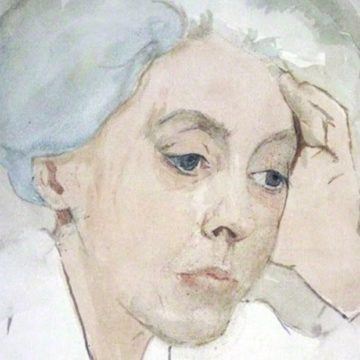
Whenever someone mentions Charlotte Mew, they feel obliged to add context. The fact that Thomas Hardy said she was the “greatest poetess” he knew, or that Siegfried Sassoon maintained she was “the only poet who can give me a lump in my throat”. Even Virginia Woolf conceded that Mew, who wrote short stories and essays as well as verse, was “very good and interesting and quite unlike anyone else”. Walter de la Mare, trying hard to define the source of Mew’s power, ventured “she just knows humanity”.

The reason why any account of Mew, including this fine biography by Julia Copus, feels obliged to begin by bigging her up is precisely because she has so often been done down. Even during her lifetime Mew’s name was familiar only to those who lived and breathed contemporary literature, the kind of people who frequented the Poetry Bookshop in Bloomsbury and waited impatiently for the next issue of the Poetry Review.

more here.

Francis Bacon’s Frightening Beauty

Joan Acocella at The New Yorker:

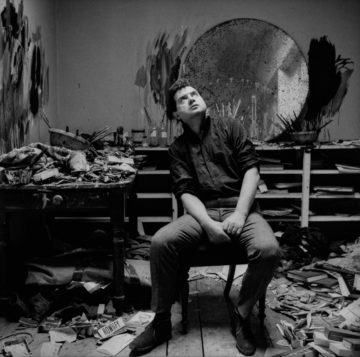
I have always been very moved by pictures about slaughterhouses and meat,” the painter Francis Bacon said to an interviewer in 1962. He regarded meat with fellow-feeling. “If I go into a butcher’s shop, I always think it’s surprising that I wasn’t there instead of the animal,” he later said. We have a photograph of him gazing serenely out at us from between two sides of beef. Cloven carcasses—indeed, piles of miscellaneous innards—recur in his paintings. Basically, he liked whatever was inside, as opposed to outside, the skin.

His favorite body part was the mouth. Once, in a bookshop in Paris, he found an old medical treatise on diseases of the oral cavity. The book had beautiful hand-colored plates, showing what Bacon called the “glitter and color” of the inside of the mouth, the glistening membranes. He bought the book and cherished it all his life. He said that he always hoped he could paint the mouth as Monet had painted sunsets.

more here.

Throttling Gaza

Dana El Kurd in Sidecar:

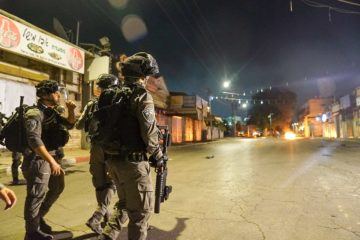
Violence against Palestinians over the last few weeks has been so horrific that it has come to the attention of those who were previously blind to it. Over two hundred dead in Gaza alone, fifty-nine of them children. Media offices bombed, thousands injured and tens of thousands displaced. Palestinians in Israel have been killed by lynch mobs while the police stand by. As a result, the usual taboos are being broken. Six US Congress members condemned the attacks on Gaza from the House floor, and Alexandria Ocasio-Cortez acknowledged Israel as an ‘apartheid state’. Yet the US is far from rescinding its support for Netanyahu. On three occasions during the latest bombardment it has blocked the UN Security Council’s call for a ceasefire, greenlighting the merciless campaign against the Gaza strip. If Trump was the most brazen supporter of Israeli aggression, his successor is not much different.

None of this is new. Gaza has been under attack at regular intervals since 2008, and with each Israeli incursion we have seen a similar pattern play out: ethnic cleansing of Palestinians in Israel and the occupied territories, huge provocations accompanied by repression on the ground, and F16s raining bombs on Gazans. Human rights organizations – international as well as Israeli – have repeatedly condemned the illegal blockade of Gaza and the forward march of Israeli settler colonialism. Yet their appeals fall on deaf ears.

More here.

Solidarity at Scale

Ted Fertik (he/him) in Alchemist:

Recently, a consensus spanning liberals to leftists has emerged that, over the last 40 years, the balance of power between labor and capital has shifted sharply in capital’s favor, and that this change has been economically and politically devastating for U.S. democracy. It is now commonplace to find economists making an argument that was deemed laughable only a decade ago: business’s domination of workers has slowed growth, fed asset bubbles and financial instability, and made the U.S. and world economies substantially more crisis-prone.

Many factors have contributed to the weakening of worker power—including offshoring and import competition, unnecessarily tight monetary policy, and austerity. Pride of place, however, belongs to the deliberate decimation of unions, especially in the private sector, accompanied by the failure of labor law to keep up with employer anti-union tactics. Union density in the private sector has fallen to 6%, and with that collapse has gone labor’s ability to set wage standards across most of the U.S. economy. Since 2010, right-to-work laws that further weaken unions have been passed in states that once had powerful labor movements: Indiana (2012), Michigan (2012), Wisconsin (2015), West Virginia (2016), and Kentucky (2017). Though teacher’s strikes in 2018 and 2019 momentarily reversed the trend, by 2017 major strike activity had declined by a factor of 70 from its peak in 1974.

The coronavirus pandemic exposed and exacerbated the detrimental effects of this long decline. The absence of unions dramatically increased the risks that workers faced on the job. In meat-packing plants, warehouses, schools, and hospitals, workers had few options besides small-scale work stoppages to force management to supply them with personal protective equipment or to refit workplaces to limit the spread of the virus. Without unions, workers could not negotiate the sorts of short work time schemes—in which workers work reduced hours but receive full pay, with the difference subsidized by governments—that made it easier for European workers to remain employed during the pandemic.

More here.

Free and Worldly

George Scialabba in The Baffler:

AT THE END OF THE SECOND WORLD WAR, the United States, with 6 percent of the world’s population, accounted for 50 percent of the world’s production. Militarily, it was invulnerable: it controlled both oceans and had sole possession of the most fearsome weapon ever invented. Culturally, American movies and popular music were all-conquering. Perhaps most important was America’s moral standing. Woodrow Wilson’s (not entirely deserved) reputation as an apostle of self-determination; the United States’ apparent lack of territorial ambition; and the awful fate from which the U.S. and the USSR had saved Europe—all aroused hopes for America’s moral leadership. Those hopes seemed to find fulfillment in the UN Charter and the Universal Declaration of Human Rights, as wise and generous a scheme for international order as any yet devised. But the UN, along with America’s moral prestige, fell victim to the superpower rivalry that extended from 1945 to 1991 and is known as the Cold War.

That is not the story Louis Menand aims to tell in his teeming and colorful history of “art and thought in the Cold War.” Helpfully, Menand explains that this is “not a book about the ‘cultural Cold War’ (the use of cultural diplomacy as an instrument of foreign policy).” Nor is it a book about “‘Cold War culture’ (art and ideas as reflections of Cold War ideology and conditions).” (A good example of the former is Frances Stonor Saunders’s The Cultural Cold War; of the latter, Duncan White’s Cold Warriors.) The Free World is intellectual history, primarily a narrative of ideas talking to ideas and works of art talking to works of art, while also trying to take into account “the underlying social forces—economic, geopolitical, demographic, technological—that created the conditions for the possibility of certain kinds of art and ideas.”

More here.

The surprising story of Indian classical music

Ivan Hewitt in Prospect Magazine:

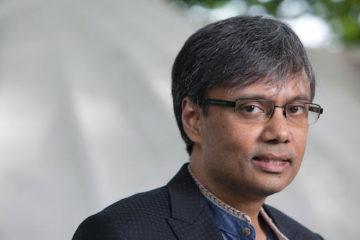
F1MH50 Amit Chaudhuri, the Indian English author and academic, at the Edinburgh International Book Festival 2015. Edinburgh, Scotland. 16th August 2015

One of the things that attracts a keen but lazy enthusiast for Indian music like me is that the sounds and the elaborate ritual of an Indian classical concert never lose their mystery. I am still puzzled by such things as the disbelieving shake of the head and sigh with which proper devotees greet a particularly expressive moment. What does that actually signify? What is the role of the almost-inaudible instrumentalist who sits next to the star soloist, and why does he not play his modest little drone in time with everyone else? What makes Raga Bhairavi a “morning raga,” when to a western ear it seems just as redolent of evening melancholy as an evening raga like Durga?  And what is a raga anyway?

The reason I’ve never troubled to find more than a cursory description of these things is that the mystery is part of the enjoyment. I don’t really want answers, which is why I hesitated before reading this book. But then I remembered the special pleasure of Amit Chaudhuri’s novels, where the subtle weave of relationships between people and sights and smells is gently evoked in a way that leaves their essential unknowability intact. One apprehends them like a scent, rather than a piece of discursive knowledge.

Chaudhuri achieves a similar miracle in Finding the Raga—which isn’t to say you won’t learn many specific things, such as the fact that Raga Todi has flattened second, third and sixth degrees. But this is no text book. He tells us that there are literally thousands of ragas, and many rhythmic patterns or talas, but focuses on just a few. He spends several pages on a rhythmic cycle called teentaal, a recurring pattern of 16 beats. To the western ear that simply sounds like four bars of four-four time. Chaudhuri shows how when combined with a system of faster “triplet” beats this iron regularity is overlaid with ambiguity, so to land decisively on the first beat of a cycle becomes a challenge. He leads us gently towards different a way of hearing and playing, and through them to different ways of feeling and knowing.

Chaudhuri is well placed to write such a book. He’s a performer, often leading his own group which combines Indian elements with blues and jazz idioms, and is the son of a well-known classical singer. During his teens Chaudhuri encountered rock music, and for a while seemed more in love with that than with his own heritage. He forsook the Indian accordion for a guitar, and tried to turn himself into a singer-songwriter on the lines of Joni Mitchell or Neil Young.

More here.

No Easy Answers

Joe Klein in The New York Times:
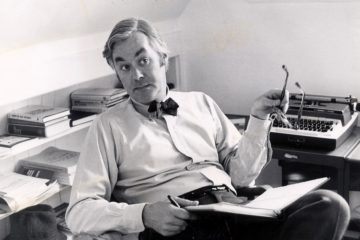
“The central conservative truth is that it is culture, not politics, that determines the success of a society,” Senator Daniel Patrick Moynihan of New York said during a lecture at Harvard in 1986. “The central liberal truth is that politics can change a culture and save it from itself.” Moynihan, an apostle of complexity, lived at the intersection of those two truths, a place where he was free to become one of the most creative American thinkers of the late 20th century. He sensed, and then came to know, that the social problems of what was being called “postindustrial” society would be different from those that came before. He identified these problems, sometimes controversially. In so doing, he predicted the dislocations of the 21st century with uncanny accuracy. He did it with elegance and wit and — this may be a surprise — transcendent humility. His spot-on sense of what truly mattered deserves to be revisited now, if we’re to grope our way past the mess we’ve become as a society.

I knew Moynihan. He was a mentor. He was a delight. He gave me lists of books to read; and encouraged me when, as a young journalist, my reporting ran afoul of convenient assumptions, left and right. Today, nearly 20 years after his death, hardly a week goes by when some new public outrage doesn’t remind me of his prescience — the persistence of ethnicity and racial caste in American life (and in the world), the migration of working-class whites from the Democratic to the Republican Party (which he predicted in 1970), climate change (which he predicted in 1969), the plague of mass shootings, the difficulty of improving public education for the poor, the fragility of family structure in the postindustrial world — and of the aphorisms that he seemed to toss off effortlessly: “Everyone is entitled to his own opinion, but not his own facts.” He was equal parts éminence grise and enfant terrible — an intellectual éminence terrible.

He had two defining insights. The first, which he shared with the Harvard sociologist Nathan Glazer, was the persistence of ethnicity in American life. Together — well, it was mostly Glazer — they published “Beyond the Melting Pot: The Negroes, Puerto Ricans, Jews, Italians, and Irish of New York City” in 1963. “The notion that the intense and unprecedented mixture of ethnic and religious groups in America was soon to blend into a homogeneous end product has outlived its usefulness and also its credibility,” they observed. “The point about the Melting Pot … is that it did not happen.”

Thirty years later, in “Pandaemonium,” Moynihan took the notion global.

More here.

Friday, May 21, 2021

Peter Singer: Keeping Discussion Free

Peter Singer in Project Syndicate:

Last month, the Journal of Controversial Ideas – of which I am a co-editor – published its first issue. The journal is a response to the shrinking boundary, even in liberal democracies, of acceptable discourse. It is specifically designed to provide a forum in which authors can, if they wish, use a pseudonym to avoid running the risk of receiving personal abuse, including death threats, or of irrevocably harming their careers.

There was a time when the threat to academic freedom in democratic countries came primarily from the right. The free speech cause célèbre of the early twentieth century United States featured Scott Nearing, a left-leaning economist at the University of Pennsylvania who was dismissed because his activism for social justice did not sit well with the bankers and corporate leaders on the university’s board of trustees.

Fifty years later, in the McCarthy era, many people were blacklisted or dismissed because of their support for leftist ideas. When I came to Princeton in 1999, Steve Forbes (who was then campaigning for the Republican nomination for president) called for my appointment to be rescinded because he objected to my critique of the traditional doctrine of the sanctity of human life.

Today, however, most of the opposition to freedom of thought and discussion comes from the left.

More here.

What Happens When Americans Can Finally Exhale

Ed Yong in The Atlantic:

This time last year, the United States seemed stuck on a COVID-19 plateau. Although 1,300 Americans were dying from the disease every day, states had begun to reopen in a patchwork fashion, and an anxious nation was looking ahead to an uncertain summer. Twelve months later, the situation is very different. Cases are falling quickly. About half as many people are dying every day. Several vaccines were developed faster than experts had dared to predict, and proved to be more effective than they had dared to hope. Despite a shaky start, the vaccination campaign has been successful, and almost half of the country has received at least one shot, including 85 percent of people older than 65. As the pandemic rages on elsewhere in the world, the U.S. is eyeing a summer of reconnection and rejuvenation.
But there is another crucial difference between May 2020 and May 2021: People have now lived through 14 months of pandemic life. Millions have endured a year of grief, anxiety, isolation, and rolling trauma. Some will recover uneventfully, but for others, the quiet moments after adrenaline fades and normalcy resumes may be unexpectedly punishing. When they finally get a chance to exhale, their breaths may emerge as sighs.

More here.

A Jewish case for Palestinian refugee return

Peter Beinart in The Guardian:

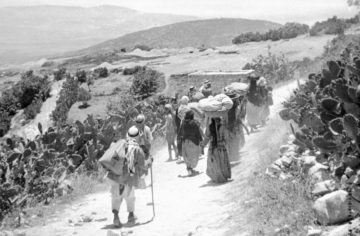
Last Saturday was Nakba Day, which commemorates the 700,000 Palestinians who were expelled by Israel – or who fled in fear – during the country’s founding in 1948. The commemoration had special resonance this year, since it was Israel’s impending expulsion of six Palestinian families from the East Jerusalem neighbourhood of Sheikh Jarrah that helped trigger the violent struggle currently engulfing Israel-Palestine. For many Palestinians, that imminent expulsion was evidence that the Nakba has still not come to an end.

Every year, commemorating the Nakba represents a kind of mental struggle to remember the past and sustain the hope that it can be overcome – by ensuring that Palestinian refugees and their descendants can return home. In my own community, by contrast, Jewish leaders in Israel and the diaspora demand that Palestinians forget the past and move on. In 2011, Israel’s parliament passed a law that could deny government funds to any institution that commemorates the Nakba. Israeli teachers who mention it in their classes have been reprimanded by Israel’s Ministry of Education. Last year, two Israeli writers, Adi Schwartz and Einat Wilf, published an influential book, The War of Return, which criticised the Palestinian desire for refugee return as emblematic of a “backward-facing mode” and an “inability to reconcile with the past”.

As it happens, I read The War of Return last year just before Tisha B’Av, the day on which Jews mourn the destruction of the temples in Jerusalem and the exiles which followed. On Tisha B’Av itself, I listened to medieval kinnot, or dirges, that describe those events – which occurred, respectively, 2,000 and 2,500 years ago – in the first person and the present tense.

More here.

Friday Poem

Osmosis: in which molecules of a solvent pass through a membrane to achieve equilibrium.

Osmosis

Example: I place my hand in a pool of salt.
Some stays. Some seeps into my skin.
Everything goes exactly where it’s supposed to.

Example: Prudencia Martín Gómez leaves Guatemala at 18
to surprise her husband in California.
Like most beings, most of Prudencia’s body is water.

When Prudencia is found
60 miles from the US-Mexico border,
a pile of clothes, limbs, and a puddle of wet sand,
is she the corpse?
or was she
the water?

If Prudencia is water,
and the desert is
a ground, then Prudencia went
exactly where she was supposed to.

If migration is a pipe
and employment is a sponge,
then Prudencia went
exactly where she was supposed to.

Some would like to build a wall,
and water always seeps through,
but much does not.

Most days, water dries in the bed of a pick-up truck
clutching a seven-year-old daughter.

Most days, water is the daughter
engulfed by men who are storms.

Most days, water flees the storm
only to join other water,
like at the bottom of a riverbed,
or drowning in an All American Canal.
Read more »