
John Hewitt in Inference:
 Variants in the SARS-CoV-2 virus control infectivity, severity, and immunity by changing tissue tropism, innate responses, and adaptive antibody generation. Although the emergence of escape mutations can see the virus spread rapidly, regardless of vaccination or antibody status, new combination therapies that strike at its heart will complement vaccinations and provide a defense the virus cannot outsmart.
One of the first treatments developed for patients severely affected with COVID-19 involved the administration of convalescent plasma. This treatment did not progress past the testing phase after a clinical trial in the US demonstrated that there was little evidence of any impact on the virus.1 The antibody spectrum of plasma may be diverse, but it is also complicated and, in many situations, dangerous to administer. In its stead, researchers are developing man-made monoclonal antibodies to target the virus with pinpoint accuracy. While still in experimental form, they can often be administered under an emergency use authorization.
Combination antibody therapies, such as the pairing of bamlanivimab and etesevimab, have been shown to wield considerable power against the virus. But they are already becoming obsolete in the face of escape variants conjured up by new strains. These treatments will remain part of the clinical arsenal, but a demonstrated lack of in-vitro activity against a threatening B.1.351 strain indicates that we have arrived at a new stage of viral warfare.
More here.
 The Biden administration’s mantra for the Middle East is simple: “end the ‘forever wars.’” The White House is preoccupied with managing the challenge posed by China and aims to disentangle the United States from the Middle East’s seemingly endless and unwinnable conflicts. But the United States’ disengagement threatens to leave a political vacuum that will be filled by sectarian rivalries, paving the way for a more violent and unstable region.
 On August 1 the Movement for Black Lives (M4BL), a coalition of over sixty organizations, rolled out “
 Daniel Borzutzky’s poetry is not an easy, elegant read: trauma, prisons, torture, murders, and arresting phrases like “rotten carcass economy” and “the blankest of times” recur ad nauseam. To read Borzutzky is, in other words, to reckon with the “grotesque.”
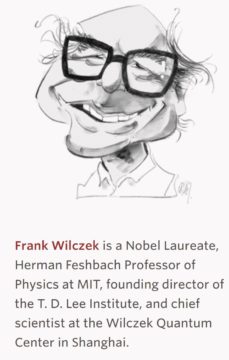 Quantum mechanics is nearly one hundred years old, and yet the challenge it presents to the imagination is so great that scientists are still coming to terms with some of its most basic implications. Here I will describe some theoretical insights and recent experimental results that are leading physicists to revise and expand their ideas about what quantum-mechanical particles are and how they behave. These new ideas are centered around a topic traditionally known as quantum statistics. The name is misleading: the basic physical phenomena do not involve statistics in the usual sense. A better title might have been the quantum mechanics of identity, but the new developments make that name obsolete too. A more accurate description would be the quantum mechanics of world-line topology. Since that is quite a mouthful, most researchers now simply refer to anyon physics.
 Last week, in its
  “We were superior to the god who had created us,” Adam recalled not long before he died, age seven hundred. According to The Apocalypse of Adam, a Coptic text from the late first century CE, discovered in Upper Egypt in 1945, Adam told his son Seth that he and Eve had moved as a single magnificent being: “I went about with her in glory.” The fall was a plunge from unity into human difference. “God angrily divided us,” Adam recounted. “And after that we grew dim in our minds…” Paradise was a lost sense of self, and it was also a place that would appear on maps, wistfully imagined by generations of Adam’s descendants. In the fifteenth century, European charts located Eden to the east, where the sun rises—an island ringed by a wall of fire. With the coordinates in their minds, Europe’s explorers could envisage a return to wholeness, to transcendence, to the godhood that had once belonged to man.
 The roots of the modern terrarium can be traced to a 19th Century experiment by Nathaniel Bagshaw Ward, an English doctor who also studied botany and entomology. Ward’s interest seems to have arisen from a journey to Jamaica as a 13-year-old boy, when he fell in love with the exotic plant life. Growing up, he developed a large collection of specimens, but he was disappointed to find that many species – particularly the ferns and mosses – failed to thrive in his east London garden, thanks, in large part, to the air pollution of the city. The UK was, after all, in the midst of the Industrial Revolution, meaning that his house was
 For the polymath, there is always a cardinal subject, a chief preoccupation around which all the other interests spin. For the fashion designer Virgil Abloh, the polymath of his cohort, who died on Sunday of a rare cardiac cancer, offensively too young, the center was architecture. He studied as an architect, and the training never really left him, even as he ventured into other arts. Abloh’s thinking was organizational, spatial, and mind-numbingly lofty. He longed to build an intricately structured life for his muse, the young Black man. Abloh designed not only this man’s clothing but also his shoes, the music he listened to in order to prime himself for the workday, the furniture he looked upon before leaving for said workday, the shiny vernacular he used in his speech, the high-concept museum exhibition at which he could practice this speech. At forty-one years old, Abloh already did all that, and so the question coursing through the minds of his mourners, whose lives had been quite literally stamped with the fruits of his imagination, is this: What was next?
 If childhoods have leitmotifs, mine was the steady, subtle, though sometimes bullying insistence on the unsurpassed importance of my Jewish American identity. On one side of my two-track upbringing, there was the uncontested conviction that Jews were the chosen people, the main players in God’s plan for humanity; on the other side, the daily pledge of allegiance to the American Republic, in all its shining-city- on-a-hill exceptionalism. How it is that my self-importance is not positively Trumpian is as big a mystery as why Muammar al-Qaddafi took over Libya and declared himself colonel, not king, or why, as John Berryman once wondered, cats love fish and hate water.
 In the face of escalating
  In the mid-2000s I set out, along with my colleagues Joseph Carroll, John Johnson, and Dan Kruger, on a large-scale study of classic Victorian novels by such authors as Jane Austen, George Eliot, and Charles Dickens, among many others. We distributed a survey to hundreds of knowledgeable people—professors, graduate students taking courses on Victorian literature, and authors who had published articles or books in the field. The respondents rated the attributes of characters in the novels exactly as if these fictional people were actual people.