
Yesenin
There is sound in suffering
And there is light in sound
And there is spirit in light
And within the spirit you stand alone
As the troubadour of some endless army.
With kindness, as a brother, you tell me to live,
May the storms never get you,
May the winds never strike you, may no whip ever hit you,
May no one ever hire you
As a slave.
You tell me to live happily
With no wealth, glory and treasures,
You tell me to live a good and honest life,
You tell me to live
As the sweet smell of wheat bread
And to repeat now and then ‘we are brothers’.
It is all right, you tell me, do not suffer,
Mountains never kneel in fear of winds –
And you swing
And you rustle
Like some eternal sorrow
Born in some corner of the wide plateau.
It is all right, you tell me, all right, all right, all right,
Look, there was nothing and there will be nothing,
Keep a drop of humanity in your heart
And your clear eyes shall never dim.
I believe you when I look at your pain
And I believe you when I look at your fear
And I carry your cross faithfully
Not knowing who will carry ours
Among tomorrow’s crosses.
It is all right, you tell me, do not suffer,
Mountains never kneel in fear of winds –
And you swing
And you rustle
Like some eternal sorrow
Born in some corner of the wide plateau
by Razmik Davoyan
translated from the Armenian by Arminé Tamrazian:
Sergei Yesenin, Russian Poet
 The best moments on television shine for lots of different reasons. They can be heartwarming, tearjerking, shocking – or, sometimes, so viscerally uncomfortable that they keep replaying in your head long after the episode or even the series is over.
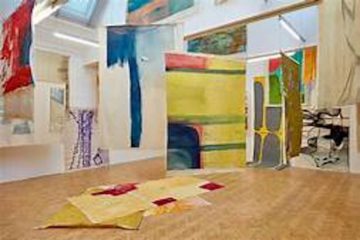 There is something that especially delights me about the story, and then also the paintings, of Vivian Suter, who happens to have a show up right now at the extension of the Reina Sofia Museum in Madrid, the extension being a large building in Retiro Park called the Velazquez Palace, which is packed full right now with hundreds of paintings by Vivian Suter, more paintings than I have maybe ever seen in a one-person show and this, indeed, is part of the delight of Vivian Suter, part of what is so fascinating about Vivian Suter, namely, that she doesn’t seem to care about her canvases all that much and so you can pack a smallish palace with hundreds of them, hanging all over the place, lying in piles, whatever, some of them covered in dirt and other detritus and a couple of them marked with what seems to be the footprints of dogs, pawprints I guess.
 Today, The Open Society and Its Enemies is perhaps best remembered for two things: Karl Popper’s coinage of the terms “open society” and “closed society,” and his scorched-earth attack on Plato as the original architect of the latter. For Popper, Plato was the first and the most influential authoritarian thinker. (Popper’s analogous charges against Aristotle, Marx, and Hegel have not proven as memorable.)
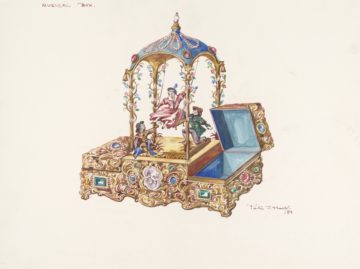 Curator Wolf Burchard has astutely understood that some of the Met’s least appreciated objects have become cultural icons, just not in the way the museum usually presents them. The Met owns one of the world’s best collections of eighteenth-century “decorative arts”; they usually languish in the museum’s emptiest galleries. Yet when Disney animated them into characters like the candlestick Lumiére in Beauty and the Beast or into scenes in Cinderella (1950), which features the heroine’s rags spiraling into a court gown, they have beguiled mass audiences. The Met rightly makes the essential formal point that Disney was inspired by the inherent animation of Rococo design, its kinetic furniture equipped with multiple moving parts and frothy ornament. To help us understand how widely this impulse pervaded eighteenth-century European culture, the museum cleverly displays a copy of a novel, Le Sopha: Conte Moral. The 1742 best seller, like many stories of its time, revolves around a thing that thinks.
 Engineers say they have now managed to fully focus the $10bn observatory on a test star. The pin-sharp performance is even better than hoped, they add.
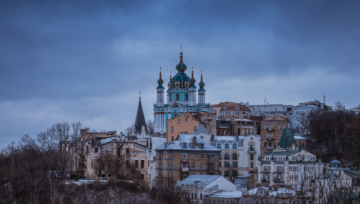 MSNBC’s Joy Reid thinks the West’s galvanizing response to Russia’s invasion of Ukraine is unfair. “Let’s face it,”
 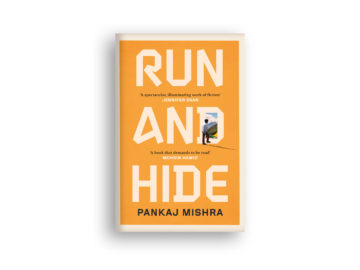 How has India’s emergence as an economic power reshaped its cultural life? What is the moral price of literary fame? Are the artistic and publishing worlds merely branches of international finance? These are some of the big questions tackled in Pankaj Mishra’s new novel—his first in 20 years. The early chapters read like a series of lofty essays smuggled into a rambling story. But it develops into a multi-layered novel, bursting with ideas.
 In 2019, neuroscientist Scott Marek was asked to contribute
  So if the traditional artistic contempt for romance as a genre has buckled under the sheer weight of audience demand, then surely Heyer, of all authors, ought to be first in line for adaptation. Stephen Fry considers this in his introduction to Venetia, only he suggests that the delights of her prose — her infectious dialogue, her constantly surprising turns of phrase, her sparkling humor, and her subtle but satisfying romantic relationships — make her too difficult to adapt. “My own view,” he writes, “is that her apparent unsuitability for dramatisation might be for the very reason that … [her] gifts and glories reveal themselves most perfectly in the act of reading.”
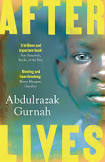 In his more mature fiction, Gurnah returns obsessively to what feels like an endlessly extending late colonial moment, stretching from the late nineteenth century to the Revolution of 1964. It is in this moment that Gurnah’s world seems to be forged and lost; what comes after independence feels more like an epilogue than the start of something new. The sense of standing with one’s feet in the sand during a retreating tide, as magic disappears from the physical universe, is at the heart of Gurnah’s masterpieces: Paradise (1994), Desertion and Afterlives (2020). All three books linger with strange encounters in late colonial Africa: Sikhs and Muslims in lonely trading outposts debating the exact geographical location of Paradise; a European Orientalist stumbling out of the desert, alone and empty-handed, into the arms of a pious shopkeeper in a coastal town; the askaris of the German Schutztruppe and the soldiers of the British Indian army pursuing each other in long marches through the countryside.
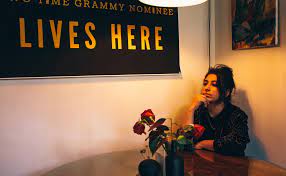 Remnants of a party linger inside Arooj Aftab’s Brooklyn brownstone on a gloomy winter day: Slightly deflated balloons in metallic purple, red and gold hover against the ceiling of her living room, and a well-used ashtray sits on her patio table. Against one wall, a banner reads “TWO TIME GRAMMY NOMINEE LIVES HERE” in big, bold letters. It is mid-December, just a few days after she heard the news. “I did not get this myself and, like, put it up,” Aftab says, chuckling as she points to the banner. Her friends had bought it for the party they threw to celebrate Aftab’s nominations for Best New Artist and Best Global Performance for her song “Mohabbat.” Aftab has lived in this apartment for more than six years. She shares it with her partner, roommate, and Tuna, a feral cat she took in as her own. She has spent a lot of time here, ruminating, writing, rehearsing and occasionally recording music— some of which is on her 2021 album Vulture Prince.
 Travis Gustavson died in February, 2021 in Mankato, Minnesota at the age of 21. The morning of the day he died, he had a tooth pulled at the dentist’s office. Due to a drug history, the doctors didn’t prescribe him strong painkillers, so he was planning to white knuckle it through the day with ibuprofen, according to his mother. Instead, he called a guy who sold him illegal street heroin and fentanyl. In a text to the dealer, Gustavson sent a photo of the amount he planned to take and asked if he had gotten the dose right. “Smaller bro” and “be careful plz!” the dealer wrote back. Gustavson overdosed.
 In a Supreme Court ruling released last week, dissenting Justice Neil Gorsuch stated that the story of CIA detainee Abu Zubaydah’s time at a black site in Poland, where he and others were tortured by a team led by James Mitchell and Bruce Jessen, contracted to the CIA, remained incomplete even though 20 years has passed. “While we know that the CIA held Zubaydah at Detention Site Blue from December 2002 until September 2003, and while we know that the site was in Poland, what happened to him there remains unclear,” said Gorsuch.
 Adding to the brutal,