
Carolyne Larrington at Literary Review:
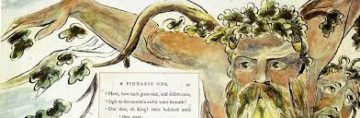
 How does an Oxford academic follow up a prize-winning trade book, a newly researched biography of Geoffrey Chaucer? And, moreover, in lockdown, when archives and libraries are largely inaccessible? Marion Turner, the newly elected J R R Tolkien Professor of English Literature and Language at Oxford, has avoided ‘second-book syndrome’ with a breathtakingly simple idea: a biography of Chaucer’s most famous character, Dame Alison (or Alice), weaver, pilgrim, businesswoman and serial participant in the marriage market, better known as the Wife of Bath. Informative, clear-sighted, entertaining and as opinionated as its subject, Turner’s new book is a wonderful introduction to the lives of 14th-century women, The Canterbury Tales and the fascinating ways in which Alison has been read and misread since she first hoisted up her voluminous skirts to show her fine red stockings during the last decade of the 14th century.
more here.
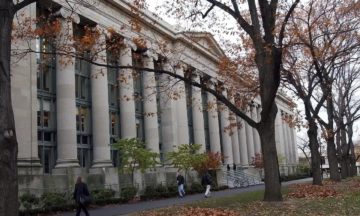
 Something was in the water in Austin. In the 1960s, a gang of classics scholars and philosophy professors had rolled into town like bandits, the University of Texas their saloon: William Arrowsmith, chair of the Classics Department, who scandalized the academic humanities with a Harper’s Magazine essay titled “The Shame of the Graduate Schools,” arguing that “the humanists have betrayed the humanities” and that “an alarmingly high proportion of what is published in classics—and in other fields—is simply rubbish or trivia”; John Silber, promoted to dean of the College of Arts and Sciences just ten years after graduating from Yale, who promptly replaced twenty-two department heads, much to the ire of the university’s board; and a third, an unassuming former radio broadcaster from the United Kingdom with a knack for classical languages and only a master’s degree to his name.
 H
H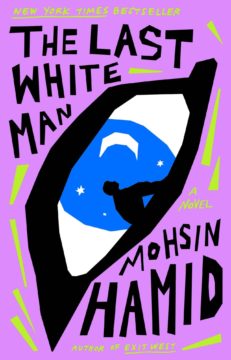 The anonymous setting of Mohsin Hamid’s 2022 novel The Last White Man brings with it a certain comfort. The British Pakistani author’s lack of specificity is purposeful: dropped into a nameless town in an unknown country, the reader has no cultural touchstones to grab onto, no societal baggage to carry. The blank slate leaves just one aspect to focus on, which Hamid homes in on with his first line: “One morning Anders, a white man, woke up to find he had turned a deep and undeniable brown.” This succinct statement of fact — a rarity in the novel — establishes the binary law of the land: you’re either white or dark, no in-between.
 When clinical trial data for the antiviral drug Paxlovid emerged in late 2021, physicians hailed its astonishing efficacy — a reduction of nearly 90% in the risk of severe COVID-19. But more than a year later, COVID-19 remains a leading cause of death in many countries, and not only in
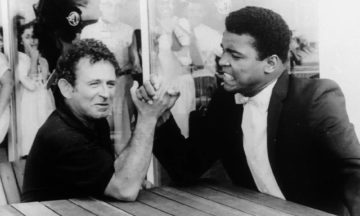
  During the three decades that I headed Human Rights Watch, I recognized that we would never attract donors who wanted to exempt their favorite country from the objective application of international human rights principles. That is the price of respecting principles.
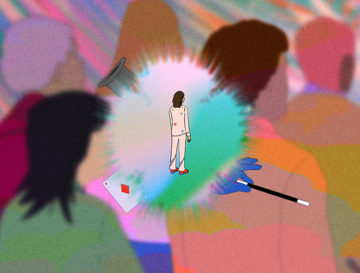 ILLUSION AND REALITY
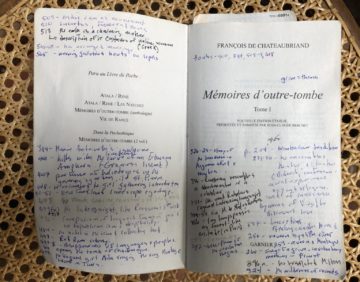 Chateaubriand says that the pleasures of youth revisited in memory are ruins seen by torchlight. I don’t know whether I’m the ruin or the torch.
 N
N It was an uncomfortable moment for people who perform colonoscopies. In October, a massive randomized clinical trial in Europe presented its initial results
 My exultant “Ha!” woke the library. I had just read Mihaly Csikszentmihalyi’s definition of “flow”—that magical feeling of getting so caught up in what you are doing that you lose track of where you are, what time it is, who might want something of you. I knew that feeling, and I craved it. Freed from space and time, oblivious to chores and deadlines, I could think and breathe and imagine. These bursts of oblivion drove everybody around me crazy, of course. I re-entered the world in a daze and had to scramble back into task-mind. But I came back refreshed and happy.
 In the four years since an experiment by disgraced scientist He Jiankui resulted in the
 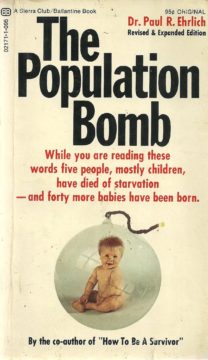 Biologist Paul Ehrlich is one of the most discredited popular intellectuals in America. He’s so discredited that
 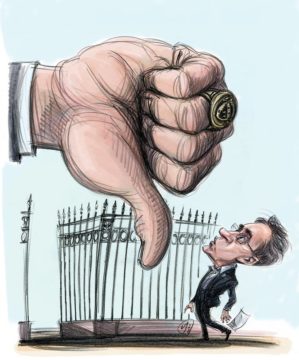 Soon after Kenneth Roth announced in April that he planned to step down as the head of Human Rights Watch, he was contacted by
 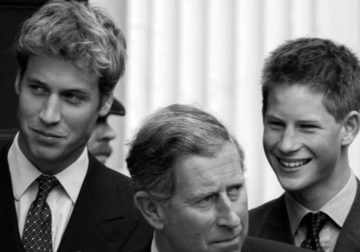 During the early stages of my father’s Alzheimer’s, when he still had lucid moments, I apologized to him for writing an autobiography many years earlier in which I flung open the gates of our troubled family life. He was already talking less at that point, but his eyes told me he understood. I thought of that moment when I read that Prince Harry, in his new memoir, wrote about his father, King Charles, getting between his battling sons and saying, “Please, boys, don’t make my final years a misery.” Time is an unpredictable thing. What will someone’s last memory be? I had the gift of time with my father, which allowed me to apologize, even though a disease hovered between us and clouded our communication. King Charles’s words reveal a man who is aware of his mortality and who would like his offspring to be aware of it as well.
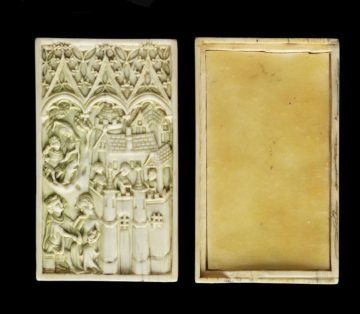 I belong to that portion of humanity—a minority on the planetary scale but a majority I think among my public—that spends a large part of its waking hours in a special world, a world made up of horizontal lines where the words follow one another one at a time, where every sentence and every paragraph occupies its set place: a world that can be very rich, maybe even richer than the nonwritten one, but that requires me to make a special adjustment to situate myself in it. When I leave the written world to find my place in the other, in what we usually call the world, made up of three dimensions and five senses, populated by billions of our kind, that to me is equivalent every time to repeating the trauma of birth, giving the shape of intelligible reality to a set of confused sensations, and choosing a strategy for confronting the unexpected without being destroyed.