
Nick Warr at The Paris Review:
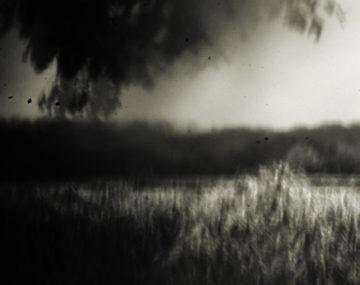 Watching a video of Sebald, at his desk, surveying his photographs with magnifying glass in hand, it is tempting to interpret his work—the prose fiction, the poetry, the essays—as existing, prior to the texts, as an assemblage of pictures. One imagines a pristine terrain of images being dissolved into the current of language, each photograph gradually written away until only the most unyielding ones remain. The jumble of photographs and manuscript pages obscuring and framing each other in the television image of Sebald’s desk are reflected in a similar mixed spatial and temporal aggregation on the printed page, where the whole is defined as much by overlapping and masking as by juxtaposition. Sometimes the edges of the photographs cause shadows to fall on the text and vice versa. Windows and lighthouses, doorways and gravestones: sometimes, the images protrude from the temporal plane of the writing (the time of the narrative); sometimes, they are visible from below the surface. The interruption of reading performed by the images confirms the irregular chronological dynamic of Sebald’s work. Constantly hindered, sent back into countless eddies and still backwaters, time, like the mineral water that is sieved through the salt frames of Bad Kissingen, percolates as much as it flows.
more here.
 Whether we’re living in the age of
 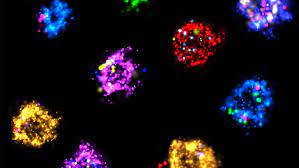 Graça Raposo was a young postdoc in the Netherlands in 1996 when she discovered that cells in her laboratory were sending secret messages to each other. She was exploring how immune cells react to foreign molecules. Using electron microscopy, she saw how cells ingested these molecules, which became stuck to the surface of tiny intracellular vesicles. The cells then spat out the vesicles, along with the foreign cargo, and Raposo captured them. Next, she presented them to another type of immune cell. It reacted to the package just as it would to a foreign molecule
 As James Grammer, the president of the
 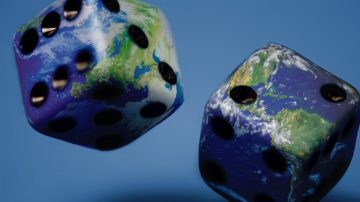 Would you live in a building, cross a bridge, or trust a dam wall if there were a 10 percent chance of it collapsing? Or 5 percent? Or 1 percent? Of course not! In civil engineering, acceptable probabilities of failure generally range from 1-in-10,000 to 1-in-10-million.
 The Republican Party’s primary season officially gets underway four months from today, on January 15, 2024, the day the Iowa caucuses are held. That makes this a fitting moment to take stock of where things stand—and to reflect on the most astonishing and disturbing fact of America’s political present, which is that, short of a medical event that requires him to bow out of the race, the twice-impeached, serially indicted former president Donald Trump, who has led the field by a wide margin for over a year and is currently ahead by
  A
A I walk to and from my office daily. It takes 25 minutes, if you don’t stop at all to look at your phone. (It takes me 35 to 40.) That includes a few steep hills, of the kind I didn’t believe existed in Ohio before I moved here. (
 Every day is not easy,” says Jill Duggar Dillard, “and right now is one of those seasons.” As a member of one of reality television’s most familiar and unquestionably largest families, the fourth Duggar child spent her formative years playing the role she most wanted to fill, the “good girl,” the “Sweet Jilly Muffin.” But then she married and began to assert her adult independence. And then the revelations about
  Toby Green in Compact:
 David Klion in The Baffler:
 Gary Edward Holcomb in LA Review of Books:
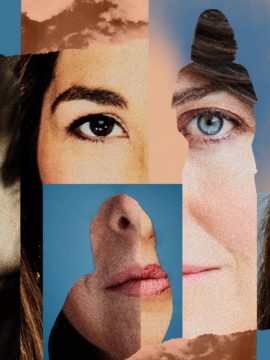 A doppelgänger is a double, a person who appears so similar to another that they could easily stand in for them, maybe even take over their life. “The idea that two strangers can be indistinguishable from each other taps into the precariousness at the core of identity,” Klein writes. In Philip Roth’s novel