
by Derek Neal
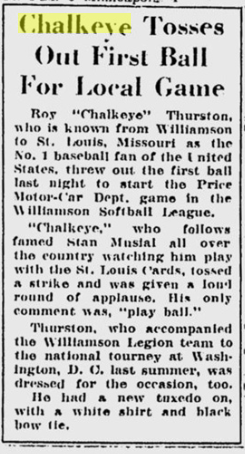
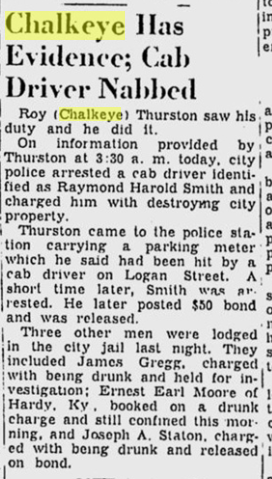
A few weeks ago my dad was telling me about a man named Chalk-Eye. This man, whom my father had never met but had heard stories about from his own father, was a local legend in the small coal town of Williamson, West Virginia. You might see Chalk-Eye, my dad said, in the pool hall or at the fieldhouse for a high school ball game. Maybe he’d be walking along the railroad, or thumbing a ride into town. He was always around. One time, my dad’s father told him, they were driving up to Cincinnati for a Reds game. They spotted Chalk-Eye by the side of the road and asked him if he wanted to come along; he did, so he got in the backseat and made the impromptu four-hour trip with them. Chalk-Eye was also—and this is corroborated by a newspaper clipping—the friend of the great baseball player Stan Musial, who starred for the St. Louis Cardinals from the 1940’s to the early 1960’s.
When the Cardinals were in town to play the Reds, Musial would provide Chalk-Eye with complimentary tickets and put him up in a hotel. There were other local figures in Williamson: Firebird Matthews, who could be hired for a day to do any physical labor needed; Roy Dibble, who sold “The Grit” (the local weekly newspaper); Jimmy Castle, who could paint but who might not be available because he was in jail. I wonder if these people exist anymore. Somehow, a place had been found for them in society; they were not gainfully employed, couldn’t hold down a 9-5 job, might not be able to fulfill the role of a husband or a father, but they were not completely destitute or alone either. The town took care of them one way or another.
Michael Bible’s novel, Little Lazarus, is about these sorts of people. A recurring character is “the man in the seersucker suit,” who is not just one person, but a social role that is taken up by anyone who puts on the suit:
He is a wayfarer, a traveler. A common sight in that part of the country until not that long ago. Some were buskers or magicians or living statues. Some were confidence men or hustlers or thieves. Others were mystics and professional raconteurs. The man in the seersucker suit wasn’t any of these. He was more of a stroller. In another time and place he might’ve been called a flaneur or a penniless boulevardier. Harmony nicknamed him Seersucker. He and his tortoise Lazarus moved from town to town predicting the future.
Throughout the novel, we meet a series of Seersuckers who take us through the 20th century: James, Simon, Andrew, Thomas, and finally, Francois, who brings us into the 21st century. Other Seersuckers are briefly mentioned: John, Peter, “and so on and so on…The Seersuckers were men and women from every race and background.” It becomes clear that the individuals themselves are not so important; instead, it’s the idea of the Seersucker, and while reading you feel that, although you might not be a Seersucker, there’s a part of you, and a part inside everyone, that could become a Seersucker if life plays out a certain way.
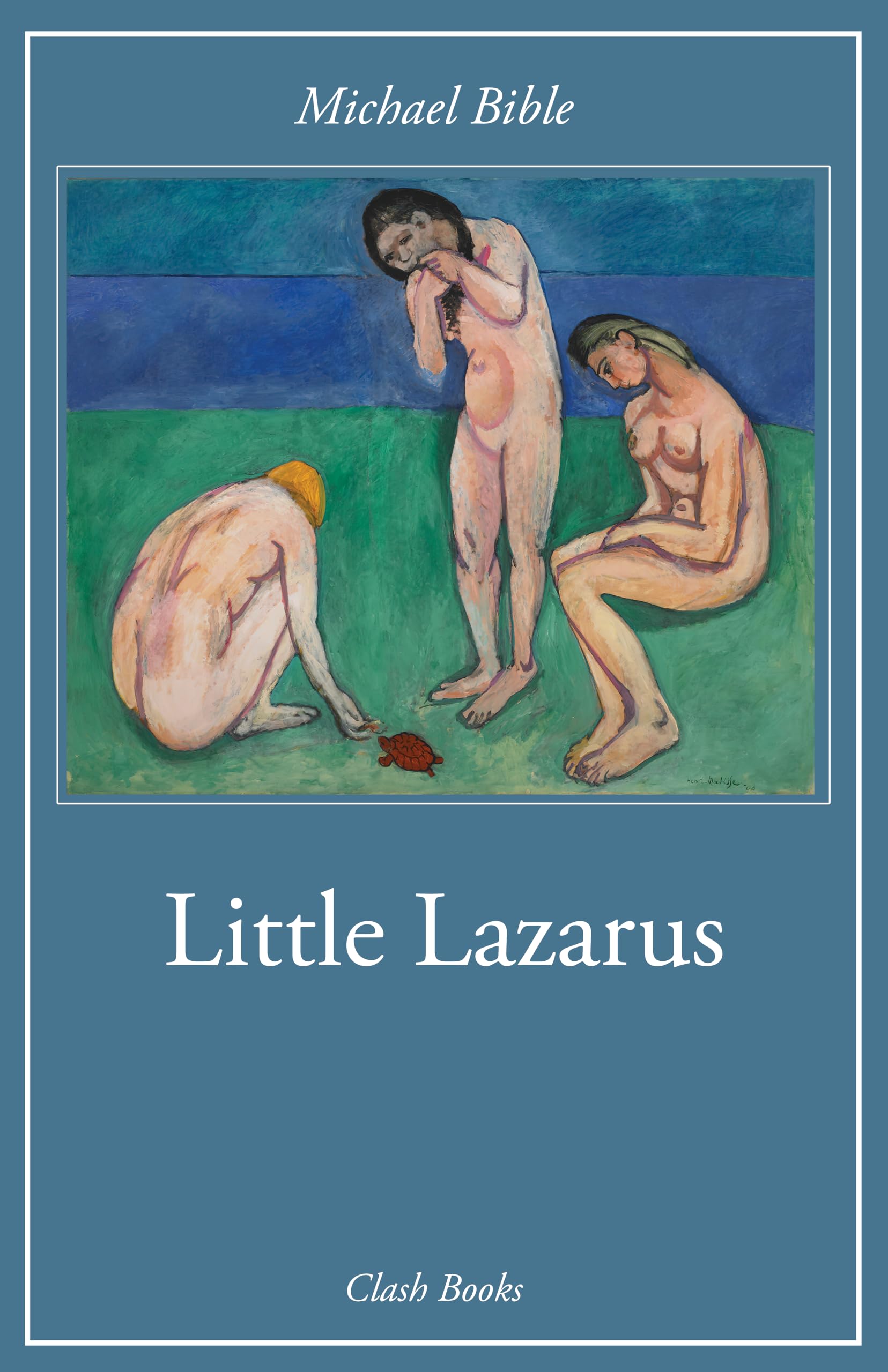
The novel is short (152 pages) and most characters are only afforded a page or two of story, sometimes only a sentence or two. The main characters of Francois and his high school friend, Eleanor, receive a bit more attention, but never enough to make this “their” story. Parts of the novel contradict each other, as we read that Eleanor ran away from home, then that her disappearance was the result of a car crash, but then we meet her 25 years later, alive and in a peculiar living arrangement with a billionaire nicknamed Sugar. This is not a realist novel (I haven’t even mentioned the turtles yet); it’s something more, something weirder and deeper, something truer. The fact that details seem to conflict is intentional, as it helps make the story feel timeless and eternal; these are old tales with an oral quality, the facts changing depending on who’s telling the story and who’s listening. The novel has Harmony, North Carolina at its center, but it radiates out to other places and times: Eleanor on 14th street in Manhattan; Francois and Ms. Hopper, his music teacher, at a warehouse jazz club in Washington D.C.; Walt, a rabid SEC football fan and frat bro who, like Andrei Rublev, suddenly feels a religious calling to become a painter; Sandy, who works at a midtown hotel and makes extra money selling pictures of her feet to the lonely, wealthy men who stay there; Jill, a teenage runaway, high in Central Park trying to manifest a better life; her drug dealer boyfriend, Quiet, who dropped out of Arizona State and moved to New York because of a Wu-Tang Clan obsession; Sugar, the desperate billionaire who wants to live forever and who pays Eleanor to verbally humiliate him on vacation in the Seychelles (“This morning Sugar comes to my room on his hands and knees and I shame him. ‘You’re a small hairy man with fat hands,’ I say. ‘I’m so sorry,’ he says. ‘I’m so repulsive.’”)
The thread tying these stories together is Lazarus, a giant tortoise who may be the oldest living animal on Earth, and who allows the man in the seersucker suit to make a living by responding to questions from curious passerby (Lazarus crawls to either a “YES” or “NO” box chalked on the ground). Each character I’ve mentioned so far comes into contact with Lazarus, Lazarus observes them, and we, as readers, view them from Lazarus’ viewpoint. This is the key to the book and the source of its strange power, as Lazarus’ age grants him the wisdom of an elder; he sees, and we realize, that the characters are just people visiting Earth for a short time and that, in the grand scheme of things, they are relatively insignificant. This is true of us, too, and is not a cause for despair, but a source of wonder that we’ve come to exist at all.
Here is Lazarus understanding that he will have a new owner:
Lazarus saw the stranger from the corner of his eye and knew this meant that Francois was not coming back. His walks to the park were over and a new episode was about to begin. The stranger’s appearance signaled in him a deep reservation. Throughout his long life Lazarus had encountered all sorts of humans and knew they weren’t always kind but weren’t always cruel either. Lazarus hid inside his shell. There was something about the billionaire that he was drawn to. Not the man himself but the fate the man augured. Lazarus brought his head out and looked around.
And later, when Lazarus is alone:
He thought of Francois and Eleanor and Sandy and Walt and the others. He thought of his first years and how they occupied his thoughts over him in a deeper way than the bottleneck of the most recent months and days. When he was young time seemed to be more important, but as he aged the years flowed together like streams feeding small rivers which fed larger rivers that led to the great expansive ocean of his memory. He was tired of it all and longed sometimes for a brief bright flash of existence. It turned out it was pretty damned hard to die. He walked on.
Lazarus, as these passages make clear, is characterized by equanimity and benevolence. The feeling I had when reading this book is the same feeling I have when Kit (Martin Sheen), in Terrence Malick’s Badlands, tells a father who thinks he’s not good enough for his daughter that it “takes all kinds, sir.” It’s the feeling I get when I listen to The Stylistics song “People Make the World Go Round” (the verses in the song list various social problems, then the chorus reminds us, “But that’s what makes the world go round/The ups and downs, a carousel”). In terms of literature, Little Lazarus feels more like an epic poem (I thought of The Epic of Gilgamesh) or a religious text than a novel. The only novel I can compare it to, one which also made me feel small and insignificant as a human, but part of something larger than myself, is Max Frisch’s Man in the Holocene, which makes you realize how long life has existed on Earth, and how short of a time humans have been here. Bible seems to have love and compassion for every character his book introduces, and this is not cloying or overly sentimental (a real risk when writing with this level of sincerity), but beautiful. He’s funny, too. When Walt and Sandy pick up Lazarus to deliver him to Sugar, the apartment security guard asks how old the tortoise is:
“Nobody knows for sure,” Sandy said. “But the best guess is around 140.”
“Damn,” the guard said. “I bet he’s seen some shit.”
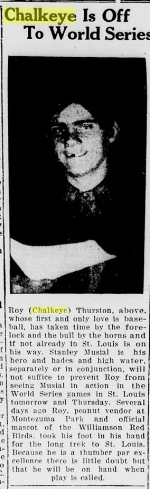
After finishing the novel, which imagines a world centuries in the future and a related tortoise named Little Lazarus, just as the novel opens with a section set centuries in the past and a tortoise that is the distant ancestor of Lazarus, I began to search for news clippings of Chalk-Eye in the Williamson Daily News. I found him in dozens of stories, mostly in the sports section in the 1950’s, with frequent references to the fact that “Chalk” had either “disappeared from town” or was “back in town.” I found him, too, in the 1940’s Mingo Republican, this time in the police blotter, accused twice of petty theft, although it seems he was never convicted. All this is ancient history now, and yet, in the vast expanse of time, it was only just yesterday that Chalk was hitching down the state highways on the way to St. Louis. My dad mentioned that there would be few people alive today who had met Chalk-Eye, and that if he hadn’t really existed, we would have had to invent him as myth. In one story, I see him as a man in a seersucker suit, moving from town to town with a tortoise that predicts the future.
***
Enjoying the content on 3QD? Help keep us going by donating now.