
by Gary Borjesson
In my essay, On the Eleusinian Mysteries, I described the origin story of the Mysteries and what we know about the rites of initiation, which lasted as long as nine days. Here I will focus on the role of the psychedelic kykeon, and how this contributed to the flowering of philosophy, science, and art in ancient Greece and Rome.
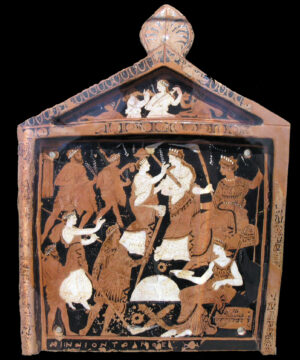
1. The heart of the mysteries
At the heart of the Mysteries was an initiatory experience, not a teaching. In other words, you couldn’t gain what the mysteries had to offer by hearing about it from someone who had been initiated, even if they would tell you—which they wouldn’t because the punishment for speaking about details was death. The experience was life-changing. Cicero, an initiate, wrote that “by their means we have been brought out of our barbarous and savage mode of life….and have gained the power not only to live happily, but to die with a better hope.”
The key experience that the Mysteries facilitated is boundary dissolution. The teaser with which I ended the first essay points to this: the experience of the Mysteries was open to everyone, regardless of the conventional identities that bound them—man or woman, slave or free, citizen or foreign worker. Even if you tried to hold on to your identity, say, as a high-born Athenian statesman, the rites of initiation promised to dissolve this limited view of yourself. Moreover, it’s not just social identities that are loosened, it’s the boundary between the living and the dead, and between the human and the divine.
As the origin story suggests, boundary crossings are at the heart of the Mysteries. In that story Hades crosses the boundary from the Underworld, abducting Demeter’s daughter, Persephone, and carrying her back to the Underworld. Demeter’s scorched-earth grief leads Hades to release Persephone, who then crosses back from the dead to the living. Her journey is memorialized each year, for Persephone’s return to the land of the living brings spring and its promise of rebirth.
At the heart of the Mysteries’ power to induce a boundary-dissolving experience was very likely a psychedelic compound. Yet it was hardly the only tool; much of what was required of the initiates supported that end. As they walked the Sacred Way to Eleusis, the initiates re-enacted Demeter’s search for Persephone, calling out for her in group chants. They fasted, bathed in sacred waters along the way, and underwent other rites of purification. This all happened before they arrived at Eleusis, where they underwent further purification before the main ceremony. Likewise, militaries have long used similar methods to dissolve boundaries—breaking recruits down so as to forge a new sense of identity by having them march and sing out cadence calls (also known as “Jodys”), and undergo other ritualized group behavior.
Singing and chanting and marching and dancing and meditating and worshiping together, among other methods, can all promote the experience of an expanded mind. But psychedelics are the most reliable technology humans have discovered for facilitating a boundary-dissolving experience.
2. The sacred (psychedelic) sacrament
Eleusis lies on the Rarian plain, famous as a grain-growing region. Demeter is the goddess of fertility, agriculture, grain, and the harvest. In the Hymn to Demeter, which tells the origin story of the Mysteries, Demeter is offered wine to assuage her grief over the loss of Persephone. She declines the alcoholic beverage, asking instead for a kykeon, a mixed drink made of barley, water, and “tender leaves of mint.” This basic recipe will be used as part of Demeter’s rites for centuries.
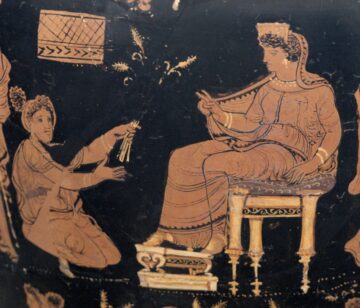
So what gave the kykeon its psychedelic kick? We’re still not certain, but the best guess comes from researchers who have found that ergot (the fungus Claviceps purpurea) grows on the barley in that region. Ergot contains a psychedelic compound. In fact, the chemist Albert Hofmann first synthesized LSD while researching compounds he derived from ergot, including lysergic acid—the LS in LSD (Lysergic Acid Diethylamide). Hofmann was asked by researchers to help determine whether the ergot growing on barley could be the kykeon’s secret boundary-dissolving
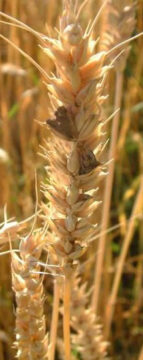
ingredient. He found that indeed it could be, but with the caveat that it would have required special care on the part of the herbalists, since ergot on grain is often poisonous. (St. Anthony’s Fire, also known as ergotism, is a kind of poisoning that comes from consuming products made from contaminated grain.)
I won’t rehearse here the evidence that the kykeon used in the initiation was actually a psychedelic. I highly recommend Brian Muraresku’s fascinating book, The Immortality Key: the secret history of the religion with no name, and The Road to Eleusis (co-authored with Hofmann). Together these persuaded me that in all likelihood it was. (Most of what I report here about the specific history I gleaned from these books.)
Before turning to how psychedelics influenced Greek culture, let me digress briefly to share Muraresku’s more ambitious thesis, that psychedelics were a key influence on early Christianity. With Dionysian festivals accounting for one-third of all religious festivals around the time of Christ, cross-fertilization between festivals and rites was natural and common. (Christ’s first miracle was Dionysian: turning water into wine for the marriage feast at Cana.) Muraresku suggests that early Christianity may have competed with these other festivals by offering a potent experience of their own, making a psychedelic kykeon part of the early Eucharist. The rite of the Eucharist was known to be carried out in graveyards, and underground tombs. Like the Mysteries, it celebrated the dissolving of boundaries between the living and dead—through resurrection. The Eucharist’s origin story is the Last Supper, where Jesus gives thanks over the bread and wine he shares with his disciples. The magical transubstantiation of bread and wine into Christ’s body and blood during communion is, for Catholics, not symbolic but literal. (As the devout Catholic Flannery O’Connor once said, “Well, if it’s just a symbol, to hell with it!”) A psychedelic kykeon might well bring home to his latter-day initiates Christ’s remark to his disciples, “This is my body given to you.”
3. The Mysteries and the Flowering of Western Culture
A long historical record, dating to at least 10,000 BCE, makes clear the place of psychedelics in religious and spiritual rituals around the world. But what do boundary dissolving experiences have to do with the flowering of art, science, history, mathematics, and philosophy? One place to look is in our time, where a range of thinkers and innovators have credited psychedelic use with aiding their insights. Two famous examples are Steve Jobs and Kary Mullis. In 1993 Mullis won the Nobel Prize in Chemistry for inventing the polymerase chain reaction (PCR), a foundational technique in modern genetics. Mullis said, “Would I have invented PCR if I hadn’t taken LSD? I seriously doubt it.”
Plato can help us explore this connection. When defending himself at trial, Socrates distinguished being an Athenian from being a human being. He claimed that his human nature had laws of its own, which may or may not agree with those of Athens. Though he acknowledged his duty to Athens’ laws, he provocatively claimed he also had a duty to explore and be true to what he discovered about his humanity.
Such distinctions depend on finding a way to loosen the bonds of conditioning and indoctrination far enough to see that the opinions of your tribe—or any tribe, including those of science and religion—may not be the true authority on the nature of things. Again, there are many ways to loosen the bonds of our conditioning; we’re focusing on a substance that reliably does so.
A core teaching of Plato and Socrates (both of whom were initiated) is that in order to think differently—in order to learn something new or update your beliefs about the world—you must first loosen your grip on what you think you know. No paradigm shift happens without this. Thus while it’s natural to assume your experience is a representation of reality, or to assume that your tribe’s ways are the true ways, it’s the case that if you get into a conversation with Socrates or take a powerful psychedelic, you will learn how subjective and partial your view of reality is. This is often both an unsettling and a liberating experience.
Speaking of liberation, Socrates’ allegory of the cave in the Republic describes the journey of education that begins once we recognize that our situation is rather like that of prisoners chained to a wall in a cave, watching a play of shadows and assuming this is reality. It has been noted that this famous allegory resembles the experience of the initiates on that culminating night in the large temple at Eleusis. After days of preparation and purification, the initiates drink the kykeon and then sit through the night in torch-lit darkness on tiered steps of the cavernous hall, hearing song and watching the play of shadows against a long wall, as actors dramatized Demeter’s return from the underworld with her daughter, Persephone.
That’s what’s happening externally. But the initiates were also having internal experiences and visions. We can wonder, then, whether the idea for the allegory may have crossed Plato’s mind as he sat there in semi-darkness, watching the play of light and shadow, the scene of the living and the dead, and thinking perhaps of waking and sleeping, and then of the enlightened standing in the sun while the ignorant are chained in darkness.
We can wonder what other ideas may have been sparked by that typical psychedelic experience of having one’s familiar sense of self dissolve (what’s now called “ego death”). Returning to the earlier distinction Socrates made, did Plato perhaps have a lived experience of his universal human-ness? Did this leave him feeling more attuned to the larger order of things, so frequently described in his dialogues? Did such experiences inspire Plato to write the myth of Er that concludes the Republic? This myth envisions the whole cosmos and how human souls in the underworld come to choose their next lives. (For more on this, see my essay Making the Invisible Visible.)
The power and the threat of Socratic philosophy and psychedelics is precisely that they encourage individuals to question received authority and favor their own experience and thinking. By loosening the bond of our prevailing prejudices, opinions, and conventions, they encourage us to explore: Do the heavens really revolve around the earth? Are the laws of Athens really the final authority on what is good and just? Is it really true that some races are naturally inferior and deserve to be slaves? Why should computing power be centralized in mainframes owned by corporations, rather than putting the power of computing into the hands of the people? What if I try making a polymerase chain reaction this way?
The Eleusinian Mysteries contributed to the flowering of culture in the west by instituting the ritual experience of boundary dissolution, making it a civilizational technology, not merely a private spiritual experience. (This isn’t the only time or place in history where psychedelics have been used thus.)
4. Cosmos Versus Chaos
The tension has been with us from the beginning. Despite God’s order, Adam and Eve transgressed the boundary, eating the fruit, so that God says, “Behold, the man has become as one of us, to know good and evil.” Socrates’ trial is another case of institutional power threatened by a boundary-dissolving power, this time of philosophic inquiry.
The Bacchae, written by Euripides around 406 BCE, a few years before Socrates’s execution in 399 BCE, brilliantly explores the same underlying story. This time the threat comes from Dionysus, who is coming to the town of Thebes. Proudly proclaiming that there is no place for Dionysus in the lawful order of Thebes, its ruler Pentheus makes the fatal decision to bar him and his rites from entry. Or rather Pentheus tries to. By the play’s end, he has been torn limb from limb by frenzied women, including his mother, who proudly carries her son’s head on a pike.
When the Roman Emperor Theodosius shut down Eleusis in 392 CE, his motivation was similar to that of Pentheus and Athens and, in our time, the war on drugs: protect institutional power against destabilizing, boundary-dissolving forces.
The Greeks reflected deeply on the tension between the need for law and order on the one hand and the value of boundary-dissolving freedom on the other. This is the tension between kosmos (which in Greek means an ordered, arranged whole) and chaos, which is the source of novelty, change, and innovation. Plato and Euripides expressed what I take to be the perennial wisdom: we need both, and any attempt to eliminate one in favor of the other leads to tragedy. As Nietzsche observed in the Birth of Tragedy, it was part of the Greek genius to recognize that great works of art, science, and philosophy arise in this creative tension between the Apollonian drive for order and the Dionysian drive for boundary dissolution.
Enjoying the content on 3QD? Help keep us going by donating now.