
by David Hoyt
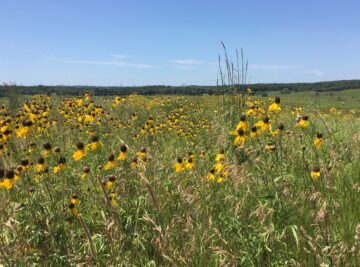
It’s hard to love the prairie. If you love it, you tend to be loving a memory of something you’ve hardly known, or a vision of something you dream might return some day, like the American Bison. Or maybe your love is more profound, in that you love it for what is beneath the surface – the oceanic swell of the ground, the large simplicity of the horizon, or the wild solitude of its winters. Here and there it pulses with a latent sense of life, thrumming beneath the emptiness of regimented fields, giant grain elevators, and wind turbines – like a flooded spring field that attracts a thousand ducks from out of nowhere.
It’s hard to love the prairie because there’s almost nothing left of it. Few landscapes of continental scale have been so quickly and comprehensively dismantled. In European colonial settler imaginations, hardly had the prairie appeared before them than it was plowed under. Some of those who were fortunate enough to encounter it in its wild state, such as Audubon, reported a sort of ecological Stendhal syndrome, a prairie-induced aesthetic exhaustion from exposure to boundless forbs, grasses, and wildlife. Despite this powerful effect, there simply wasn’t sufficient time for the landscape to seep into the collective settler consciousness before it was harnessed to agriculture, taking any passing familiarity with its flora and fauna and rhythms of life away with it. Within little more than a generation of settlement came the plow, then barbed wire, and little more than a generation after that, the Dust Bowl. There really is little sense of what it was like before all the corn.
What remains, at least in the Corn Belt states, are remnants. Many of them are too small to generate much of an impression unless you look very closely. A prairie, like its close kin the range further west, is a matter of scale, calling for a certain amount of space between horizons. Even then, grasslands have had to battle an imported, Euro-American prejudice in favor of trees. Despite initially deforesting much of New England in a failed attempt at agriculture, early settlers to the prairies next decided that there were not enough trees in places such as Nebraska. They were thus encouraged to plant trees where nature had failed to provide them by the likes of J. Sterling Morton, the father of Arbor Day. The nation’s first municipal nature preserve, the Forest Preserve District of Cook County (1914) outside of Chicago, as its name suggests, initially included virtually no grasslands, despite being surrounded by them. This obsession with trees as plants which ‘improve’ the landscape lives on in the widespread idea that plating trees is a general cure-all for environmental challenges such as climate change.
The irony of all this is that not only are grasslands by acreage the largest single terrestrial ecosystem on the planet, incorporating large swathes of the temperate latitudes in both hemispheres, but they are also among the largest terrestrial sinks of carbon, and among the most biodiverse. What sets them apart is something we have only recently begun to appreciate: in a prairie, most of the biological action is underground. There is certainly every reason in the world to preserve tropical rain forest (trees, again), but everything there is above ground. Cut down the Amazonian forest and you are left with very little. Tropical soil is notoriously thin. In the case of the prairie, around 80% of the biomass of a given area – plants, animals, and insects – is underground. This is what makes so much of it, from Iowa to Argentina to Ukraine, fit for world-class farming.
All of that organic activity, over the course of millennia, has also stocked away an estimated one third of the terrestrial organic carbon on earth. And as a carbon sink, grassland has a major advantage over forests: Both can burn, but when a forest lights up, most of the carbon withdrawn from circulation and contained in lignin is then released to the atmosphere. In a grassland, while the flames pass above – and they can be towering – most of the carbon remains stored below.
Grasslands are also unparalleled at squeezing biodiversity into small spaces. Ecologists like to rope off a section of ground and catalog the living things within it. The metric of choice is usually a square meter, but it can be smaller. In one quarter quadrant, roughly twenty by twenty inches, or the size of a small doormat, ecologists in a Missouri prairie found 46 native plant species, some of them highly conservative, meaning they are very rare. This is a world record. For a sense of comparison, go out into your yard, garden, or down to the local park, and count the species in a comparable area. To identify a dozen species of anything, let alone native species in multiple square yards of planted restoration, would be an accomplishment. To build a community of 46 within a very small area takes centuries, and the hand of nature.
Multiply this density of life by a few hundred million acres, top it with tens of millions of bison grazing and pissing and trampling and wallowing in it all, together with numberless other now-nearly-vanished mammals of the plains (elk and mountain lion and badger) and you have something that could rightly be called an American Serengeti. And that is not to mention the insects, whose sonic presence when in season warrants tropical comparisons: the mosquitos, the raucous cicadas, and the glorious moths of evening such as the Cecropia and Luna. When Audubon made his way across a wet prairie east of St. Louis around the time of the New Madrid earthquake in 1811, without a horse and on foot in the muck, he retained sufficient presence of mind to marvel at the number of butterflies of different colors and sizes hovering above vast fields of flowers.
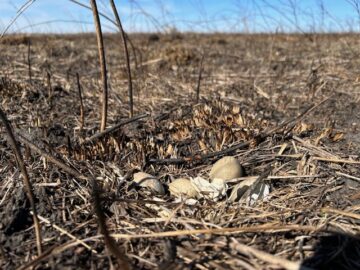
Old eggs and nest of Eastern Meadowlark against clump of Big Bluestem Grass in a Central Illinois prairie remnant
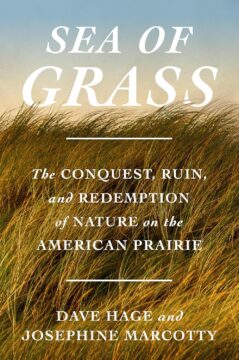
Most of this is gone now. The prairie may be unique in this. The Rockies are still there. The forests of New England, victims of an initial, misbegotten attempt at agriculture, have regrown. Even the Great Plains, home to Sioux and Lakota, are still recognizable where its ranchers are holding out against the plow. But the prairie, especially the richest, fullest, wettest portion of the central Mississippi Valley, has been engineered into a giant plantation for the production of two crops, corn and soybeans, and corn above all. We know from recent research that songbirds making the arduous spring trek northwards from South America are so daunted by the Corn Belt that they treat it as they do the Gulf of Mexico – as something to get across as quickly as possible. How this has come to be – how even migratory birds have come to view the Midwest as flyover country – is the story told in Dave Hage and Josephine Marcotty’s ambitious book Sea of Grass, a book as big and sprawling and rich with life as its subject.
It is a geography of the post-glacial Mississippi watershed, a history of settler colonialism in the heartland of the United States, a nuanced study of grassland ecology, and a consideration of the impact of technology in the service of capitalism on the face of the land. In all of these respects it is welcome and urgently needed. Care for America’s largest landscape calls for a vision matching its scale.
Hage and Marcotty are journalists, and this comes through in pleasantly clear exposition throughout, as well as a sense that the authors have spent time on the ground getting to know the people and landscapes of the enormous region they have made their subject. This ranges from watermelon farmers in south central Indiana working to support pollinating insects in a region doused in glyphosate, to the rangeland of northwestern Montana, where First Nation communities are involved in the complicated project of bringing bison back to their homeland on the High Plains.
Sea of Grass could have focused exclusively on the handful of such contemporary actors working to bring some measure of sustainability and ecological heritage to the agricultural systems it explores. This alone would have been both worthy and entertaining – the sorts of folks who are willing to buck the enormous incentives proffered by modern agriculture are typically non-conformists and make for enjoyable profiles. The fact that Hage and Marcotty have resisted the journalistic tendency to skirt deep consideration of the past leads to an ultimately more powerful critique of the problems that have taken over a century to reach their present magnitude. Solid historical background paired with up-to-date knowledge of policy, politics, and science is rare in a work of this scope, and difficult to orchestrate. We should be thankful that the authors resisted whatever doubts they or their editors may have had about including the chapter on the drainage of the Midwest – one quarter of which was wetland, and an achievement which the New York Times compared, with regard to just Iowa, to the engineering of the Panama Canal. “How the West was won” might be aptly paraphrased as “how the Midwest was drained,” and how most of its wetland was destroyed in the process.
As fascinating as is the story of draining the prairies, thereby banishing malaria from upper Illinois and Indiana, and delivering their rich, bottomland soils to the plow, there is nothing in the facts of this story that is not told on the websites of state school extension programs. Where Sea of Grass differs from these is in its key, set to the pitch not of triumphant progress, but to that of tradeoffs, losses, and most importantly, inescapable ecological feedback loops that force themselves upon us. Emblematic of this is the so-called “pesticide treadmill,” or the artificially induced arms race between agrochemical companies and the insects they target, an arms race in which pests will always win, and which may in fact work to increase their number and potency. Hage and Marcotty present the received and narrowly accurate narrative of progress – of increasing acreage cultivated, of rising yields per acre, and of miles of drainage tile installed – while never losing sight of what the extension programs tend not to dwell upon: the cumulative loss and biological impoverishment of topsoil, the skyrocketing rates of nitrate pollution in municipal drinking water, and the crashing populations of insects and birds upon which successful farming ultimately depends.
The loosely structured narrative laid out by Hage and Marcotty pivots around the years 1945-1950, bracketing two distinct eras of agricultural exploitation. The first, from the period of Indian removal in the early nineteenth century up to the first half of the twentieth, is the story of nature’s free gifts freely appropriated. A pioneer farmer in 1830’s Illinois could break the prairie and hand-sow his corn, then watch it grow to fifteen feet without lifting a finger. Cattlemen on the Great Plains could turn their herds loose on federal lands to graze, free of charge, before shipping them east to Kansas City and Chicago. The costs were the displacement of native peoples, and immediate losses in biodiversity – noted at the time by some pioneers themselves – together with the eventual depletion of resources, the Dust Bowl being the most infamous instance. Founding Fathers Thomas Jefferson and George Washington both lamented the poor soil husbandry practiced by early colonial and early American settlers, ever tempted to seek virgin lands further west rather than do the work of repairing soils exhausted by the production of cash crops. Could they have foreseen the disaster of the 1930’s, barely fifty years after the southern plains in Oklahoma and Kansas were opened to the plow?
The second period follows World War II and is characterized above all by a shift from simple exploitation of the free gifts of nature to the chemical and genetic manipulation of plants; a decoupling of farming from nutrient cycles operating within the biosphere, such as the circulation of nitrogen, phosphorus, and carbon; and the introduction of novel technologies of weed and pest control with unforeseen consequences, such as neonicotinoids.
In this second, chemical phase, war is the mother of all things, serving as an accelerant to the industrialization of agriculture. If there is a modern analogue to Shelly’s Dr. Frankenstein, a top candidate is Dr. Fitz Haber, a tragic German-Jewish figure of late Wilhemine Germany who gave the world a technique for producing artificial nitrogen fertilizer that doubled as a weapon of mass destruction. Haber himself personally oversaw the use of his technology in the form of poison gas first used during the Great War. Haber has been the subject of recent fascination and perplexity, in no small part due to the ambivalence of his technological legacy highlighting the nexus of warfare and the control of nature.
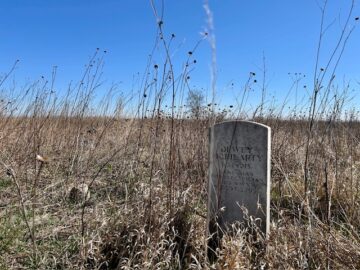
Prairie remnant in an old cemetery in McLean County, Illinois
After the Armistice, the chemical weapons were banned, but not the fertilizers. Not for the last time, the U.S. government encouraged the conversion of wartime armament production to domestic purposes to significant effect. In this case, it meant conversion from explosives to fertilizer, together with other chemical pesticides developed during the war. (The intimate connection between synthetic fertilizer and warfare has recently been highlighted by an executive order issued by President Trump, invoking the Defense Production Act, which grants federal protection and purchasing preference to the sole supplier of elemental phosphorus in the United States. The Soda Springs plant in Idaho, owned by German agrochemical conglomerate Bayer, mines elemental phosphorus there for use in fertilizers, the herbicide Roundup, and military explosives).
It was not until the late 1940’s, however, that the chemical revolution spurred by global conflict began to comprehensively change the way people farmed. Until then, and even as late as the 1980’s, many American farmers followed older models calling for crop rotation, cover crops, and the mixing of animal husbandry with row crop agriculture – ‘hooves on the grass’ – in order to preserve soil fertility. Where implemented consistently, such practices preserved a degree of balance between agriculture and ecosystem function, a balance which allowed the Illinois River valley and adjacent counties to serve as a sportsman’s paradise, a national destination due to the large populations of waterfowl that migrated through annually.
A number of developments conspired against this wildlife bounty, beginning with the arrival of DDT on consumer markets after the Second World War and culminating in the near universal adoption of genetically engineered corn and neonicotinoid pesticides. The chapter on “Bugs” is a nuanced and informative account of the shifting tides in this battle between agriculture, insects, and consolidating corporate power, sometimes referred to as the ‘pesticide treadmill.’ It is a cycle which grows ever more financially onerous for producers while guaranteeing more, and more resistant pests. What chemical attempts to protect monocrop farming since 1945 have shared among their successive technologies has been the effort to liberate agriculture from the constraints of both evolution and natural nutrient cycles, replacing them with artificial and increasingly expensive inputs controlled by a small number of global firms. Accumulating research is establishing, as Hage and Marcotty document, that this is not sustainable. As the authors note in their survey of this history, and pointing to the inevitable emergence of herbicide and pesticide resistance, “evolution always wins.”
In the second and concluding part of Sea of Grass, Hage and Marcotty document an inspiring and creative collection of efforts to bring a fullness of life back to the prairies. These range from large-scale, public-non-profit landscape restoration collaborations such as the cobbling together of Glacial Ridge National Wildlife Refuge in northwestern Minnesota, the creation of enormous and controversial private preserves such as American Prairie in Montana, the effort of private ranchers to find a path to sustainability in the unforgiving environment of the Great Plains, and work by groups such as Practical Farmers of Iowa (PFI) to search out similar pathways which draw on the best of conventional and alternative farming models.
Reading all of this, one gets the impression that elements of an overall solution are in place, but bringing them together requires challenging a status quo that has taken shape over the course of nearly two centuries and which is deeply entrenched in the global economic order. And yet, this wouldn’t be the first time that the region gave rise to a movement, ‘grass-roots’ if you will, that reacted against the overweening control of far-off monopoly capital over the lives of people working the land. Whereas the populists and agrarians of the 1880’s and 1890’s confronted railroad monopolies and tight-money financial interests, today’s farmers and ranchers confront monopoly seed/fertilizer/pesticide combinations, as well as concentration in meatpacking. Federal farm policy gives significant money to conservation programs, but not enough to meet demand, while subsidizing environmentally harmful boondoggles like ethanol production, which absorbs some 40% of American corn production.
This is clearly not a system working to ‘feed the world,’ as some rhetoric might claim. We have enough corn, and probably too much. What has been lost in the turn to unshackled production for global export has been a way of life, the health of our rural soil, air, and water, and the integrity of the natural ecosystems upon which they depend. Des Moines is choking on the nitrate load from runoff into the Raccoon River. Shrimpers in the Gulf of Mexico have been put out of work by the phosphorus load dumped there by the combined contributions of Iowa, Illinois, and Minnesota. The sportsmen of Pheasants Forever and other such outdoor groups have had to work mightily to bring back the flocks of duck and geese that once clouded the sun along the Mississippi and Illinois Rivers.
The Pulitzer Prize-winning editor of Iowa’s Storm Lake Times-Pilot, Art Cullen, sees here an opportunity in what may seem like dark times on the American farm. The Chinese market for American corn and soy may be gone forever, but perhaps this disruption offers up a silver lining. Unhitching farm production from global commodity markets and outdated federal subsidies such as ethanol mandates might allow it to return to something more human for farmers and more resilient for the land. Shifting crop insurance and financial incentives away from export production and towards domestic markets for more diverse crops could increase the quality and amount of food – not biofuel – produced by the prairie, while helping speed adoption of common-sense conservation practices.
In the cosmology of the Anishinaabe peoples, several nations of whom lived in northern Illinois, it is told of the Original Man, Nanabohzo, that when he came to the world, he learned from the animals. He did not name them, or conquer them. They were the foundation of everything, for he himself had nothing. Whatever he did have, they gave to him. The return of American Bison to several tracts of Illinois prairie after an absence of over two centuries marks the convergence of this ancient wisdom with painfully acquired ecological science. After the prolonged disruption of modernity, we have learned from the bison what the prairie needs, and what they gave to it. More than any other species, they gave unifying shape to the vast grassland stretching from Indiana to Montana, and sustained the Native American peoples who flourished there together with them. When I see buffalo charging out of the livestock trailer at Burlington Prairie only 50 miles from downtown Chicago, and remember the herd grazing at Midewin Tallgrass Prairie 50 miles south, and then another herd further west at Nachusa Grasslands, I think that they may be the just medicine needed for a change of heart, the buffalo medicine that may finally redeem the sea of grass.
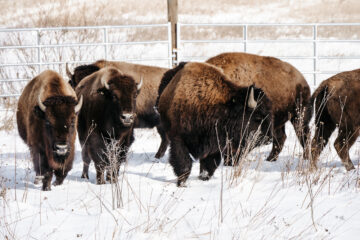
Bison released into Burlington Prairie Forest Preserve, Kane County, Illinois, December, 2025.