
Boundaries Dissolving: The Secret Power of the Eleusinian Mysteries

by Gary Borjesson

In my essay, On the Eleusinian Mysteries, I described the origin story of the Mysteries and what we know about the rites of initiation, which lasted as long as nine days. Here I will focus on the role of the psychedelic kykeon, and how this contributed to the flowering of philosophy, science, and art in ancient Greece and Rome.
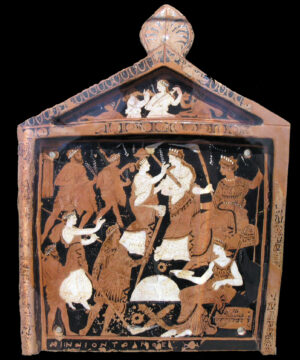
A votive plaque known as the Ninnion Tablet depicting elements of the Eleusinian Mysteries, discovered in the sanctuary at Eleusis (mid-4th century BC)

1. The heart of the mysteries

At the heart of the Mysteries was an initiatory experience, not a teaching. In other words, you couldn’t gain what the mysteries had to offer by hearing about it from someone who had been initiated, even if they would tell you—which they wouldn’t because the punishment for speaking about details was death. The experience was life-changing. Cicero, an initiate, wrote that “by their means we have been brought out of our barbarous and savage mode of life….and have gained the power not only to live happily, but to die with a better hope.”

The key experience that the Mysteries facilitated is boundary dissolution. The teaser with which I ended the first essay points to this: the experience of the Mysteries was open to everyone, regardless of the conventional identities that bound them—man or woman, slave or free, citizen or foreign worker. Even if you tried to hold on to your identity, say, as a high-born Athenian statesman, the rites of initiation promised to dissolve this limited view of yourself. Moreover, it’s not just social identities that are loosened, it’s the boundary between the living and the dead, and between the human and the divine.

As the origin story suggests, boundary crossings are at the heart of the Mysteries. In that story Hades crosses the boundary from the Underworld, abducting Demeter’s daughter, Persephone, and carrying her back to the Underworld. Demeter’s scorched-earth grief leads Hades to release Persephone, who then crosses back from the dead to the living. Her journey is memorialized each year, for Persephone’s return to the land of the living brings spring and its promise of rebirth. Read more »


Monday, February 14, 2022

From Analog to Digital

by Carol A Westbrook

I gave my husband an Ember mug for Christmas. The Ember mug is artfully crafted, with its embossed monogram and satiny, comfortable finish. The magic of this mug is not its beauty, but the fact that it holds coffee or tea at a constant, pre-set temperature for over 2 hours. It’s great for someone who likes to linger over that second cup of coffee and carry it around the house.

My husband likes his coffee hot, so I set the mug’s holding temperature to 140°. While I was at it, I changed the color of the LED indicator light, just to see if I could. For this I used a cell phone app. I checked my phone to make sure that coffee pot was set to brew at 6 am, and that the house thermostat was set to increase the house temperature at 5:30 am from the low 60’s to the low 70’s, so we’ll be warm and toasty when we awake. And of course, the bread machine would have been busy since 4:00 am, making the breakfast bread. For dinner, I decided I will put a few things in the crockpot and program it to start cooking at 4 pm. I began to realize how our smartphones control so many things in our life; the Ember mug was just one more addition to our “Internet of Things,” or IOT. Read more »

Monday, October 24, 2011

Hippie-punching The Apple Genius: Was Smartass Steve Jobs A Dumbass For Refusing Early Cancer Surgery?

by Evert Cilliers aka Adam Ash

Steve Jobs & appleA lot of people think Steve Jobs was not that smart after all. First diagnosed with pancreatic cancer in October 2003, he waited a full nine months before he had a secret operation in July 2004. He put off the surgery advised by doctors, friends and family, and instead explored macrobiotic diets and other options, including going to “spiritualists.” When he finally agreed to the operation, his cancer had spread beyond his pancreas, hastening his impending death.

So what do you think?

What you think depends on one thing and one thing only: whether you are among those who've been very ill or not.

There is a huge chasm between the sick and the well, as big as the chasm between the 1% of rich people who run our country and the 99% who have no say and are at the mercy of the 1%.

It's about as big as the one between the quick and the dead. The quick have plenty to say about the dead, but the dead can't hear or talk back.

Number one: if you're well, the chances are good that you'll feel as ready to blame sick people for their illnesses and their choices about it, as Republicans are at blaming poor people for being poor.

Number two: if you're well, you have no idea what a person goes through who is faced with a life-threatening illness, and you can easily muster the arrogance to judge their choices.

Number three: if you're well, you're just plain lucky in your genes, environment and circumstances, and you'd do well to STFU when to comes to having opinions about others not so fortunate. You're a little like those arrogant men — Romney, Perry, Santorum, etc. — who think they have the right to decide for an entire gender, not their own, whether that gender should have a choice to abort a pregnancy or not.

Told of Jobs' choice by biographer Walter Isaacson, 60 Minutes interviewer Steve Kroft asked this question: “How can such a smart man do such a stupid thing?”

Read more »