Losing The Plot (Dreaming Dulles)

By Maniza Naqvi

PoppyblossomShe had been at Arlington cemetery on that hot swampy August day when a flag draped coffin had arrived from Andrews Air Base. The constant roar of planes taking off from National Airport nearby and the insistent shrill of their landings was making it difficult for Eileen to hear the speeches though it was possible to catch their gist: A great debt was owed. Jet stream streaked the steamy skies above.

Colleagues, hundreds of them, straightening, tightening and yanking their ties given the occasion and sweating in their suits on that hot humid afternoon, had come to pay their last respects from both sides of the beltway and the river. Old buddies had gathered that day to say their goodbyes and pay their respects—she had spotted George Schultz —Bill Webster and Bob Gates, Dick Cheney, Don Rumsfeld, and Zbigniew Brzezinski; there was Judge Bork and Alexander Haig and Edmund Muskie, and Charles Percy—and the intrepid and ubiquitous Charlie Wilson and so many, many others that she recognized. Good men. Strong men. Brave hearts. Men with resolve. Patriots.

There must've been a thousand people at the funeral that day by the time the second coffin was lowered into the ground. There had been no wives to receive the folded flags—both men recently divorced. Ambassador Arnold Raphel and Brigadier General Herbert M. Wassom. They'd laid down their lives for their country—bringing down the Soviet Union. No two ways about it. God damn heroes, God Bless them.

The head of the Pakistan Intelligence Services a General had been there too, of course. A man who could be sinister in a roomful of people to those he considered as lesser in the species and at once genial to a fault to those he considered his superiors because of rank and power. A man of considerable zeal, also to a fault. He was there at the funeral as though he were family. In fact he was the main receiver of condolences, embraces, pats on the back. Naturally. A man who had a special vision for his country and understood the pulse of Pakistan.

In her own way she understood it too. Eileen knew Pakistan well. Or rather Eileen knew the Pakistanis who counted, well. She had written off Stanley's off color remark as just his being drunk rather than being a jab at her. Not much there. Eileen had managed to change her name from Irene Stone to Irene Khan to Eileen Costa, in several decades. She had been a widow and a divorcee. Neither one of her marriages had lasted long—one man had obliged by dying, the other one by leaving her for another man in Washington DC. There was not much to embellish. Eileen knew how to compartmentalize, recognize the useful, take it and move on. This was her core competency. At the age of nineteen she had been passing through Pakistan as a college dropout after having decided after her sophomore year to hitch-hike across the planet instead of graduating. This decision of hers to go further had been a sure why not kind after she had arrived in Europe with a group of friends in the summer of 1970. They had made their way across Europe and were in Trieste when she was faced with the choice of taking that one space left in the car to join a couple of friends who had purchased a Citroën and who were going to drive it through Yugoslavia to Bulgaria on through Turkey into Iran and Afghanistan and on to Pakistan. The plan was to get to India. The plan stopped there. The idea was that by the time they arrived in India they would know who they were and where they were going: presumably to an ashram. All would be revealed. All they had were their passports, a few hundred dollars for the gas—and some change of clothing each. Almost everywhere they stopped along the way they ate for free—welcomed by people into their homes. They had heard about the treachery of border guards and highway robbers but they never got to experience any of this. They ate, drank, smoked, sang and drove their way all the way to Pakistan. Eileen got sick in Rawalpindi. Too sick to travel any further: Hepatitis. Her friends left her in the care of the nuns and a very attentive and kind doctor at the Holy Family hospital. Eileen was given a private room by the staff who after seeing that she was a foreigner felt she was in need of special care. There, lay Eileen, for four months, a hue of seasick green and chalk, her hazel eyes sunken and circled by dark shadows, her face gaunt, her long honey brown hair now cropped by the sisters to improve its health. Two months after that she had not only made a full recovery but had, more remarkably, married the doctor who had been treating her: the very kind and middle aged Dr. Asfandiyar Khan. At the age of twenty Eileen, half her husband's age and towering above him by a good six inches found herself catapulted to the position of being the much admired and looked up to (literally) wife of a respected physician. Dr. Khan was considered an admirable man because he had broken away from the traditions of his feudal family who presided over the supervision of large tracts of farming land and did precious little else except the very strenuous task of ruling and controlling. Now she was the daughter in law in a family of a powerful Government civil servant who was the special advisor to the President who was a military General, of course. She had in-laws and relatives-in-laws who's names read like the who's who list in the military, bureaucracy and business corridors in the country. To keep herself busy she volunteered once a week at a women's center for handicraft production; twice a week at the United States Information Center—as a librarian and English tutor; and once a week at the American School as a substitute teacher. The marriage was exciting, fun and mercifully short lived. By the time she found herself getting bored, the good doctor too had obliged and died of a heart attack. Shortly after the funeral Eileen had taken a Pakistan International Airline flight back home. It was the very same air craft, she was told, that had taken Kissinger and his team to Beijing, for secret talks with Zhou En Lai thanks to Pakistan's services in its status as the best friend forever of both China and the US and therefore the ideal match maker. The marriage, Eileen's, hadn't produced progeny. So all she had was the experience and it was to serve her well. It had been enough, this intense cultural immersion, upon which to build a career. It had made her as they put it on either side of the Potomac, a Pakistan hand. In addition to writing several novels with names such as “The Veil and the Sword”; followed by the “Veiled Caravans followed by two more: “Wives are Witches and Mothers Saints” and “The Naked Fakir”, she had managed to complete her college and university education in international relations and gender studies with a specialization on Pakistan. She had made her way back to Pakistan almost a decade later. And there at a garden party one evening at the embassy replete with white gloved waiters; guests armed with gossip and innuendos as their depth of political analysis and Chinese lanterns dangling amongst the lush fragrant blossoms of the Frangipani she had met Stanley. Who, at that time, sardonic and handsome was playing his part as the spy master intellectual and she a USAID consultant on gender issues. That was the summer of 1984.

Eileen had repeated and rehashed at least a thousand times what Stanley had said to her on the phone three nights ago until she realized that he had said something very different from what she had understood. He had said their names when he called her in the middle of the night. She had played it back in her head over and over again—and it seemed to be clearer now. But she couldn't be sure. She thought he had mumbled on about infallible innocence. But now she thought he had said something like Raphel and Wassom, Eileen, Raphel and Wassom. She hadn't heard what he had said before that—but then she was sure he had said our infallible innocence before hanging up.

Stanley had been there too, at Arlington Cemetery. He seemed very alone though he was surrounded by so many colleagues. He had accompanied the coffins back home from Islamabad.

She had looked across at him—standing there in his seasonally appropriate and anything but, occasion wise, very crumpled cream colored seer sucker suit. His face was pale and gaunt, aviator glasses masked his eyes. The sun was strong. He was looking towards her but she couldn't tell whether he had picked her out in the crowd or was even looking at her—. She hadn't seen him in over a year. A lot had happened since then. She'd gotten married to a career diplomat Jeffery Costa—posted recently in Nairobi. And Stanley had continued on in Islamabad.

After the ceremony, as the crowd made its way to the parking lot, she had caught up with him. She had offered to drive him to his hotel and he had accepted. Instead, when she stopped her Ford Taurus at the last light before she turned into the hotel in Chrystal city—and Stanley had said: God, I need a drink, she had offered to fix him one at her home. He had come back with her to the apartment in West Falls Church which she and her husband were renting while she completed her training at Langley and he was away doing a tour of duty in Kenya. A rental worked in this transitory life style. As she had explained to Stanley, later when Jeff and she retired they would get something in Georgetown or out in Rappahannock County. Stanley was jetlagged, drunk and still shaken. After a few minutes of fumbling with love making, Stanley had patted her on the head; rolled over and promptly started to snore. A few hours later she had driven him back to the hotel. They had chalked their lack of enthusiasm to the events and the fact that Stanley was drunk, shaken and jetlagged.

The day before, just before dusk, in the incandescent light of a sinking sun on the horizons of the capital, in a plot in the same cemetery other funerals had taken place. Here too, US flag draped coffins, two, had been lowered in gently and had been given the full honors. No speeches. The remains of General Zia ul Haq and General Akhtar Rahman were buried with full honors in Arlington Cemetery as fallen American heroes. Zia and Rahman. Raphel and Wassom.

Stanley had attended with several colleagues and the ISI General. There was one very special guest, General Zia's mistress, the blonde bombshell from Miami, who sobbed throughout the short ceremony her eyes red and swollen behind the black net veil of her hat—her long legs in black fish net stockings, her low cut cocktail satin sheath of a dress entirely appropriate for the patriotic part she had played in keeping the stressed out General happy.

Stanley had imagined that he had heard a ghostly drawl whispered in his ear: Islamabad's half as big as Arlington cemetery and twice as dead. When the pieces began to fall into place in later years the habit of hearing Dulles in his ear became a past time on quiet evenings of reflection over whiskeys, listening to the BBC World Service and watching the light diminish against the hills in Islamabad. Stanley imagined himself in conversations with the founding father the legendry and long dead CIA Director Allen Welsh Dulles –In Stanley's day dreaming he would be sitting beside Dulles in his study in front of a crackling log fire in a beautiful home in Georgetown along a tree lined street near Dumbarton Oaks. Just beyond the closed door filtering sweetly in, would be the sounds of grand children chasing each other their parents telling them to pipe down—Gramps was working. The aroma of many mingled good scents wafting around them: tobacco, whiskey, leather seats Old Spice and the smell of turkey on its final minutes of roasting.

Stanley did not know whether to place Dulles in the setting of an ascetic—of mission furniture—and austere surroundings—enveloped in silence—outside a bleak dead scene of January or instead in the embrace of domestic bliss. Stanley had chosen to imagine him this way:—surrounded by warmth—on the coziest day of the year—thankful, contented and satisfied. Poinsettias on the bay window sill sat looking out on to a white picket fence. An autumnal tree lined cobbled street beyond. Persian carpets at his feet—miniatures on the walls— here a Ming vase in the corner, there a stone relief from Angkor Wat—or instead perhaps something encrusted with sapphires a snuff box from Battambang. It was a full house of living long and prospering. If you want to keep it this way over here—then we have to keep it that way over there.

There was Dulles—puffing on his pipe—wiping his spectacles with his silk tie before readjusting them on the bridge of his nose and holding forth on his life's experiences: Back in my day just when I was getting started in all this I learned a lot from the British and the Germans. Everything I know. I wrote a book—I know Stanley, you're a fan—you've read it back and forth—memorized it I'll bet: The Craft of Intelligence. So you know how much I love secret operations.

As do I Sir. As do I.

Yes Stanley. But be careful son. In trying to understand one's adversary my boy—one risks the danger of becoming him—or at the very least empathizing. This is a hazard of the trade.

How often does that not happen? Stanley in his musings had asked.

What?

Stanley had rephrased his question: That we don't become him? At some point far along in the operation, do we even know the difference between him and us? Especially if we have created him?

Dulles nodded: Ah—yes—that would be the mirror effect——looking too deeply at something has the effect of reflecting back one's own image—even if there is nothing at the point at which our gaze is directed—If we look hard enough—an image emerges—like a mirage in the desert. It can happen to great men like ourselves. It always does on principle—happen to great men like ourselves.

Yes, sir.

I approve of your creativity Stanley—thinking outside and inside the box—you're committed to constant change! As I was in my time: Operation 40; Operation Mockingbird, Operation Paper Clip—ah those were the days! The only problem is that over time—these things can establish and entrench themselves and morph into their own organizations—cartels even—unless there is constant change. The first principle of a good organization committed to maintaining its monopoly on information and power, Stanley is constant re-organization. But here's the dilemma, Stan—how can you ensure change to be constant when you're the agent for stopping change?

Indeed Sir. How?

Ah, Stanley my boy—I like your idea—a coffee company—it has merit. I had an idea like that myself called it the United Fruit Company. So you see Stanley it's all been done before there's nothing new—no phenomena at all. No surprises. Besides—in your case—the country you've grown so fond of—Pakistan is as old as we are, the Agency. I mean. It is our lover, our mistress—-it is our sibling in a way isn't it—if not our very own child?

Stanley must have grimaced at this suggestion because Dulles seemed to have admonished him: Now don't go getting ideas Stanley that anyone of these shits including that chit of a girl that Bhutto's daughter was any different. They are all our products. Not worth losing any sleep over. All created, groomed and taught by us. All of these so called leaders—right and left—belong to us—belong to each other—they're our quislings—can't do without our commodities, our luxuries—our way of life. Don't expect them to rise up against us, do you? They are us. More us than we are us. Indebted to us—no—not just indebted to us—but indelibly us.

And Stanley had interrupted: The question is: who will rise up against them?

Well now that's what we need to look out for and look into. That's what we're forever trying to fix aren't we? The non-quislings' rebellion. In that our interests seem to converge with that of the cartel's. We want to keep the natives from getting restless, so to speak, keep the rebellion down.

Stanley had interjected: But the cartel Sir, is our enemy too. It will destroy us as surely as it will Pakistan.

And Dulles would have had replied: There are no permanent enemies as they say my dear boy, only permanent interests. We are permanent. And I assure you Pakistan will not be destroyed it is permanent, have no fear. It is ours permanently. Henry Mortimer Durand and Sir Cyril Radcliff—did the deed of breaking off the chunk that was of interest to us. They were assigned the task to make the mess we have today. The British weren't interested in keeping all of India—they couldn't leave fast enough—two world wars had finished them. The only part of India that ever interested them was the western part and that's the chunk they broke off and kept for themselves. The good bits. That's the part that gave them access to Central Asia, China, Russia, and Iran. That's the part, which fit their imperial needs and commercial enterprises best. And then of course, ours too. No sunlight between the Brits and ourselves you see. That's the part they irrigated, grew cotton in and parceled off to their stooges—And those stooges—those stable boys who tended the British horses those two anna servants of the Raj who scraped, bowed and cow-towed at noon—the time when the Englishmen loved to ride—those are the guys who became a strengthened tribal and feudal elite. The Two-annas, and Noon and so forth. Our stable hands—at the helm. It was this part—with the rivers—the water and the glaciers; the cotton and wheat fields; and the irrigation systems, which they put a boundary around garrisoned and called Pakistan. This was the part that they wanted to keep—the jewel in the crown so to speak. The eastern part was a mistake—and that corrected itself in 1971—we right sized the chunk we wanted. And it is this Pakistan that is ruled by the Brits and us to this day through our quisling class that speaks English and is educated in Oxbridge—and Sandhurst and now of course in Yale, Harvard and Princeton and down the road in both directions and in our War Colleges and so forth.

And then when that stopped working they got themselves goons like the one who controls Karachi and General Musharraf—both of whom live in London protected by the British! Of course, that's fine by us. The days of the gentlemen lawyers studying at Lincolns Inn are over—They were quite useless in following through effectively on the plans in any case. Lily-livered. The new mafia bosses are more up to the task and greedy too. They do the job for us in this day and age and they are the ones that rule now. It's all about ensuring that the port functions just fine for our commerce and our coalition forces….The British never left. They got themselves a permanent garrison. And of course we just took over. And who ever has come along and decided, foolishly, very foolishly indeed, to question these boundaries these rules of the game—or turn on the deals they've made with us—in these past 60 years—well it's been fatal for them—they've gotten very sick and died of arsenic poisoning—termed as cancer or a heart attack, or have been assassinated—Till I was around this is how things were done. And later much the same things continued: executions, assassinations or simply disappearances. No need for investigations or anything into any of these murders. Oh yes, when the crowd amongst the quislings clamored for some level of inquiry or investigation—we agreed to the Brits trotting out Scotland Yard to sort things out—From the murder of the first Prime Minister all the way to Benazir—all an inconclusive investigation—and then we provided the record as a press release through our BBC. Everything sounds better in British English—sounds truthful. Even to us. We kept everything running smoothly at the big ol' Garrison!

You tell me that the Taliban are the wretched chaps flailing about—in their rage—against us and the cartel. I can see your point of view Stanley. Your theory may have some merit. It's a rebellion of the have-nots who have risen up against the cartel—without even knowing who is in the cartel. Poor saps—the only problem is that we are using them too—and so is the cartel. They are our pawns: our mules and our minions–and therefore our worst enemies. They are nobody and they are everybody who wants their country back and everybody who wants an end to misery. But misery never ends. That's the dynamic of power. But here we are: Our own minions and mules dare to mutiny against us. Tsk. Tsk. What a sorry state of affairs. It always is.

And Stanley had asked: And what do we plan to do now? I mean what's our end game? What's the grand plan? Are we in danger of creating another Khmer Rouge—are we going to end up instigating the carnage that we had in Cambodia during the Vietnam war?

Dulles had looked at him with indulgence: Grand plan? There is none. We do it, for its sake. That's the plan.

Do we keep fighting till we've killed every Afghan, every Pathan, every Punjabi, every Baluchi and every Pat Tillman that gets it? And then, what? Where does this stop?

And Dulles replied: Does it?

Dreaming Dulles for Stanley always stopped there. Dulles was his own special theatrical tintinitus.

On the fourth night of his absence Stanley had returned. When he knocked on her hotel door—she had opened it, and the look on his face accusatory perhaps had made her scream out his name and rush forward to hug him and pull him into the room.

Where have you been Stanley! I've been worried to death. Three days ago you called me at 4 a.m. and then you disappeared!

Stanley sounded tired and calm: I didn't disappear—who said I disappeared—I closed my shop and went for a trek in the mountains. But tell you what—I had a little visit from our colleagues four days ago—snooping around my house—Hey Eileen did you sound the alarm on me?

Eileen had started crying to Stanley's surprise.

She crisscrossed her arms across her chest holding onto her shaking shoulders and hugged herself: What was I supposed to do? I called you in the morning—you didn't answer—you weren't answering any of your phones.

Stanley interrupted her—No I meant did you—

Eileen sobbed: The help in your house or your coffee shop had no idea where you were so what was I supposed to do? I was petrified, I was completely at my wits end. I informed the Embassy. They looked for you and….

Looked for me? Stanley laughed….well here I am Eileen.

Really Stanley….Eileen had begun…You have no idea what I've been through. I cancelled everything. I haven't moved from here, from the hotel waiting for word from you. The embassy called me in today and showed me a video. I thought I would die.

Come on now Eileen—you?

Stan! I thought I had lost you Stanley. I was so scared. It was a video of a guy in a hood sitting cross legged on the floor—some Arabic words behind his head —Three guys standing behind him were also hooded and in shalwar kameezes carrying automatic weapons. They told me it was a video they had received from your kidnappers and Stanley—they are planning on going public with it.

Stanley laughed….well here I am Eileen. How do you think they're going to explain their little foray into Hollywood?

I don't know, Eileen replied as she pulled him to her and onto the bed. Look at you, just look at you she said over and over again.

Stanley lying half over her propped his head on his arm seemed amused and surprised: What's gotten into you girl—I thought we were done.

Done? I'll never get passed you Stan. Murmured Eileen, as she reached up and pulled him down and began with gusto to demonstrate to him the ardor of her devotion.

Later—sleepless and satiated with Eileen in bed next to him he had kissed her head and said: I guess they'll call it a false alarm—they'll have some terrorist expert come on to explain that this is a disinformation propaganda tactic by the terrorists to break our morale. I don't know.

What's going on Stanley—I don't understand.

I just told you what I think. The kidnapping looks pretty real doesn't it? We're good at making things look real. We lead in making movies. And here I was only hiking in the mountains. Darn! But hey kid—I didn't know you felt this way—I'm touched.

Shut up Stanley! Eileen laughed with embarrassment. She appeared endearingly clumsy, gawky in her stance and almost shy.

Stanley replied gently: Okay.

I mean over all these years Stan—you're the only one. Eileen her eyes moist, her nose red had sniffled and stared at Stanley's face.

You should have let me know you were alright Stan. I'm scared for you. I'm scared there's something terrible that's going to happen to you. I don't understand what you're doing here. I mean for three days you completely disappear—the embassy shows me a video of your kidnapping—Now you're here in my hotel room I mean what's next?

The end of the drug cartel.

Uh huh Stan-drug cartel. I thought it was the coffee shop…..

Stanley had asked: Can I trust you Eileen.

And she had replied wide eyed: I don't know Stan can you?

The coffee business as you must know Eileen is just a front.

A front? A front for what Stanley—I thought you said you had had enough of us and wanted a break.

Yup, you heard right. The coffee shop gave a couple of us a good front to start following the money–. I get to stay here—there are a couple of us in this with me.

Couple of you? Who? What? Where? Doing what exactly Stan?

I'm here, the others are stationed in Miami, Dubai, Yerevan, Kyiv and Pristina, I haven't met them yet—but we've all met on line. That's the way we want to keep it to insure each other's security. We've got started on a little coffee investigation. It's our front—from my little café to the coffee importers and exporters offices we've set up in other places. No one's suspicious about a guy gone native trying to grow some coffee and starting up a coffee shop. So we've been looking into where to grow it, how to finance it, how to transport it—Who to talk to about licenses, clearances, finances, imports, exports, port authorities, truckers—the whole distribution network. Funny, how everything here involves the Generals—and the truckers. And coffee growing follows the pattern of poppies—from blossoms to bombs. And interesting how coffee and heroin have the same routes and the same bankers. And everything in between is a growth industry: drugs, oil, weapons and human trafficking.

We set up shop Eileen, to see who would show up, offering to buy, sell and finance. It's interesting what we're learning. The defeat of the Soviet Union and the end of the cold war right? Let Freedom ring, right? Ching-ching! After all free people are free to loot, right? Free market, right? It's called unbridled capitalism.—the war we won when we took down the U.S.S. of R. So when the cartel wants to expand into tourism—build hotels and they find that there's existing over capacity—well they simply blow up the existing capacity—–same thing for anything else—they've learned the B-52 way of getting things done—if it's getting in the way—just blow it away.

I was here on April 10, 1988 when the arsenal depot at Ojheri camp, the ammunition depot to supply the Afghan war, which was located in Islamabad exploded, days before a Pentagon investigation panel was supposed to arrive to take inventory of the Stinger missiles and other weapons that were supposed to have been in there.

Kaboom! Live ammo falling all over the city. The smell of burning flesh and death, Three things happened that day. Thousands of civilians were killed by the debris and exploding weapons. No problem. Zia used that to dismiss the civilian stooge Prime Minister who was beginning to make noises against him. No problem. Evidence of missing Stinger missiles—sold by a weapons cartel—gone. No problem. But it was a problem. The explosion at the arms depot was a huge problem for us. It was clear that there was collusion between the CIA and the Pakistanis. The arrival of the weapons panel was supposed to have been a top secret. Even the members of the panel weren't supposed to know until the last moment after they had boarded the plane as to what their mission was supposed to be. It was on a strictly time sensitive need to know basis. The coincidence of the camp exploding—was too big—someone on the inside on our side and all the way up there on the food chain had to have leaked the information.

Uhuh?

The information that the leak was being investigated was leaked as well. Our guys and their guys had set up a pretty cozy drugs and arms business with a gigantic network. They had a pretty free reign for a long, long time, no questions asked. Ojehri Camp which was supposedly housing our Stingers was blown up to make sure that the trail ended there and no investigation panel could ever verify what was missing. Now all that was needed was one more spectacular act to ensure that the business could flourish. Take-off.

We know that a C-130 exploded over Bahawalpur on August 17, 1988. We know that the plane carried the President of Pakistan and the Chief of Army Staff General Zia-ul-Haq and his top seven generals: We know that the plane carried the US Ambassador Arnold Raphael and Brigadier General Herbert M. Wassom.

We know that by 1988—the Soviets had left Afghanistan—the drug trade was at its peak—and the Generals in Pakistan were making money hand over fist on this trade. We know that the CIA was using the drug trade to finance their war in Afghanistan. We don't know whether the guys handling the Generals and supervising the whole operation were involved in making money for themselves.

What if the Generals and their American friends including the Ambassador had forged a loving relationship in a drugs and arms cartel? What if they staged their own deaths—and are now running the whole drug mafia operation under different names—different identities, different faces? What if General Zia, General Rehman (CJCSC), Lt Gen Afzaal (CGS), Maj General Nasir (DGCD), Maj General Abdus Sami (VCGS), Maj General Awan (GOC 23 Div) Arnold Raphel and Brigadier General Herbert M. Wassom are all alive and well? What if all eight of them Generals and the Ambassador are living in Houston, Miami and Dubai and operating the world's most successful and lucrative drugs and weapons cartel? What if the rest of the guys on that plane—are dead? Those poor saps, the pilots and the ADCs etc murdered before the plane took off-the plane was flown by two cartel pilots. What if the C-130 took off and landed safely—what if what exploded in mid air—was a drone.?

Stanley, what if I tell you that you need to be fitted for a straight jacket?

The Americans on the plane, if we don't count the fact that all the Generals including Zia had American citizenships—were Ambassador Arnold L. Raphel, who was considered, like myself a Pakistanphile—the expert who had been a close friend and confidant of Zia. The other guy was Herb—remember him? General Herbert M. Wassom, the head of U.S. Military aid mission to Pakistan?

I know who was on the plane Stan.

General Akhtar Abdur Rehman, was Zia's best friend. He was the Chairman of the Joint Chiefs of Staff and. That made him the number two guy after Zia, in Pakistan. Under Zia, General Rehman headed Inter Service intelligence (ISI), Pakistan's and he worked closely with us in Afghanistan against the Soviets. He was responsible for putting the Mujahideen force together, training them, organizing them into fighting units—raising resources and getting our weapons to them. He ran the circus on that freak show with a couple of freaks from our side.

And then the explosion—Kaboom. And with that it was all over. Eleven years of a powerful military regime and eleven years of our backing it with everything we had—everything—–and not a whimper even when it blew up? A funeral—and then nothing? Isn't that strange? No follow up by the army—the most powerful force in the country—no follow up by us?—At all? Not for Arnie not for Herb? Nothing? Even though we had our guys on the plane plus our most trusted ally who had defeated the Soviet Union? Nothing? Granted, neither left a widow behind to rail and rant demands for an investigation. But why was the FBI involvement to investigate stopped huh?—Why was their investigation stopped? An investigation which was mandated by law? Why was it stopped by the Centcom Commander back then General George Crist? And none of the FBI agents were even allowed into Pakistan to look into anything having to do with the plane crash till seven months after the event. And meanwhile we were told that evidence from the crash had disappeared not only from the crash site but also from the hangar in which supposedly parts of the C-130 were kept.

The cartel was functioning fine—the drug trade was thriving—then the Taliban happened. A major setback for a while but then the ISI was deployed to rein them in and to do the cartel's bidding. All was going well. And business continued to show growth. There were promising opportunities for expansion and diversification. The cartel defeated the USSR and set up its own shop. To the victors go the spoils, right? Now that the Soviet Union had fallen —-mafias were thriving and had taken root. What if amongst them was the biggest one—the cartel started in the name of Washington's and Zia's jihad against the infidel the USSR? There was potential to be tapped into apart from the drug and weapons trade. There were oil and gas fields, ports pipelines and hotels. And more wars to finance and infrastructure construction. Dubai was a shining success story. New Jersey started to get constructed as a financial center right across the river from the World Trade Centers—-right around that time, didn't it Eileen? Coincidence?

But then a real setback to the cartel happened when Ahmed Shah Massood who sat on a major trafficking route into Europe and on major poppy fields—informed the cartel that he was cutting loose—striking out on his own—going straight to the source through his own networks in Kosovo. On September 9, 2001 the cartel took care of this little rebellion by Massood. Two days later—the cartel's plan to take full control began to unfold.

Eileen laughed: You expect me to buy any of this?

Sovereign debt. That's where they're sitting, Eileen. Governments have been selling bonds—the cartel has been buying up the bonds. They've been buy up the bonds through private equity investment firms that belong to them based out of Dubai. Governments have in effect been laundering money for the largest criminal organization in the world headquartered in Dubai. The bonds are financing the wars. The cartel is financing the wars. The cartel owns us. Isn't it something!

Stanley, you're losing it…

We live in the age of Erik Prince and Blackwater–Xe–why is this so unbelievable for you? What if I tell you that the attacks in Mumbai—and the war that we are fighting in Afghanistan—are their war to keep the drug and weapons trade and their business interests, their vast business networks thriving?

Stanley—I'd have to say you're……

You have to trust me Eileen. You asked me Eileen —whose side I was on? I decided Eileen to go to the other side, gather information for the law protectors. I decided to join a group of guys and become an informant for the FBI. Enforcing the law and protecting the constitution seems much more appealing to me then enforcing our foreign policy. And guess which tower the FBI had a quiet little investigative unit going on in it, gathering all the intel on all these fuckers? Now Eileen, who's side are you on?


Read more »

Monday, August 3, 2009

Who John Galt Isn’t

Obama-o It was the “o” what did it, three swirling red crests with the vertiginous rabbit-hole center fading into white that hypnotized my attention and coaxed my bike tire left so that I nearly grazed the back wheel of a BMW. It was an encounter I would have lost, surely, and it surely would have been my fault, though I’m confident the owner was selfish and had no interest in looking out for my interests.

The bumper sticker was affixed with tape or static cling to the back windshield, hovering just below eye level. “Socialism Didn’t Work Last Time Either,” only instead of the “o” in “Socialism,” some wag had substituted the Obama “o”. One immutable law of rhetoric is that digs don’t need to be accurate to make their point. But as the BMW shifted gears and drag-raced past me, a second bumper sticker appeared, balancing the first like a convex diptych, secured in the other far corner of the back windshield, written in a cleaner sparer font than the fat white letters of “Socialism.”

“Who is John Galt?” Who, indeed.

The allusion, of course, was Ayn Rand’s Atlas Shrugged, a manifesto (or apologia) for capitalism unbound. Galt is the Prometheus of productivity, a dynamo whose fiery ideas would ignite the economy if not for the vulture bureaucrats. When Galt (among others) withdraws from society in the book and refuses to offer his liver to the body politic, the vultures panic, and society teeters on collapse. The lesson—practically spelled out in italics—is that a few brilliants like Galt drive mankind forward, and any constraints on their activities impoverishes all. Sporting a Galt bumper sticker ensures that you can take a moralistic stand without having to actually do anything.

I’m going to leave aside here the dubious taste of anyone who’d admit they read and liked Rand. If you plotted Literary Merit on the x-axis versus Book Sales on the y-axis, the slope of the line for Rand’s oeuvre would be undefined, a perfect vertical up and down. She’s atrocious with dialogue, unconvincing with sex, clumsy with pacing, heavy-handed with foreshadowing, lousy with clichés. (I’d add character development if she included any human beings in her stories.) I’m embarrassed for her, and she died in 1982.

Read more »

Monday Poem

…in a curved space, a body can seemingly defy basic physics
and “swim” through a vacuum without needing to push on anything
or be pushed by anything.

………………….Eduardo Guéron; Scientific American, August 2009

Swimming in Space Time

A short walk from our house
2 minutes tops
the river came through
in a bend at the end of
a short street where
on a small beach
built of slow sand
the river had sloughed
in the shelter of a prominence
upon which a monarch of a
tree stood its four foot trunk
under a green crown
cumulous as the cloud of
dark hair I’d one day wear
I dove down and came up
swimming in space time
in a vacuum when
a bird turned
above my head
and dove too
intent upon a dragonfly
which buzzed through
like the humming bird
with crimson neck
and impossible wings
(as invisible as she
was divine)
swimming in
space time

by Jim Culleny; 7/29/09

The Nobleness of Life is to do Thus

A tribute to Omar Azfar by Azra Raza, M.D.

There’s a special providence in the fall of a sparrow. If it be now, ’t is not to come; if it be not to come, it will be now; if it be not now, yet it will come: the readiness is all.

Shakespeare, HAMLET, Act v. Sc. 2.

ScreenHunter_08 Jul. 26 22.11 At the end, the readiness to face whatever providence had in store was there, both in the case of Omar as well as his mother Naheed. I only saw him two or three times without Naheed in the roughly 16 months of our acquaintance in New York, therefore it is hard for me to think of them separately. She brought her two sons to meet me in September of 2007 shortly after I had moved to New York. Omar, the 38 year old elder son, a graduate of Oxford and Columbia, had been diagnosed with a highly malignant osteogenic sarcoma of the left shoulder. He had received a round of aggressive chemotherapy a few days before and his mouth was a battlefield of raw ulcers, abraded mucosa, bleeding gums. As we sat down to an elaborate meal with family and a few close friends, Omar calmly produced a bottle containing some sort of a bland, soothing drink and sipped away as if it were an equally exclusively prepared gourmet meal, all the while entertaining us with his signature brilliant quips and observations. Such was his class, such his chic. My childhood friend and the current Consul General of Pakistan, Mohsin Razi and his lovely wife Sarwat were present at dinner that evening. Earlier this year, when Mohsin and Sarwat heard about Omar’s death, they rushed to offer their condolences to Kamal and Naheed, both tearing up in the car at the memory of this dinner when Omar had shown such an astonishing and calm acceptance of his condition.

Starting with the first note I received from Omar via cyberspace in the summer of 2007 which was copied to Ama, and ending with my last glimpse of him as he lay dying with his mother curled up next to him in bed, straightening his blanket, holding his hand, I was exquisitely aware of what a unique privilege it was to be witnessing this sublime relationship. Of course love is never quantifiable. In Shakespeare’s Anthony and Cleopatra, Act 1 Scene 1, Cleopatra demands to know how much Anthony loves her.

Cleo.If it be love indeed, tell me how much.

Ant.There’s beggary in the love that can be reckon’d.

Cleo.I’ll set a bourn how far to be belov’d.

Ant.Then must thou needs find out new heaven, new earth.

The friendship alone that existed between Omar and Naheed would require new heavens and new earths to accommodate it.

Arz o samaan kahaan teri wusatt ko paa sakay

Mera hee dil hai wu kay jahan tu samaan sakay

Read more »

Selfishness as the Source of Violence

By Diondra Marchus

“This great evil – where's it come from?
How'd it steal into the world?
What seed, what root did it grow from?
Who's doing this?
Who's killing us,
robbing us of life and light,
mocking us with the sight of what we mighta known?
Does our ruin benefit the Earth,
aid the grass to grow and the sun to shine?
Is this darkness in you, too?
Have you passed through this night?”

—Have You Passed Through This Night?, By Explosions in the Sky

There comes a point in every life when one makes the crushing and perplexing realization that the world is fundamentally flawed, that all of humanity recognizes the problem and agrees that it must be fixed, and that in spite of our agreement it continues to plague the Earth. The problem is violence, and though we feel victimized by it, and though we feel it is out of our control, we have no one to blame for it but ourselves.

In fact, ironically, it is our very desire for self-preservation which causes violence. The preservation of the self is dictated by human nature and society as the primary goal of every individual, and as long as this is so, we will continue to terrorize each other in defense of ourselves. Conversely, if world peace is ever to be achieved, it will require of all parties concerned a complete paradigm shift, contrary to our human nature, which decentralizes the pursuit of self-preservation.

Read more »

Make Mine a Black-and-Tan

Beer It's grown tiresome, but it still needs to be said.

The Story So Far: Very Famous Black Harvard Professor is arrested for breaking into his own Cambridge, MA house. Obama outraged. Media mayhem ensues. Cops pissed off. Tempest enters teapot. Obama invites VFBHP and cop to White House for a beer.

In other words, chillax, mofos!

Look, man, here's how it went down. Here's what Obama & Co. were thinking. What we have here, Obama thought, is the classic Town-Gown Conflict suddenly made tasty to the press corps – in part, but only in part – because this one event highlights the Great American Conflicts of rank, class and race in a single handcuff. Obama's seen this shit before, remember, both at Harvard and at the University of Chicago (the latter, a phenomenally white enclave surrounded by black Chicago slums which are currently among the most murderous of neighborhoods). This was a textbook example of how to turn a challenge into an opportunity, and – it must be said – without the cynicism that corporate or political interests tend to place upon that phrase.

But I'm not interested in the event.

I'm interested in the press's reaction. Moreover, I'm interested in, shall we say, “the press/political interface” – at this particular moment in time. Frank Rich is absolutely correct in his interpretation of Big Media's construction of this story:

[Obama] answers a single, legitimate race-based question at the end of a news conference and is roundly condemned for “stepping on his own message” about health care. It was the noisiest sector of the news media that did much of the stepping. “Health care is bad for ratings,” explained one cable anchor, Dylan Ratigan of MSNBC, with refreshing public candor. What a relief, then, to drop dreary debates about the public option and declare a national conversation about black-white fisticuffs.

What's hilarious is that even after Obama's remarkable speech at the Press Correspondents' Dinner (yes, I keep coming back to that), the media establishment, fighting for survival, continues to undermine itself. Even as veteran journalists like Mort Rosenblum write impassioned pleas for serious reportage, the monologuists in our national conversation chase headlines – rather than stories – like 3rd-graders chasing a soccer ball.

Read more »

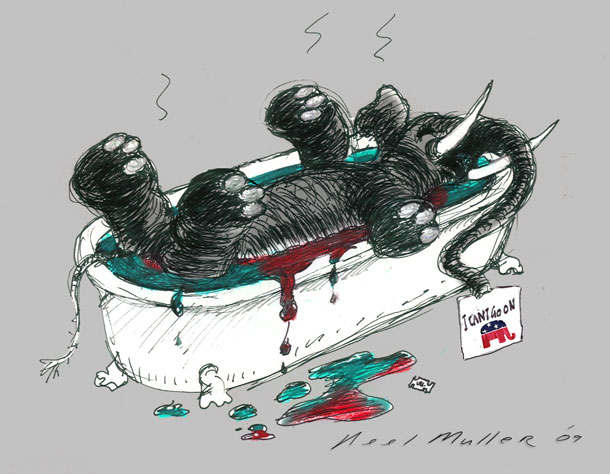
Obama’s Secret Advice to the G.O.P.

ElephantSuicideFinal

My fellow Americans on the other side of the aisle:

Ever since my election, I’ve been watching you implode, my eyes dilated in horrified fascination (like they were glued in that Indiana Jones movie to the Nazi’s face melting into molasses).

Now I know I’m the last man on earth you want any advice from, but maybe you should consider absorbing a few choice pearls from my bipartisan heart, especially now that the only Republican leader who is still boning her own spouse, Sarah Palin, is fast losing ground among independents.

I want to speak to you honestly, clearly and candidly, with a generous measure of tolerance, totally on your own level, complete with punchy four-letter words I picked up from the Chicago streets and from Professor Rahm, so you know I’m absolutely sincere in my advice, and not towering over you from the commanding heights of my intellect or voiding over your pea-brained noggins with beefy Chicago-sized turds.

No. Not at all. You know me as a man who always gives the other fellow a fair hearing. When others engage in bickering, I advocate peace. When it comes time to protect our national interest, I’d shake a hand drenched in blood.

Read more »

Monday, July 27, 2009

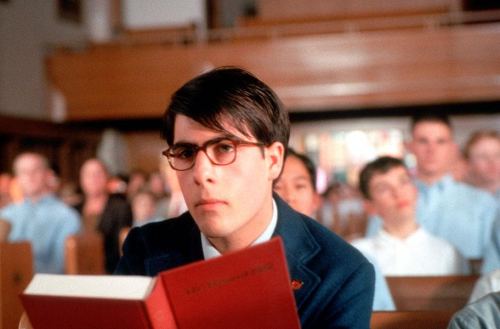
The Humanists: Wes Anderson’s Rushmore (1998)

Rushmore

by Colin Marshall

Because thousands of a certain generation's cinematic lives have been changed by this film, its territory is best approached with caution. Mine, however, happens to be among those thousands, 1998 marking as it did the opening of my prime window of cultural absporpton. Cinephilic teenagers of the 1960s had The 400 Blows, Breathless, Dr. Strangelove; cinephilic teenagers of the 1970s had Harold and Maude, Chinatown, Taxi Driver; cinephilic teenagers of the 1980s had Repo Man, Blue Velvet, Stranger than Paradise; cinephilic teenagers of the 1990s had Rushmore.

The impact of Wes Anderson's second film didn't propel me immediately from the screening room to a new, theretofore unseen world illuminated by pure light cast forth by the angels of cinema. Its effects were those of a gradually-dissolving ingested substance, working only in the fullness of time. I knew I'd seen something epiphanic, but damned if I could put my finger on what or why. While it has sparked and continues to spark in young viewers as much of a fanatic enthusiasm for film, both its appreciation and its craft, as the most radical, stylistically transgressive piece of deliberate provocation, it does so within a shell of relative normality. But though translucently thin, this shell appears to have confused almost as many filmgoers as it's blindsided with slow-acting inspiration.

“You can't tell if it's a comedy, or if it's a drama, or what it is!” complained some with whom I excitedly sought to discuss the movie. While my adolescent mind couldn't counter this grievance, I now realize that coming up with a genre to fit Rushmore into is an exercise not only doomed to futility but ignorant of the very seat of the film's strength: you can't tell if it's a comedy or a drama or what because it isn't. It is, strictly speaking, a film without genre, which is to say, a film without any of the bundles of clichés that constitute the genres' membership qualifications. This must have rendered marketing a futile ordeal, which would account for the movie's unimpressive domestic box office performance. (But since genre is a labor-saving marketer's device in the first place, perhaps this is a simple case of reaping what's been sown.)

Read more »

a coupla robot heads sitting around watching tv (or, i caught a bad meme this weekend)

Talkingheads When it comes to “memetics,” which some say is the new science of studying “memes,” consider me a skeptic. Doesn't a science need to have a clearly defined subject and verifiable findings? At this point the “meme” concept seems more or less to be where the “artificial intelligence” idea was twenty years ago: That is, it's not so much a hypothesis as it is an analogy – a somewhat vague and fluid analogy – one that lets people think in some new and smart ways but leaves them subject to flights of excessive rhetoric.

Which means it's useful … but not exactly real.

The uninitiated among you may be wondering what, exactly, is meant by the word “meme.” You're not alone. Meme advocates are still arguing about that. The word was first used by Richard Dawkins in his book The Selfish Gene, as a contract of “mimeme” (meaning imitated behavior.) Dawkins was suggesting that cultural behaviors, reproduced as one person mimics the actions of another, could be considered analogous to genes.

What are some examples of memes? Opinions vary. But the word has caught on in the blogging and Internet world, where its definition seems to be indistinguishable from “fads” or “catchphrases.” Lolcats is described as a “meme” on the Web, for example, and so is “rickrolling.” Expressions like “Jump the shark” and “FAIL” are memes in the online universe, too. A more rigorous and universally agreed-upon definition appears to be lacking.

Read more »

Interpretations: Bl’ker

by Steve Tignor

IPhotof you live in New York, there are, theoretically, an infinite number of reasons to vary your route home from work. Dozens of neighborhoods, hundreds of shops, thousands of bars can be explored with only the slightest detour from your particular beaten path. So why do I rarely, if ever, take the opportunity? Call it inertia, or lack of imagination, or, more realistically, the result of nine hours of staring at a computer and circling a mouse around. After that, whatever path gets me to my apartment and into a drink the fastest is the one I’m going to follow. More than once I’ve convinced myself to make a post-work side trip to, say, a book store in Union Square, only to emerge from a daydream and find myself walking up the steps at my normal stop in Brooklyn anyway. The best-laid plans are powerless in the face of the daily habits of the 9-to-5er. The upshot, sadly, is that the city where I work is seldom the city where I explore—it’s not the city where I see.

My office is in Murray Hill and I live in Cobble Hill in Brooklyn, which makes my best commuting option the 6 train to 14th St., and then the 4 to Borough Hall, a wobblingly reliable 20-minute express shot down the east side. Late in the evening, though, the 4 can be exasperatingly slow, so slow that on some nights I’m compelled to throw routine to the wind and take the 6 two more stops, to the Bleecker St. station, where I can catch the F to Brooklyn.

Bleecker is less a proper station than a decaying, half-finished interstice that serves as a connector between the subway’s formerly competing systems, the IRT (i.e., the numbered trains) and the BMT (the lettered trains). It’s the only stop in the city where you can transfer between lines on one side—downtown—and not the other, a flaw that’s currently costing the MTA $134 million to rectify. The space’s most notable landmarks are two large, blue mosaics that date from the system’s proud opening in 1904. “Bleecker Street” is carved out at their centers with a beaming, capitalized pride that mocks the dilapidated state of the station today.

Jarring as they may be, those mosaics weren’t what caught my eye one recent evening after work.

Read more »

Monday Poem

“These are tears of joy. I can die a happy woman. Though I don't feel much like dying today… Think harder. Write faster. Please take your time and hurry if you possibly can.”
–from reader F.M. on a previously posted poem: A Politically Incorrect Ode to Whitman


Steep Sigh

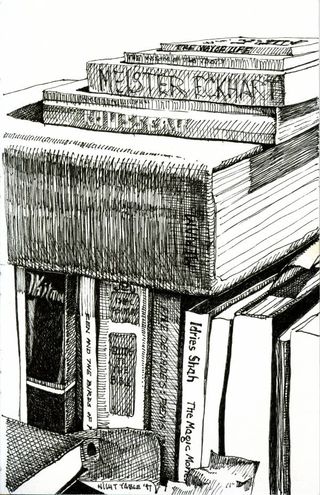
Walt Whitman’s ready nearby Night table
tucked humbly among authors
I keep close upon my night stand
for the waking of my
night eye

You'll see him in this drawing
I made years ago, still stacked
(a bedrock source) while others
cycled in & out of this small
proximate collection
like many million moments
that have blindly come and
slid by

Yesterday I found a poem
which said well some things
I've thought as days have
gone by;
…….;…of Whitman
and the subject he so expertly
unravels and so surely
pins and spins and
re-ties

And funny you should mention
tears since this morning
without reason I
………………….had a sudden sob-fest
returning from the dump
after dropping off our rubbish in
my weekly, sloughing,
drive-by

It might have been the singer
in the dashboard or
the adolescent female walking
sadly postured
plying the left shoulder as I
whizzed by
………………(a clone of my granddaughter?)
or— ……….who knows what existential lever
I'd leaned upon too deeply in a
steep sigh?

by Jim Culleny, 7/26/09

Night Table; drawing by Jim Culleny, 1997

Economic Recovery for Whom?

Michael Blim

Heard enough about those “little green shoots” of economic recovery? Not finding them in your backyard garden? Not popping up in between the cement slabs on your stoop?

Perhaps this is because the only place the green is sprouting is on Wall Street and on the balance sheets of several mega-banks. The Dow Jones has hit 9,000 again. Goldman Sachs and JP Morgan reported hefty profits. Seems like old times.

But these are new and perhaps even better times for the masters of the money universe. They now operate with a full and explicit federal guarantee against failure, and many have made back their government loans at little or no expense. Even though the banks and big financial firms working through them laid us low, the Obama Administration seems to have passed out “get out of jail cards” to their operators. Unless Andrew Cuomo decides to play spoiler, the miscreants who triggered the world financial crisis will be back living large in no time. This is also because the proposed Obama financial regulation regime is so weak that it is even described as toothless by that paragon of 18th Century classical liberalism, the Economist.

Walk off Wall Street and you hit upon another world. Never mine no green shoots. There is instead massive die-off, as if the economic eco-zone had been ripped up by a financial Katrina and been left to molder.

The rot and decay of a near-dead economy lie all around us. There is universal acknowledgement that we will reach 10% unemployment in the fall. Every occupational category has been hit thus far, with rates of unemployment doubling since 2008 in computing, architecture, engineering, community and social services, health care technical services, construction, maintenance, repair, manufacturing, mining and transport. Already in double digits are food services, buildings and grounds maintenance, construction, farming, fishing, forestry, construction, mining, manufacturing and transport. In addition, state and local governments are laying off workers at unprecedented rates.

The unemployed are running out of benefits – an estimated 600,000 have run out of benefits since the recession began, and the rate at which workers will lose their benefits is growing exponentially as the stimulus package extension of benefits runs out.

I also counted 9 states and Puerto Rico as having forced furloughs of varying lengths on their workers thus far.

Read more »

The Owls: A Deuce and a Half

By Alan Koenig

George “Cousin Georgie” Mayer, the last living member of my family to fight in WWII, died earlier this summer. In February of 1942, at the age of eighteen, he was drafted and spent the entire war fighting in the Pacific theater under General Douglas MacArthur.

Georgie saw continuous action — except for two periods of convalescence after contracting malaria — and his eventual return to Chicago after an absence of three years is a hallowed chapter of family legend. He died after a thirty year battle with leukemia. What’s unusual about his story is we know how it got him.

In late August or early September of 1945, on only his second day in occupied Japan, a “deuce and half” truck from his unit pulled up and some soldiers asked Georgie if he wanted to visit Hiroshima. In one of those historically haunting moments in which future consequences are unknown, he accepted. While recalcitrant about many of his battle experiences, Georgie was more forthcoming about visiting Hiroshima, mostly because there wasn’t all that much to tell.

“There was simply nothing there. All day long we walked around in dust, nothing but dust.”

Highly radioactive dust. The first atomic bomb had been dropped only about four weeks before his unit’s macabre visit. By the time Georgie was diagnosed in the late seventies, the VA administration was tracking the soldiers from that fateful truck as well as many other luckless American military tourists. A strange corollary to the epochal tragedy of Hiroshima: The VA deserves credit for the intensive care they gave him over three decades, care widely believed by my extended family to have extended his heroic life.

*

Alan Koenig is a Ph.D. student, teaching fellow, writer, and political analyst living in Queens, NY.

*

The Owls is a literary experiment that cross-posts here by the generosity of 3Quarksdaily. “A Deuce and a Half” forms part of an ongoing project called “Stamps” featuring writing and images about places. Other recent posts in the Stamps project have included a photograph by Frederick Schroeder, a poem by Kirsten Andersen, and an essay by Sean Hill. If you would like to get updates from The Owls, send an email with the word “Subscribe” to owlsmag[at]gmail[dot]com.

James Ensor: Keepin’ It Surreal

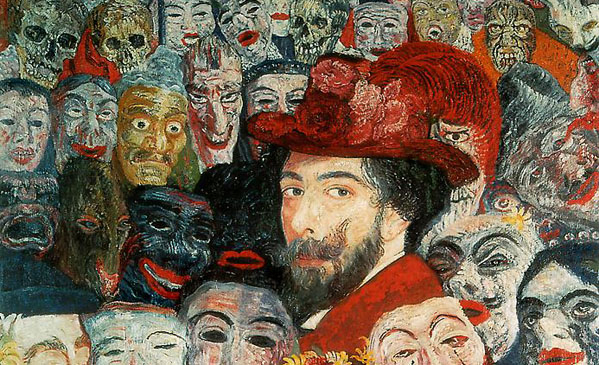
Ensor_selfp:title Self-portrait with Masks (detail), 1899, Menard Art Museum, Komaki City, Japan

Elatia Harris

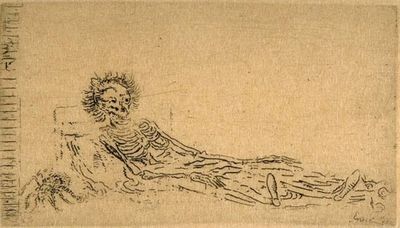
James Ensor, the Belgian painter, died in 1949, having done his last searing work half a century earlier. The man in the sea of masks, above, was wrapping it up in the studio even as he painted this self-portrait at age 40. In two decades of furious industry, he had cast himself as Christ, as John the Baptist, as an insect, a skeleton and a herring. Crucified, beheaded, rattling but undead, made a meal of by critics or simply subhuman, he spared a thought for how he might appear a century after his birth. My Portrait in 1960, below, is an etching on woven paper. It's no self-portrait — the actual sight of his remains would necessarily be recorded by some other guy. This is just a nudge.

Pre099x

Ensor kick-started Surrealism and Expressionism, driving Flemish painting forward from its roots in the Renaissance to its foundational place in Modernism. In him, Bosch, Bruegel and even Rubens found an heir who would poke holes through the possibilities of paint, and figure forth a vision powerful enough to impel artists a century later to engage with it en route to terra incognita of their own. And that's not all. While it is common to feel repelled by art considered in exquisite taste in the late 19th century, uncommon it is for an artist of that era to step neatly outside taste once and forever, offending a certain high idea of painting with lasting sureness of touch. As the song, Meet James Ensor, written by They Might Be Giants, urges us — “Appreciate the man.”

With the first major Ensor show in the United States in more than 30 years, the Museum of Modern Art in New York makes that very easy to do, through September 21. I have had a lifetime with James Ensor, one of my mother's art gods. Mother was a Southern lady, the kind that naturally thrills to the transgressive in art. And I am brought to my knees, again and again, by this painter so utterly uningratiating.

Read more »

Monday, July 20, 2009

Psychological Science: The [Non-]Theory of Psychological Testing – Part 2

“Psychological Science: The [Non-]Theory of Psychological Testing – Part 1” can be found HERE.

Q & A

Q. If Psychological Test Theory (PTT) is not a theory but a tautology, then what should be substituted in it's place?

A. How about replacing it with a scientific, or observational theory. *

* I hope those who believe PTT is a scientific theory will indulge me in my elaboration, below.

The story so far

No modern science begins with the assumption, explicitly or implicitly, of the reality of Plato's World of Ideal Forms. The one exception is testing and measurement in the social sciences, particularly psychological or mental testing. What is not appreciated by many, if not most, social scientists is that PTT assumptions like True Score, or Latent Trait, are not like literary dramatic license that gives weight and impact to the narrative. From the point of view of the philosophy of science, they are indistinguishable from Plato's Ideal Forms, and have no place in modern science. Mathematical argument

Mathematical argument is found in all modern science. The social sciences are no exception. Scientists use mathematical argument in three ways:

  1. It is used as a way to analyze, understand, and communicate data from observation;
  2. Mathematical argument helps one hypothesize about data not yet observed; and
  3. In the service of supplementing 1 and 2, properties of mathematical inventions and constructions are used as convenient substitutes for the undetermined properties of observed or hypothesized data.

PTT, however, tends to use mathematical inventions and constructions, not as a supplement to mathematical argument based on observation, but as a near total substitute for it. This is the tradition handed down to Western civilization from Pythagoras, that is both praised and lamented by Carl Sagan in his book and Public Broadcasting Service (PBS) video series, “Cosmos”.

“Pythagoras…developed a method of mathematical deduction…. The modern tradition of mathematical argument, essential to all of science, owes much to Pythagoras.” Pp. 149-150.

“In the recognition by Pythagoras and Plato that the Cosmos is knowable, that there is a mathematical underpinning to nature, they greatly advanced the cause of science. But in the suppression of disquieting facts, the sense that science should be kept for a small elite, the distaste for experiment [emphasis mine], the embrace of mysticism…, they set back the human enterprise.” P. 155.

Read more »

In Light of Nalanda

By Namit Arora

Biggoosepagoda1I don’t know many books in which ‘Go west, young man!’ would be a call to go to India. One such book is Journey to the West, ‘China's most beloved novel of religious quest and picaresque adventure,’ published in the 1590s in the waning years of the Ming dynasty. The novel’s hero, ‘a mischievous monkey with human traits … accompanies the monk-hero on his action-filled travels to India in search of Buddhist scripture.’ [1] It allegorically presents pilgrims journeying toward India as individuals journeying toward enlightenment. [2]

Biggoosepagoda2 The inspiration for this novel was a journey made by a 7th cent. CE Chinese man, Xuanzang. [3] Though raised in a conservative Confucian family near Chang’an (modern Xian), Xuanzang, at 13, followed his brother into the Buddhist monastic life (Buddhism had come to China around 2nd cent. CE). A precocious boy, he mastered his material so well that he was ordained a full monk when only 20. Disenchanted with the quality of Buddhist texts and teachers available to him, he decided to go west to India, to the cradle and thriving center of Buddhism itself. After a yearlong journey full of peril and adventure, across deserts and mountains, via Tashkent and Samarkand, meeting robbers and kings, debating Buddhists on the Silk Road and in Afghanistan—where he saw the majestic Bamiyan Buddhas—he reached what is now Pakistan.

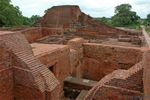
Nalanda48 He spent 17 years, from 629-645 CE, in the Indian subcontinent, traveling, visiting places associated with the Buddha’s life, learning Sanskrit, and studying with Buddhist masters, most notably at the Nalanda University in modern-day Bihar, one of the first great universities of the world, where subjects like grammar, logic, philosophy, metaphysics, astronomy, medicine, and theology were taught. His erudition seems to have brought him fame and royal patronage in India. In a convocation of religious scholars ‘in Harsha’s capital of Kannauj … Xuanzang allegedly defeated five hundred Brahmins, Jains, and heterodox Buddhists in spirited debate.’ [4]

Read more »

Monday Poem

Hawks

East or west down the trail in fog
the bark of a distant dog

a meadow rolls off in that cloak
a cleft in its breast of a brook

deciduous trees to the north
a hawk in the fifth or the forth

scans for the twitch of a meal
not a stitch of remorse will it feel

as it falls on its prey like a bomb
with finesse and genetic aplomb

there are such people who prey
on an earth god created this way

by Jim Culleny; July 16,2009

On Sympathy

Justin E. H. Smith

I am not all that fond of natural-law theory, as I tend to think that there are very few things about which nature sends us the loud-and-clear message: don't do it! In fact, I've narrowed the list down to just three: incest, coprophagy, and flying.

Now many readers will be surprised to see that last item tacked onto the list. After all, nearly everyone who can afford to do so flies on a regular basis, whereas sibling-marriage and shit-eating are nearly unheard of. But I fly roughly once a month, including an average of 2-3 round-trip transatlantic flights per year for the past 15 years, and every time I do it I think to myself: if there were a God, and he were to finally come and give us his list of rules, he would not tell us not to show cleavage, or drink alcohol, or any of the usual proscriptions. He would tell us, earth creatures, to get the hell out of the sky.

I am one of those irrational people, ridiculed by the sane, normal, and mature, who suffers from debilitating aviaphobia. By 'debilitating' I mean that I spend every minute of every flight convinced of imminent death. The suffering is so severe that even though there is no significant statistical danger of dying in an air disaster, I do fear that there is a real danger of physiological consequences stemming from the anxiety. People who don't understand will often tell me to learn a bit about the statistics of air accidents. Trust me, I know the statistics. Tell me the name of an airline, and I can list for you all of the fatal accidents in which it has been involved, when and where they happened, what was the mechanical cause.

There was a time when I could tell myself: that air disaster over there, in Indonesia, in Congo, in Siberia, has nothing to do with me. My sphere of concern has traditionally been North America between the Arctic and the tropical zones, the North Atlantic, and Western Europe. To some extent, I confess I still have a way of distancing myself from certain disasters: that was a Tupolev, I say. Anyone who gets on a Soviet-built airplane is just asking for it. But then I remember that my basic conviction about my own air travel is that I am asking for it too.

Read more »

Monday, July 13, 2009

Kiarostami’s ‘Shirin’: watching a movie about watching a movie

by Jeff Strabone

KiarostamiWhile the world waits for the second Iranian Revolution, it’s important to recall that Iran is not just a place of political turmoil, nuclear ambitions, and theocratic dictatorship. It is also a place of great poetry and cinema, as the work of Abbas Kiarostami reminds us. How timely then that he has a new film out called Shirin that adapts—sort of—a twelfth-century romance and offers the world a stunning new achievement: a feature-length film whose narrative is made up entirely of reaction shots.

Kiarostami’s career has been distinguished by relentless experimentation, particularly in recent years. His film ABC Africa (2001), about AIDS orphans in Uganda, includes seven minutes of nocturnal darkness. Ten (2002) consists of ten scenes shot in a car with cameras on the dashboard. In each scene, the actors drove Dreyer 4through Tehran leaving the director and crew behind. Five (2003) has only five stationary shots depicting whatever passed in front of the camera.

Like Dreyer’s close-ups in La passion de Jeanne d’Arc (1928) or Michael Snow’s zoom in Wavelength (1967), Shirin (2008) will join a very small group of films known for their singular use of a particular device. However dry or coldly formalist it may sound on paper, Shirin is a deeply moving film that follows the emotional narrative of a female audience’s reaction to watching a period melodrama full of the kind of romantic love that seems to be in short supply in modern Iran. 

Read more »

Desire Paths: Reading, Memory and Inscription

by Daniel Rourke

The urban landscape is overrun with paths. Road-paths pulling transport, pavement-paths and architectural-paths guiding feet towards throbbing hubs of commerce, leisure and abode.Beyond the limits of urban paths, planned and set in tarmac or concrete, are perhaps the most timeless paths of all. Gaston Bachelard called them Desire Paths, physical etchings in our surroundings drawn by the thoughtless movement of human feet. In planning the layout of a city designers aim to limit the emergence of worn strips of earth that cut through the green grass. People skipping corners or connecting distinct spaces vote with their feet the paths they desire. Many of the pictures on the right (from this Flickr group) show typical design solutions to the desire path. A delimiting fence, wall or thoroughfare, a row of trees, carefully planted to ease the human flow back in line with the rigid, urban aesthetic. These control mechanisms have little effect – people merely walk around them – and the desire path continues to intend itself exactly where designers had feared it would.

The technical term for the surface of a planetary body, whether urbanised, earth covered or extra-terrestrial, is regolith. As well as the wear of feet, the regolith may be eroded by wind, rain, the path of running water or the tiny movement of a glacier down the coarse plane of a mountain. If one extends the meaning of the term regolith it becomes a valuable metaphor for the outer layer upon or through which any manner of paths may be inscribed.

The self-titled first Emperor of China, Qín Shǐhuáng, attempted, in his own extravagant way, to re-landscape the regolith of time. By building the Great Wall around his Kingdom and ordering the burning of all the books written before his birth Qín Shǐhuáng intended to isolate his Kingdom in its own mythic garden of innocence. Far from protecting his people from the marauding barbarians to the West or the corrupting knowledge of the past Qín Shǐhuáng's decision to enclose his Kingdom probably expanded his subject's capacity for desire beyond it. There is no better way to cause someone to read something than to tell them they cannot; no better way to cause someone to dream beyond some kingdom, or attempt to destroy it, than to erect a wall around it. As we demarcate paths we cause desire to erupt beyond them. The regolith, whether physical or ethereal, will never cease to degrade against our wishes.

Read more »