Andrew Bujalski is the young director of the films Funny Ha Ha, Mutual Appreciation and Beeswax, which is newly available on DVD. Though Bujalski's funny, realistic movies are often considered by critics to be of a similar genius to other independently-produced pictures of the 2000s focusing on the personal relationships of twentysomethings, they possess an intellect and an aesthetic all their own. Colin Marshall originally conducted this conversation on the public radio program and podcast The Marketplace of Ideas. [MP3] [iTunes link]
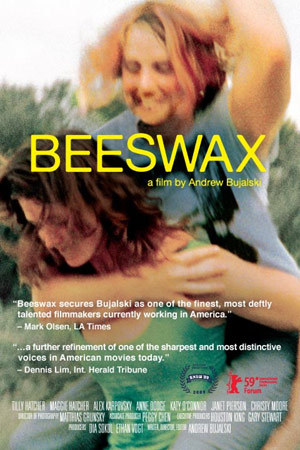 Watching your three films, I feel like Beeswax is starkly distinct from the two that precede it, but I can't put my finger on exactly why. What would you say to that?
I would probably agree, for starters. Are you asking me to put my finger on it?
Yeah, obviously you're the closest person to that film in existence. I can't quite articulate why. It feels different. I can't exactly point to reasons why it's so different, but why do you think it's so different from Funny Ha Ha and Mutual Appreciation?
I could get into a million reasons, which are mostly minutia. One of the things about being so close to a film is, I do sort of see the forest for the trees and the trees for the leaves. I could start with technical things: we shot widescreen format, which we hadn't done on the earlier films. I could go into the fact there are twins at the center of it, which is very different, too, from the other films. All of them have been written for the people who ultimately played the leads, none of whom were professional actors but all of whom had a particular kind of charisma that I thought would translate onscreen.
Of course, those are very different kinds of charismas. That's another thing that's different about this film. What the Hathcher sisters, Tilly and Maggie, who play the twins in the film, brought to it is… there's something about their energy which is a little more inward, not quite like anything I was used to seeing on screen myself and was really interested to try to put at the center of a movie and see what happened. The audience has to lean forward a little bit to see what they're doing. I think — of course, I'm very attached to the film — I think they're miraculous in it. The rhythm of it is a little different. It's more plot-heavy, more exposition-heavy. Certainly, that was another challenge. I could go on and on.
This procedure of creating a film, of conceiving a film starting with the fact that you know somebody and wanted to see if they could carry a film, it's something you've talked about in othe r interviews and have done with the previous two films as well. What sort of things bring these people to your attention as possible leads, whether the Hatcher Sisters or the stars of Funny Ha Ha or Mutual Appreciation?
Maybe it comes from having spent too much time at the movies as a kid. It might not be healthy to look around the world and say, “How would this translate in the movies? What would this be like if I were asking it to hold together the center of a narrative?” I think everybody knows somebody who they think, “Oh, that guy could be a movie star.” Not that I've asked these people to be “movie stars” with everything that entails today.
In no case have I written films I thought were biographical of these people, per se. Beeswax is not the true story of the Hatchers any more than Funny Ha Ha is the story of Kate Dollenmayer and Mutual Appreciation is the story of Justin Rice. I took what I could imagine them projecting onscreen, how I imagined what they do in their ordinary lives, and translated that into the realm of the performer. I've noticed that, when you ask people to act — and this is probably true of professional actors as well — most people pick out something about themselves to exaggerate. People tend to want to do caricatures of themselves. You start from there, and then you can craft it in one direction or another. What is this essence of you that we can translate into a performance? Is there a story to be built around that?
Was the essence these actors would pick out from themselves and exaggerate the same thing you saw in them that you wanted to use? I can imagine that being ideal — they pick out the same thing you see — or they pick out something completely different, and you've got to make a different movie. Has that happened?
Certainly, yeah. There are surprises throughout the production process. Anything you try to boil down in concrete terms — there are always swerves and surprises. If somebody ate something weird for breakfast, they might come in in a different mood than you expected.
With Beeswax, I had a vague notion of the story, but I hadn't begun to write it. I went to the girls and asked them if they would… first of all, it's a huge commitment. You're asking somebody who is not a professional actor to take quite a bit of time and quite a bit of emotional energy to give to a project like this. As we all get older, it becomes harder for people to find the time to do these. First, I asked if they would even be interested. They both seemed game for it. We did a little screen test, and at first I had a notion of what these two roles would be. We switched it.
We did one run-through of a scene with Maggie playing the small business owner and Tilly playing her sister, and then we did it again and switched the roles. My initial instinct had been to cast the opposite of the way I ended up actually doing the film. I thought I would have Maggie play Jeannie the small business owner, and it became clear from that screen test that what they were going to bring of themselves to the roles instinctually — it was much more interesting the opposite way. Tilly was bringing a certain reservation. There was an inwardness and even maybe a defensiveness that I thought could be really, really interesting, if we used it right, in the Jeannie role.
This was a situation where, early on in the process, before I'd written the script, where something made me think very differently about how I was going to approach this. That's at the macro level. On the micro level, when you're on set, you always have to be paying attention to what the actors are bringing, and looking for ways to make that make the film more interesting.
Read more »