By Liam Heneghan
[This is the first in an occasional series of pieces on the philosophy of science.]
In the guestbook of a flower shop near my Evanston, Illinois home, a few blocks west of Lake Michigan – that body of water which serves as a sea for those born far from the brinier fluids of a true ocean – I observed the tiny carcass of an insect compressed upon the page, beneath a comment that read, “Yellow roses are the gift of cowards, Carl.” Intriguing. Its antennae were shaped like little Christmas trees, an anatomical curiosity permitting many people, I expect, to readily identify the fly as a chironomid midge, a fly hatched from a larva that lived in the lake’s proximate substrate, whose pupating body rose at some late life-stage and floated upon the surface of the waters, whose pupal exuvium sloughed off like the skin of a small but darkly-meated banana, and which then, as an adult, rose again to swarm as part of a male-only congregation waiting for a mate to flit along. Chironomid males, recall, have those telltale plumose antennae which act as a delicate sexual nose of sorts, to detect the presence of female flies. The ephemeral and outlandishly sexual nature of their adult lives is underscored by the fact that they do not feed, being equipped with a greatly reduced feeding apparatus. This much is well enough known; a well-informed school-child will elaborate on the matter. What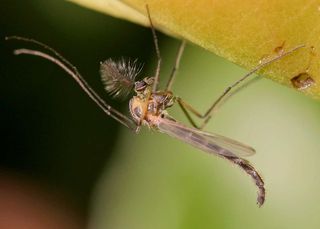
I qualified as a zoologist at University College Dublin, getting a master’s degree for work on chironmids that I collected in Irish National Parks in 1987, having completed my bachelor’s work the year before. I eventually earned my PhD there in 1994. A rigorous education. In our Irish system a young person shows up at university at seventeen or eighteen years of age, knowing, it is assumed, exactly what subject matters they expect to devote a lifetime of work to. Choosing, in my case, the natural sciences, I was educated in these sciences: all other domains of knowledge were excluded. I was taught (eclectically) across four science sub-disciplines in my first year, in my second specializing in three, in my third year, two, and yes in my last year I honed my skills as a zoologist taking a suite of specialist courses and undertaking a year-long research project on the systematics of a genus of chironomid midges, the Thienemannimyia group. The task: to unravel the phylogenetic (roughly evolutionary) relationships between the numerous species in the group.







 The correct answer would be “it depends” or “compared to what”? After all, it’s not so much that everyone else in Eurasia stopped thinking 500 years ago, but rather than an explosion of knowledge occurred in Europe that rapidly outstripped other centers of civilization in Eurasia. And after a period of relative decline,