At the V&A until 20th February 2011
www.vam.ac.uk/shadowcatchers
Sponsored by Barclays Wealth
by Sue Hubbard
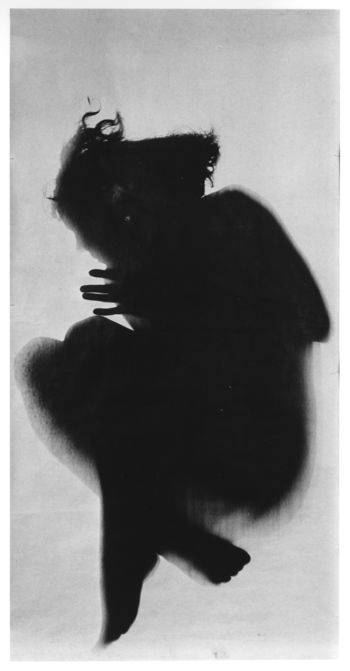
From 1834 William Henry Fox Talbot (1800-1877) created ‘sciagrphaphs’ (the depiction of shadows) and ‘photogenic drawings’ using botanical specimens and lace placed on sensitized paper. These spectral images implicitly posed questions about the nature of reality. The term for all such works is a ‘photogram’, though strictly speaking they do not depict shadows as they are caused by the blocking of light rather than by a cast shadow. The photogram was later usurped by the process of projecting negatives through an enlarger lens. In an increasingly mechanist age this new technology proved more seductive to the scientifically minded Victorians than camera-less photography, which became the idiosyncratic realm of those interested in exploring the subconscious and the so-called spirit world. The playwright August Strindberg took to leaving sheets of photographic paper in developer exposed to the night sky, believing that his resulting ‘celestographs’ were caused by this exposure to the heavens rather than to the more prosaic explanation of dust collecting on the surface of the paper. In 1895 the previously unwitnessed interior of the human body was revealed by Wilhelm Konrad von Röntgen’s newly discovered x-rays, mirroring a growing interest in the unconscious and the revelation of that which could not be seen by the naked eye.
During the 1920s the photogram was rediscovered by a number of modern artists, particularly the Dadaists. Man Ray and László Moholy-Nagy were both attracted by its automatic qualities and the possible patterns of light that could be developed on sensitised paper without the use of any apparatus. László Moholy-Nagy wrote: “The photogram opens up perspectives of a hitherto wholly unknown morphosis governed by optical laws peculiar to itself. It is the most completely dematerialized medium which the new vision commands”. In 1937 his move to Chicago, to teach at the New Bauhaus, ensured that an interest in camera-less photography was transported across the Atlantic.
During the Second World War the role of documentary photography, with its ability to act as a witness to unpalatable truths and humanitarian concerns, became ever more important. In 1947 Robert Capa, Henri Cartier-Bresson, George Rodger and David “Chim” Seymour – photographers who had all been very much affected by what they had witnessed during the conflict – began the photographic agency Magnum, leaving the more experimental practice of camera-less techniques to the fringes of fine art practice. Now the V&A have mounted an intriguing exhibition entitled Shadow Catchers , the first UK museum exhibition of the work by contemporary camera-less photographers that includes Pierre Cordier (Belgium), Floris Neusüss (Germany), Susan Derges and Garry Fabian Miller (UK) and Adam Fuss (UK/USA).
[Photo credit: Floris Neusüss, Untitled, (Körperfotogramm), Berlin, 1962, Collection Chistian Diener, Berlin, ©Courtesy of Floris Neusüss.]





 The correct answer would be “it depends” or “compared to what”? After all, it’s not so much that everyone else in Eurasia stopped thinking 500 years ago, but rather than an explosion of knowledge occurred in Europe that rapidly outstripped other centers of civilization in Eurasia. And after a period of relative decline,