by Misha Lepetic
“If you design with a view to optimize anything, it is bound to end up suboptimal, because it can’t cope with change. This applies as much to political constitutions, universities and buildings”
~ Jeff Mulgan
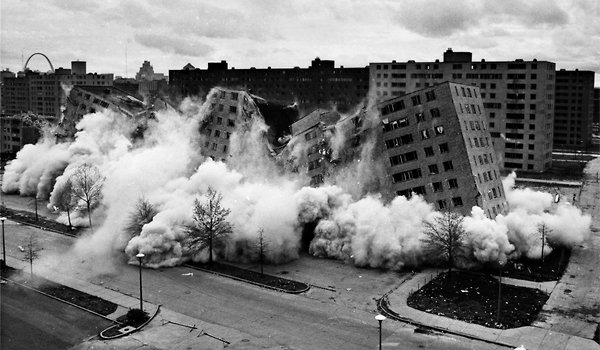
Recently I had the good fortune to catch “The Pruitt-Igoe Myth” at the IFC Center here in New York. The docuementary is a fascinating corrective to the perception that when we talk about failed public housing, we are talking about failed architectural design. The documentary makes liberal use of the above 1972 picture and footage, which has become visual shorthand for, as Alexander von Hoffmann writes:
…an icon of failure. Liberals perceive it as exemplifying the government’s appalling treatment of the poor. Architectural critics cite it as proof of the failure of high-rise public housing for families with children. One critic even asserted that its destruction signaled the end of the modern style of architecture.
There is much to be said about the story of Pruitt-Igoe. Its history, and the narratives and ideologies that are woven around that history, constitute a microcosm of how we choose to perceive many aspects of architecture, urban planning and public policy during the 20th century. Unsurprisingly, such a grand flameout was bound to attract grand pronouncements, since there was something for everyone to cherry-pick for his or her own agenda.
The genesis of a housing development as large as Pruitt-Igoe was made possible by the United States Housing Act of 1949, but flight to the St Louis suburbs was already in motion. Postwar migration from the South, in the form of the Second Great Migration, re-filled that urban core with poor families that could not afford much better than the tenant buildings run by slumlords. However, even this migration was not sufficient to re-inflate the population of the City of St Louis, which would peak at 857,000 in the 1950 census. Currently standing at 319,000, the 63% loss in population has left the city at roughly the same size as during the 1870 census. Even more remarkably, the St Louis Metropolitan area – the destination of urban flight – saw its population grow from 400,000 to well over a million in the same 60-year span.