“No one is so stubborn and dangerous as the beneficiaries of a fallen idea –
they defend not the idea, but their bare life and the loot.”
~Sándor Márai
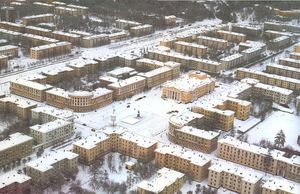
Originating in the late 1930s under Stalin’s direction, these cities bore all the hubristic hallmarks of an authoritarian command-and-control regime, including a unrepentantly narrow raison d'être and an utter disregard for geography. Known as ZATO cities (for “zakrytye administrativno-territorial'nye obrazovaniia,” or “closed administrative-territorial formations”), the sensitivity of their mission furthermore prevented them from even being placed on maps. A logical corollary to this is, if you don’t want to place something on a map, you probably aren’t keen give it a memorable name, either. At first, these cities were named in relation to the nearest, recognized city, and hyphenated with the approximate distance in kilometers. I must admit, given the nuclear remit of about ten of these cities, that there is something deliciously evocative about such a nomenclature – as if one was listing the known element and its artificially fabricated, enriched but less stable isotope. However, even this nomenclature proved a bit too explicit for the comfort of the Soviet authorities:
Thus, the All-Russian Scientific and Research Institute of Experimental Physics (VNIIEF) was initially known as Arzamas-60, a postal code designation to show that it was 60 km from the city of Arzamas. But the “60” was considered too sensitive, and the number was changed to “16.” In 1947 the entire city of Sarov (Arzamas-16) disappeared from all official Russian maps and statistical documents. The facility has also been known Moscow-300, the town of Kremlev, and Arzamas-75. Zlatoust-20 is probably the same as Zlatoust-36, and Kurchatov-21, Moscow-21, Moscow-400 and Semipalatinsk-121 are almost certainly the same as Semipalatinsk-16.
This points to another difficulty intrinsic to the ZATO archipelago – how many of them are there? Even today, it is difficult to say with any degree of certainty. Estimates tend to cluster around 40, but, somewhat confusingly, “in addition, there are thought to be at least 15 ZATO in existence that cannot be accounted for.”

An ambiguous ontological status isn’t the only privilege of the ZATO archipelago, either. In their Soviet heyday, these cities concentrated tens of thousands of the most advanced scientists and engineers in self-sufficient urbanizations loosely modeled on the factory town template. To compensate for the stresses of performing highly surveilled work in a remote location to which few had access, ZATO workers tended to be better paid than their counterparts who worked in more prosaic locations. Also, all financing for ZATO cities was administered directly through the federal budget. While this fact may seem dry and unimportant at first blush, it had tremendous consequences as the Soviet Union transitioned into post-Communist Russia.