by Paul Braterman
Last November, creationist objectors in Texas tried yet again to sabotage the state's textbook adoption process. One of the objections concerned the age of the Earth, using the long refuted cooling argument that goes back to Kelvin in the 1860s. An online conversation about the matter directed me to the real flaw in Kelvin's reasoning, which is different from what I had believed (see my earlier posting). Further digging led me to the oldest formulation I know of Intelligent Design (ID) creationism (of course, it was not called that, but “Unsolved Problems of Science”. Now over a century old, it already shows the key features of “modern” ID, even down to the link with conservative politics, and the despicable misuse of fraudulently edited quotations.
Kelvin's reasoning was based on a very simple physical model, heat flow from a solid sphere initially at uniform high temperature. This model, and estimates of the rate of heat flow and temperature gradient, led him to assign a maximum age of a mere hundred million years, with the most probable age around a quarter of that. And yet the argument from radiometric dating, something with which Kelvin himself was never happy, gives overwhelming evidence to the contrary. Rutherford, and everyone else for decades afterwards, thought that Kelvin's error lay in the neglect of the heat generated within the earth by radioactive decay itself. Actually, it is a mistake to imagine that radioactive heating has all that much to do with it, and I must confess to having repeated this mistake many times in my own teaching and writing.
The real error (details here and in Pt I) had been pointed out a decade before Rutherford confronted Kelvin at the Royal Institution, and three years before radioactivity had even been discovered. Kelvin's calculation only considered heat transfer by conduction, whereas convection from depth is far more important. Convection can efficiently transport heat over long distances. It would have brought far more to the surface than Kelvin's model allowed for, meaning that it must have taken far longer to get rid of it. John Perry, one of Kelvin's own former students, was sure that Kelvin's estimate of the earth's age was far too low, suggested that Kelvin could have drastically underestimated the efficiency of heat transfer, and even suggested that the Earth's interior could be in a partly molten state, making convection possible.
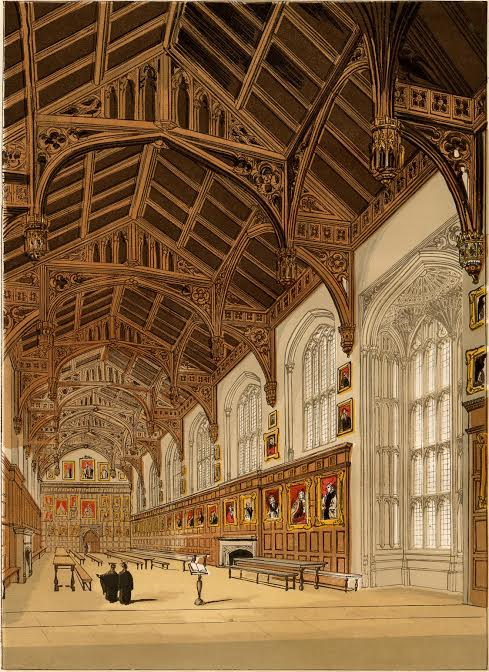
Christ Church College. The future Lord Salisbury studied here, but did not sit his final examination.
In this piece, I want to talk about two things, how I learned the error of my ways, and exactly what it was that goaded Perry into an uncharacteristic public quarrel with his former mentor. I will also very briefly discuss the enormous importance of mantle convection for the present-day science of geology.