by Scott F. Aikin and Robert B. Talisse
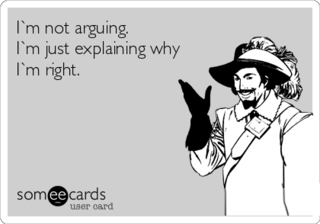
Why We Argue presents a conception of proper argumentation that emphasizes its essentially cooperative and dialectical dimension. Very roughly, our view runs as follows. The central aim of cognitive life is to believe what is true and reject what is false. We pursue this by appealing to our evidence and reasons when forming and maintaining our beliefs. Yet in pursuing this aim, we quickly encounter conflicting and inadequate evidence and reasons; furthermore, we discover that we each must rely upon other people as sources of evidence and reasons. Importantly, the others upon whom we must rely do not always speak univocally; they often provide conflicting reasons and evidence. Accordingly, in the pursuit of our central cognitive aim, we confront the inevitability of disagreement. Argumentation is the process by which we attempt to resolve disagreement rationally. Consequently, argumentation is inescapable for a rational creature like us; and the aspiration to argue properly is an indispensible corollary of our central cognitive aim.
The project of arguing well requires individuals to interact with each other in certain ways, and to avoid interacting in other ways. More specifically, in order to argue well, we must individually attempt to take the reasons, perspectives, arguments, criticisms, and objections of others seriously; we must see even those with whom we most vehemently disagree as fellow participants in the process of proper argumentation, and we must engage with them on those terms. This means, among other things, that when engaging in argument, one must seek to make the most of the reasons and considerations offered by one's opposition. Verbal tricks, insults, threats, and obfuscation are failures of argumentation, even when they prove effective at closing discussion or eliciting assent. A lot of Why We Argue (And How We Should) is devoted to cataloguing and dissecting common ways in which argumentation, especially political argumentation, fails.
So much for the nutshell version of our conception of argumentation. Let's turn now to the critical reaction it commonly invites. Critics say that our view is misguided because it cannot acknowledge the brute fact that most often we argue not to rationally resolve disagreement, but to end disagreement; and the favored way of ending disagreement is by winning an argument. Here a sports analogy is often introduced. Critics often claim that just as one plays baseball not (primarily) for the exercise, camaraderie, or the cooperative teamwork, but rather to win baseball games; so it is that when one argues, one argues to win.