by Paul Braterman

I have recently visited two very different sites where time is turned to stone, where just looking at the rocks shows the passage of enormous lengths of time, dwarfing all of recorded human history. At the first site, the rocks I was looking at were ancient sediments, with the clearest possible evidence of prolonged interruption. In the second, they were comparatively (!) recent volcanic outpourings showing the traces of slow continuous change. In the first case I was looking at an
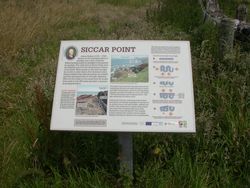
gate off a minor track, although it occupies a special position in the history of geology as a science. The second is visited by over 750,000 tourists annually, has its own well-appointed visitors centre, and was the occasion of a recent shameful episode of science denial. The first records events connected with the closing of an ancient ocean; the second with its reopening.
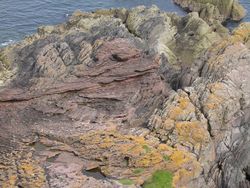
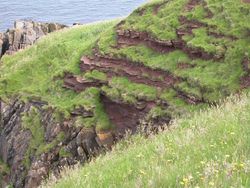
As Hutton realised, we are looking at a complex sequence of events, which we would now describe as follows:
- The initial coarse sediments were laid down in moderately turbulent offshore conditions. Turbulent enough to mix up debris of different sizes, but not so turbulent as to erase the boundary between different sedimentary layers.
- Enough time passed for them to form solid rock.
- Then came at least one, and possibly two (remember the curve in the strata exposed on the beach) episodes of mountain building, folding the sediments so dramatically that here they are standing on end.
- Next a lengthy interval, how lengthy Hutton had no way of knowing, in which these mountains were worn flat, apart from irregularities caused by local streams,
- The deposition, and eventual consolidation, of the upper sandstones
- And finally, the erosion of later deposits, exposing the sandstone and, down on the beach, the ner-vertical strata of greywacke.