by Tasneem Zehra Husain
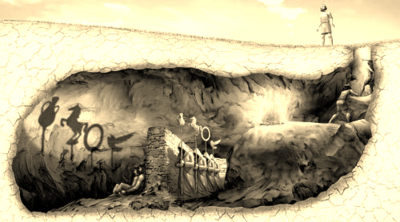
Remember Plato's allegory about the cave? Prisoners, chained inside a cave, sit facing a blank wall with a fire lit behind. All they know of the world is through shadows cast on the wall, by whatever it is that moves between them and the fire. The entirety of their knowledge is constructed from observations of these moving silhouettes. For them, reality consists of flat images, devoid of color and and (three-dimensional) form.
But of course the fallacy must be exposed, and so one prisoner somehow breaks free of his shackles. He turns and sees the fire, and the objects that cast the shadows. Suddenly, he is confronted with things far more complex than he could have conceived, with qualities he lacks the vocabulary to describe. Should he venture out of the cave, his confusion and disorientation increases by several orders of magnitude. Bathed in light and color, he is assaulted by the unfamiliar sensory richness that surrounds him. Were he now told that he had been harboring a delusion his entire life, and that this is in fact reality, he would have a hard time wrapping his mind around it.
The point of this story, of course, is that we are prisoners of our experience. Imagination helps us explore extrapolations and combinations of the familiar, but what if there are things that lie beyond our ken? Who's to say that what we perceive isn't just a sliver of the whole truth? Plato's millennia old allegory remains relevant, because even now we are haunted by the insecurity that we might be missing out – that the universe is more than we can know. So here's an interesting twist: what if our perception adds a dimension, instead of slicing it out? How could that happen? Let me give you an example.
About twenty years ago, stereograms were all the rage. On the surface, these ‘Magic Eye' pictures were merely repeated patterns, but if you stared at them long enough and in the right way, a three-dimensional image would pop out of the paper. In case you haven't seen these before, here's one you can practice on.
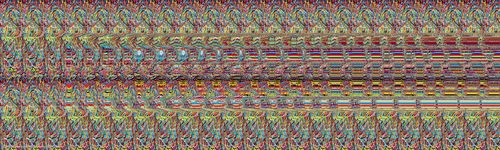
The only advice I have to offer, if you're new to this, is that it generally works best if you hold the paper (or screen) relatively close to you. Beyond that, it just takes some patience. As with all illusions, once you've seen through it, it's much easier the second time around. (Hint: this particular stereogram hides a single word.)
But how do these images work? The answer lies in the way we perceive depth. As we look out onto the world, both our eyes form individual images, from their own spatially separated viewpoints. (To compare the difference between the image formed by one eye and the other, try holding a pencil up, a foot or so in front of you. First close one eye, and then the other. The pencil appears to move.) The brain processes both these images and combines the information to form a judgement about depth.
Stereograms create the illusion of depth by tricking the brain. Because of the repeated patterns, the eyes might each be looking at two distinct points, but be confused into thinking that they are the same. The brain, as it processes the images from each eye, assumes those two points should overlap and, as a result, conjures up an illusion of depth. So human physiology leads us to add a perceived dimension, even when it is not physically present.
Read more »