by Mike Bendzela
 The Smiling Toads of Darwin's Bluff
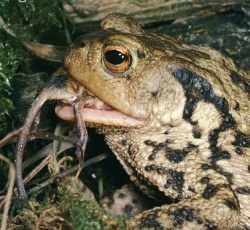
An obscure species of Bufo inhabits a remote point of land called Darwin's Bluff. Long ago, one of these toads learned to "smile," but this was a fluke: It was born with a congenital defect of the jaw. Like most toads, it spent its days in an inconspicuous spot in the dirt, just sitting. There it smiled.
Some crickets fresh from molting had been schooled in the appearance of various predators of the bluff — a disturbingly long course of study for these nymphs. Upon emerging from the earth these crickets fed cautiously. But a few of the more amiable insects were attracted to the new smiling thing in the dirt. The same went for some grasshoppers, slugs, flies and beetles. Even some spiders and small mice were attracted to the smile in the dirt.
And now all the toads of Darwin's Bluff are smiling.
The Flounder's Eye
The Atlantic herring (Clupea) lived wisely in schools and indeed never left them. Excitedly they darted above their flatfish neighbor, the flounder (Pleuronectoidei), and informed him of their newest lesson:
"It seems hard to believe, but we are one and the same! Your kind once swam upright like us and had eyes on the right as well as the left side of the head."
Gazing up at these herring the flounder quipped, "Right and left are myths. The world has two directions — fore and aft — as anyone with eyes can see."
Moral: Evolution bestows upon us no native insight into our makeup.
From Froglet to True Frog
Their metamorphosis now completed, the froglets (Rana) migrated out of the pond en masse and immediately set about gobbling down every Caelifera grasshopper nymph they could see. But as these baby grasshoppers emerged from the earth they molted and began to grow and hopped out of the froglets' reach. "Whatever shall we do?" shrilled the froglets, "the grasshopper nymphs have outstripped us!"
"Hop harder!" their mothers cried.
As these froglets matured they could galumph forward with more elan and gobble down the grasshopper nymphs again. But the grasshopper nymphs kept molting: they shed their exoskeletons and grew larger bodies, which allowed them to outstrip the froglets.
"The grasshopper nymphs have escaped us again!" shrilled the froglets.
Their mothers just repeated, "Hop harder!"
And on it went, the froglets growing and galumphing forward, gobbling up nymphs, which molted and outstripped the froglets . . . until one day some mature frogs caught up with adult grasshoppers — which up and flew away!
And in this way the frogs learned Darwin's great lesson: The better you become, the more incompetent you be.
* * *
Mike Bendzela grew up in Ohio and currently teaches English at the University of Southern Maine. He is also a seasonal apple and vegetable grower and an Old Time musician. These fables are from a book-length manuscript, Fit for Darwin: Evolutionary Fables and Other Emblematic Tales.