by Brooks Riley
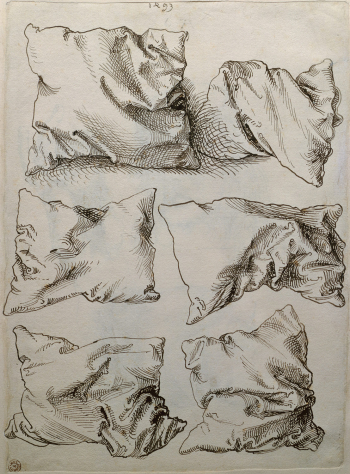
The impression of a tousled head still lurking in the pillow’s shadowed indentation conjures a ghost whose presence can be felt if not seen, with an imagined long single golden strand of hair left behind within its folds. A hint of Dürer’s personality emerges from this fantasy, of a man who found wonder in all things—a pillow, a weeded piece of turf, a hare, a deformed pig, a rhinoceros, an iris, a beached whale. He would spend a lifetime exploring the elusive secrets of beauty and mathematics in nature, and nature and beauty in mathematics.
Personality is like ether, it hovers in the atmosphere long after death. Decades, even centuries later, long after the end of memories, traces of it move through the air like a fleet aroma caught at just the right odd moment. Where did that come from? It is elusive, and cannot be captured or bottled or even explained. Such is the personality of Dürer. It rises like a mist from a certain landscape seen from the train. It lurks in the amusing portraits of friends like Stefan Paumgartner as St. George, or Willibald Pirckheimer imbibing at the baths, or the selfie pointing to the pain in his spleen. It rages in two haunting, nude sketches of himself. Or radiates in that iconic self-portrait from 1500, which hung in his atelier, never for sale but as constant reminder of the perfection he would strive for with his self-proclaimed ‘diligence‘, that most German of virtues—a quasi-blasphemous Christ-like pose that sanctified his art through his person. Thomas Hoving once called it ‘the single most arrogant, annoying and gorgeous portrait ever created,‘ missing the point—or perhaps not. It was so life-like, Dürer’s dog ran over to it and started licking it before the paint was quite dry. Of the plethora of explanations for this work, I like to think he painted it in case the Apocalypse predicted for 1500 really happened. I will survive, it says. And he did.