https://youtube.com/watch?v=VUDAdOdF6Zg
A couple of weeks ago I was making my online rounds. When I checked YouTube I saw a link to a conversation between Steven Pinker and Joe Rogan. I’m quite familiar with Pinker and have correspond with him a bit, though I’ve not read his most recent book. And the name, “Joe Rogan”, set off some resonance that I couldn’t place. OK, I’ll check it out, thought I to myself. See what Steve’s up to these days and find out about this Joe Rogan guy.
It was a long and interesting conversation and, yes, it did cover Steve’s current book, Enlightenment Now, though it took awhile to get around to it. Otherwise the conversation ranged widely: flame wars on Usenet, comedy roasts, altruism, the Flynn effect, mass murderers, spiritual enlightenment, aerobics, online magazines, the long-term course of human history, the post-Trump world, and others.
I liked Rogan’s style.
The good old Wikipedia told me that Rogan had been on News Radio back in the 1990s–OK, now I know who he is–and then hosted Fear Factor earlier in this century–saw that, too, some of them. Early in his life he’d the become interested in the martial arts–karate, taedwondo, kickboxing–and had won some state and national titles. Moreover, he’s put in a lot of time as a commentator with the Ultimate Fighting Championship. AND, he’s been working at stand-up comedy all this time. He’s also into nutrition, hunting, mind expansion–cannabis, psychedelics, sensory deprivation–health and nutrition, and who knows what else.
This guy’s got some range! Read more »


 It’s with a certain pleasure that I can recall the exact moment I was seduced by the musical avant-garde. It was in the fourth grade, in a public elementary school somewhere in New Jersey. Our music teacher, Mrs. Jones, would visit the classroom several times a week, accompanied by an ancient record player and a stack of LPs. You could always tell when she was coming down the hall because the wheels of the cart had a particularly squeak-squeak-wheeze pattern. However, such a Cageian sensibility was not the occasion of my epiphany. I’m also not sure if fourth-graders are allowed to have epiphanies, or, which is likelier, if they are not having them on a daily basis.


 If by “objectivity” we mean “wholly lacking personal biases”, in wine tasting, this idea can be ruled out. There are too many individual differences among wine tasters, regardless of how much expertise they have acquired, to aspire to this kind of objectivity. But traditional aesthetics has employed a related concept which does seem attainable—an attitude of disinterestedness, which provides much of what we want from objectivity. We can’t eliminate differences among tasters that arise from biology or life history, but we can minimize the influence of personal motives and desires that might distort the tasting experience.
 Dr Abdus Salam had once said, “It became quite clear to me that either I must leave my country or leave physics. And with great anguish, I chose to leave my country.”
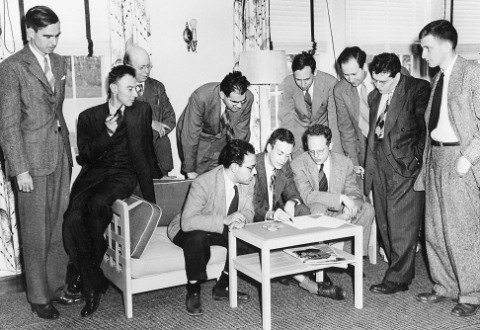 A new theory seldom comes into the world like a fully formed, beautiful infant, ready to be coddled and embraced by its parents, grandparents and relatives. Rather, most new theories make their mark kicking and screaming while their fathers and grandfathers try to disown, ignore or sometimes even hurt them before accepting them as equivalent to their own creations. Ranging from Darwin’s theory of evolution by natural selection to Wegener’s theory of continental drift, new ideas in science have faced scientific, political and religious resistance. There are few better examples of this jagged, haphazard, bruised birth of a new theory as the scientific renaissance that burst forth in a mountain resort during the spring of 1948.
 “Griselda was fighting against the patriarchy the only way she knew – through her unquenchable lust for venison.”

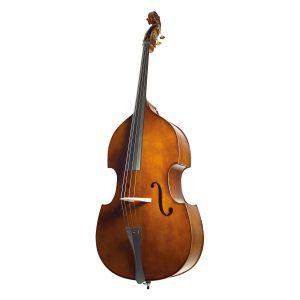 by Christopher Bacas
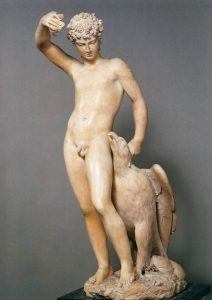 A celebrated altercation between Benvenuto Cellini (1500-1571), the Florentine artist, and fellow sculptor Bartolommeo Bandinello (1493-1560) resulted in the latter exclaiming “Oh sta cheto, soddomitaccio.” [Shut up, you filthy sodomite!]. The accusation had merit in the legal sense at least since Cellini had indeed been accused of the crime of sodomy with at least one woman and several young men. The incident is oftentimes recalled in writings about the period as it provides a compelling illustration of the sexual appetites of the artists of the Renaissance.