
by Robert Fay
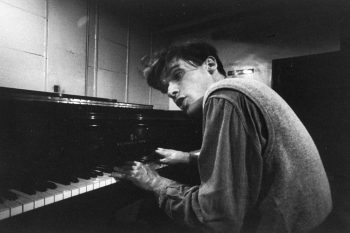
Lake Simcoe, Canada. The sound of the Chickering piano. Bach.
He is lazing down a wooded foot path, teasing his collie Banquo with a stick. He wears gloves, a wool Donegal cap, muffler and long coat despite the July temperatures. He is not being self-consciously eccentric; he simply fears getting a chill, and therefore sick. The film is black-and-white, giving the imagination ample room to conjure up the verdant rapacity of the brief northern growing season. He is then pictured inside the cottage seated before the Chickering, swaying and rocking as he alternately taps and presses the keys, his hands occasionally leaping back from the instrument as if caught in flagrante delicto.
The regal pianissimo of the Italian Concerto.
He is humming. He will always hum when he’s secluded within the architecture of the immortal scores. Recording engineers will despair of this harmonizing, but the microphones must be present, and he will sing as he plays, because the two expressions are a hypostatic union, an indivisible entity offering themselves to the music. He hums because the composition is only a series of notations until it becomes a part of his body, a force within, causing him to sway and vocalize the rapturous melody.
The cottage is the perfect bourgeois expression of respectable 1950s Toronto. It is not to be confused with a cabin. It is the weekend retreat of prosperous fir merchant, not a sportsman. And the Toronto of the 1950s is Victorian, hardworking and Protestant, and Glenn Gould will decide he can live nowhere else, despite his fame and financial success. Read more »
 My seventy-something year old uncle, who still uses a flip phone, was talking to me a while ago about self-driving cars. He was adamant that he didn’t want to put his fate in the hands of a computer, he didn’t trust them. My question to him was “but you trust other people in cars?” Because self-driving cars don’t have to be 100% accurate, they just have to be better than people, and they already are. People get drunk, they get tired, they’re distracted, they’re looking down at their phones. Computers won’t do any of those things. And yet my uncle couldn’t be persuaded. He fundamentally doesn’t trust computers. And of course, he’s not alone. More and more of our lives have highly automated elements to them,
  The Anna Karenina Fix
 In the Third Essay of On the Genealogy of Morality, Nietzsche levels a powerful attack on the modern Platonistic conception of mind and nature, urging us to reject such “contradictory concepts” as “knowledge in itself,” or the idea of “an eye turned in no particular direction, in which the active and interpreting forces, through which alone seeing becomes seeing something, are supposed to be lacking.” More recently, Donald Davidson’s attack on the dualism of conceptual scheme and empirical content, and thus of belief and meaning, requires us to see inquiry into how things are as essentially interpretative.
 Andrea Scrima: As a visual artist, I worked in the area of text installation for many years, in other words, I filled entire rooms with lines of text that carried across walls and corners and wrapped around windows and doors. In the beginning, for the exhibitions Through the Bullethole (Bemis Center for Contemporary Arts, Omaha), I walk along a narrow path (American Academy in Rome) and it’s as though, you see, it’s as though I no longer knew… (Künstlerhaus Bethanien Berlin in cooperation with the Galerie Mittelstrasse, Potsdam), I painted the letters by hand, not in the form of handwriting, but in Times Italic. Over time, as the texts grew longer and the setup periods shorter, I began using adhesive letters, for instance at the Neuer Berliner Kunstverein, Kunsthaus Dresden, the museumsakademie berlin, and the Museum für Neue Kunst Freiburg. Many of the texts were site-specific, that is, written for existing spaces, and often in conjunction with objects or photographs. Sometimes it was important that a certain sentence end at a light switch on a wall, that the knob itself concluded the sentence, like a kind of period. I was interested in the architecture of a space and in choreographing the viewer’s movements within it: what happens when a wall of text is too long and the letters too pale to read the entire text block from the distance it would require to encompass it as a whole—what if the viewer had to stride up and down the wall? And if this back and forth, this pacing found its thematic equivalent in the text?
 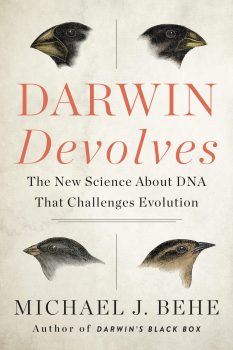 “[T]here is in fact nothing that can alleviate that fatal flaw in Darwinism” says Professor Behe,
  rapture, claiming that “Michael Behe’s Darwin Devolves Topples Foundational Claim of Evolutionary Theory” and that “Anyone interested in knowing the truth about the design/evolution debate will find Darwin Devolves a must read.”
 I wonder whether Behe’s most vociferous supporters actually understand his position. Unlike them, he

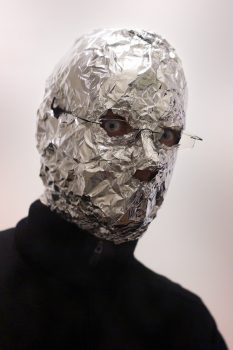 I was lugging several superheavy boxes of dishes up the concrete stairs from the sidewalk to the front door when a guy in a silver suit materialized in front of me. The first rule of moving is that when you pick something up, you don’t put it down until you have it where it goes. This is because picking it up and putting it down are half the battle. So, I tried to go around him.
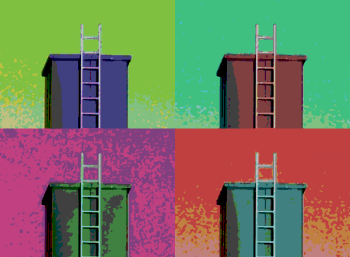 The Alps are much grander this morning. I like to think they tiptoed closer in the night, but it’s only an optical illusion created by a local high-pressure system called föhn, which magnifies them and everything else on the horizon. Sitting outside in the loggia, a spacious recessed balcony that resembles a box at the opera, I am audience to many forms of entertainment—weather theater, rainbow theater, sunrise theater, moonrise theater, but best of all, avian theater with its motley cast of bird species performing their life cycles like variations on a theme, in full view.
 When one makes an artwork, something flows from artist to audience. The thing flowing is actually several: concepts, ideas, aesthetic experiences, duration itself, beliefs, attitudes, and probably much more. Artworks work in a similar way to language, although it would be foolish to believe that artworks are language. Their similarities to language end at the transmission from one to another of the things flowing. That’s how language works as well. But for art, as with something like emotion, the flow is vague in how it is sent and received. It seems to me that the best linguistic analogy for what artworks do is located in assertion. Artworks assert a position. Of course it is entirely possible, and even the norm, that their version of assertion is cryptic to the point of being sometimes unintelligible. But assertions don’t need to be crystal clear. One can assert their dominance over another through a series of non-linguistic subtle bodily movements. Likewise, artworks can make assertions through their physical presence.
 Most people see understanding as a fundamental characteristic of intelligence. One of the main critiques directed at AI is that, well, computers may be able to “calculate” and “compute”, but they don’t really “understand”. What, then, is understanding? And is this critique of AI justified?